



Another Georgia red light camera program has fallen thanks to a state-mandated extension in the duration of the yellow warning period at monitored intersections. Members of the Dalton City Council yesterday voted unanimously to cancel its contract with the UK-owned photo ticketing firm LaserCraft Inc. which has been operating the traffic cameras on a month-to-month basis since May. “Thus far it appears the increase in yellow time has resulted in a significant decrease in violations,” Dalton Police Chief Jason Parker told the city council yesterday.
The program issued a total of 6,487 tickets worth $454,090 in 2008, but the rules changed in January when a law originally introduced by state Representative Barry Loudermilk (R-Cassville) mandated the addition of one second to the yellow warning at any intersections where cameras were installed (view law).
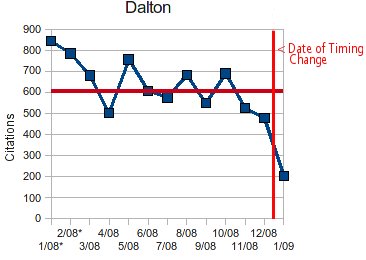
Data obtained by TheNewspaper show that this change yielded immediate results at the intersections of Highway 41 and Shugart Road and at Thornton Avenue and Waugh Street. In 2008, LaserCraft issued an average of 639 citations each month at these locations before the extra second was added. After the change was made, the company was only able to issue 200 tickets (view chart).
Even these figures mask the real impact. At Shugart Road, the drop in citations was 73 percent, primarily representing straight-through violations. At Waugh, violations dropped only 43 percent but Mayor David Pennington explained that this was because two-thirds of the tickets issued at the intersection were actually for rolling right-hand turns on red, a highly technical violation that rarely causes accidents.
After reviewing the results, Councilman Charlie Bethel urged staff to ensure the Georgia Department of Transportation would maintain the extended yellow timing once the cameras were removed.
“Maybe for once our state elected officials were very wise in passing this bill,” Councilman Denise Wood added.
Use of the cameras produced no measurable reductions in accidents, according to city officials. The drop in violations, however, meant that the program would have turned into a significant money-loser had it continued to operate. Faced with the same situation, the cities of Decatur, Duluth, Lilburn, Norcross, Rome, Snellville and Suwanee have also taken steps to end photo enforcement in the aftermath of the new signal timing law.
Dalton began photo ticketing in 2005 after being sold on the program by Jay Morris Specter, 53, who at the time was a regional director for an Australian red light camera firm. Specter was convicted of fraud in 2007 and is currently imprisoned at the Edgefield Federal Correctional Institution in South Carolina.



The regulation says nothing about the GREEN light cycle, so use that loophole.
I’ve said it before and I’ll say it again: Keep cutting the GREEN light time until you trap more and more vehicles needing to get through the intersection. Tighten it down until only two cars get through and the revenue will flow again.
Of course this reduces the efficiency of our transportation grid, increases air pollution, global warming, fuel imports, and transportation costs which leads to sub-optimal driver attitudes and increased cost of goods and services but our cities must prevent this revenue stream to be wrenched from their grip.
/sarcasm
Boring, but true.
Set yellow light intervals according to highway engineering principles, and your violators are fewer, the intersection safer.
Set speed limits according to highway engineering principles, (85th percentile), and your violator class is by definition the upper 15%, of which at least 5% NEED police intervention.
Automated enforcement won’t work well enough to make money if most folks follow reasonable laws.
On the other hand, short yellows and low speed limits = profit.
Profit does not equal safety.
The argument for scameras fails.
Notice how quickly the revenue fell off? No way to attribute this to the presence of the camera, clearly people were getting hosed, not acting improperly.
So how about this? Before this all started, what if the local government flat out said they plan to implement red light cameras as a source of revenue and didn’t hide behind this safety rhetoric? Anybody think the cameras could have been more successful?
So how long will the benefits of a longer yellow last once motorists catch on?
When I was growing up in the late 50s and 60s, Pittsburgh used a green, green AND yellow, yellow, and red sequence for all traffic lights within city limits. Seemed like a good idea — you got double the warning time that the light was going to turn red.
Problem was “good” drivers knew to prepare for a stop; “bad” drivers got extra time to press on the loud pedal. Such signalization was disallowed after the feds started standardizing such things in the early 70s (when we also got all-yellow center lines whether broken or fixed).
Same with these so-called 85-percentile speed limits. Once drivers get used to the new, raised limits, they start pushing the envelope a little further. I wonder what compliance is like in the 80 mph zones on Texas and Utah interstates. Everyone knows the police have a “tolerance,” right?
AvDub :
So how about this? Before this all started, what if the local government flat out said they plan to implement red light cameras as a source of revenue and didn’t hide behind this safety rhetoric? Anybody think the cameras could have been more successful?
No. Because when forced to abide by longer yellow limits, the program loses money. So it’s out on it’s ear.
210delray :
So how long will the benefits of a longer yellow last once motorists catch on?
…Same with these so-called 85-percentile speed limits. Once drivers get used to the new, raised limits, they start pushing the envelope a little further…
Not true. There is evidence that “catching on” is not an issue. Unfortunately, I don’t have a link to a citation. But I’m sure somebody here does!
So how long will the benefits of a longer yellow last once motorists catch on?
The fact that adding one second can improve the compliance rate substantially suggests that the “improvement” is permanent. The compliance rate shoots up because the lights were just too short for reasonable people caught in the dilemma zone to make it.
The drivers were set up to fail, and they did. These weren’t intentional light runners, but those who got caught by an interval that is not consistently applied, and is therefore somewhat unpredictable for the driver, making it difficult to comply.
There are federal engineering standards about how long yellow lights should be, but states are not required to follow them. The main determinants are approach speed (for which the speed limit is often used as a proxy, even if travel speeds are higher) and the width of the intersection.
We should be using these standards. If you look at these cases, you can see time and again that the cities are not following the engineering guidelines that are available to them.
You don’t need to be a traffic engineer to know that if they are fudging the intervals, it’s because they want there to be violations. It’s an easy way to increase revenues without seriously compromising safety, because the violators run the lights at points in the cycle when they are unlikely to be involved in collisions.
When I was growing up in the late 50s and 60s, Pittsburgh used a green, green AND yellow, yellow, and red sequence for all traffic lights within city limits. Seemed like a good idea — you got double the warning time that the light was going to turn red.
Problem was “good” drivers knew to prepare for a stop; “bad” drivers got extra time to press on the loud pedal. Such signalization was disallowed after the feds started standardizing such things in the early 70s (when we also got all-yellow center lines whether broken or fixed).
Studies on this subject show that having two warnings is a detriment, for it creates the cheating/fudge factor that you are talking about. Extending the yellow light is a positive; a pre-yellow is not.
210delray: “Everyone knows the police have a “tolerance,” right?”
Oklahoma is usually fairly lax on speed enforcement, but some years ago, in a fit of moralistic fervor (or maybe the feds were raising hell), the state added signs just below the speed limit signs that warned “No Tolerance.”
Along the route of my daily commute one of the “Speed Limit 65 / No Tolerance” sign pairs lost the top sign. The result for several months was that motorists were simply notified they were in a place of no tolerance. I bet Californians and New Yorkers passing through gleefully grabbed their cameras. I did.
Is it safe to conclude that the cameras would start to cost more than they made once the violations went down?