



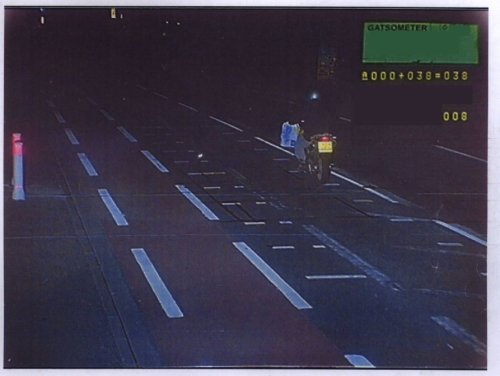
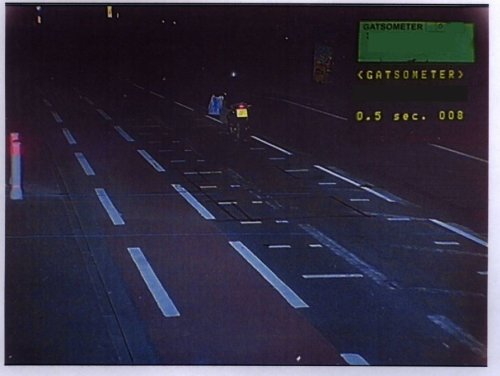
The East Sussex, UK, police are attempting to have speed camera photographs removed from websites, claiming they represent copyrighted material. In particular, the police are targeting a set of images taken in June 2008 that motorcyclist Peter Barker used to prove that a radar device that clocked him at 38 MPH must have been wrong. Based on measurements of the photographic evidence, a Brighton Magistrates Court judge agreed and threw out the case against Barker. These are the photographs of Barker’s alleged infraction that East Sussex Police are trying to ban: photo one and photo two.
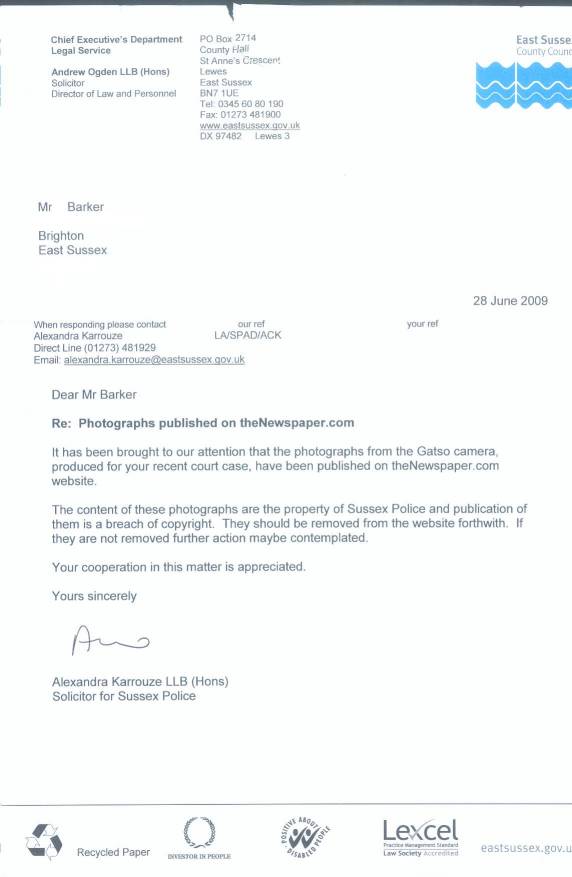
“It has been brought to our attention that the photographs from the Gatso camera, produced for your recent court case, have been published on TheNewspaper.com website,” Sussex Police Solicitor Alexandra Karrouze wrote to Barker in a June 28 letter. “The content of these photographs are the property of Sussex Police and publication of them is a breach of copyright. They should be removed from the website forthwith. If they are not removed further action may be contemplated.”
Sussex Police did not send any copyright notice to TheNewspaper, nor did Karrouze respond to requests for clarification and comment. The agency became particularly upset with Barker in May after he threatened legal action against the Sussex Speed Camera Partnership for insisting that he had been speeding even after his court acquittal. The agency had no choice but to issue a swift apology.
“The partnership accept that such an assertion should not have been made and have apologized unreservedly to Mr Barker for this error,” the partnership said in a statement.
Barker believes that the local council and police do not want motorists to know that a time-distance calculation can be performed on the images to check the vehicle’s speed against the radar reading. A difference of more than ten percent between the two figures renders the machine’s speed estimate “unreliable” under UK guidelines.
While officials may prefer that drivers simply pay the tickets when they arrive in the mail, tens of thousands of innocent motorists have seen good reason to challenge their citations. In May, the National Prosecutors Office in The Netherlands refunded 9298 photo citations and another 2640 in February because of uncertain camera accuracy.
In March, three thousand automated tickets in Lausanne, Switzerland, were thrown out after a “technical problem” caused tickets to be issued to law-abiding motorists. In February, prosecutors in Nuremberg, Germany, began investigating a police chief for tampering with a photo radar evidence log. A major investigation in the UK last year concluded that 2660 speed camera tickets were unlawfully issued in Lancashire. In Arizona, 589 bogus speed camera tickets were canceled after faulty speed sensors were discovered.
Source: Copyright Letter to Peter Barker (East Sussex, UK County Council, 6/28/2009)



If they didn’t sent a letter to the newspaper, the copyright argument is essentially bullshit.
But that won’t deter them to apply some phyco-terror to the guy. After all, he discovered the flaw, made cause against them and won. It’s not convenient that such “behavior” spreads, because it obviously will reduce the revenue.
Bitches!.
George Orwell, call your country. Oops, forgot, we’re gonna get GPS tracking for our cars. (Can’t wait, so I can sell GPS jammers, or contract out my services to dis-Obama-ize the system.)
I don’t know how it in works in the UK, but anything not protected under national security here in the USA can be obtained and revealed under the FOA. The local government may delay, but those tactics would ultimately fail.
I’m surprised these are used in Arizona. In the parts of the country that acknowledge that Bill of Rights contains a second amendment there is an easy fix for a malfunctioning (i.e. all) speed camera.
In Romania, we recently had all speed cameras removed because of a corruption scandal involving the police and speed camera operators. I hope this can set a precedent for other countries too. The only good way to deal with this is to remove speed cameras permanently. They are just a source of revenue – traffic safety and speed reduction can be achieved with more efficient and cheaper means, without the use of this orwellian machinery.