



A week ago, we swam against the trend of China analysts who predicted a 30-40 percent rise in March new car sales in the Middle Kingdom. By using our patent-pending TTAC forecasting methodology, we projected China’s sales rising between 50 and 60 percent in March. The numbers are in. We were wrong.
Totally wrong was China’s National Passenger Car Information Exchange Association. They had predicted a rise of 40 percent.
The true number? 63 percent. Well, the patent-pending TTAC forecasting methodology (use GM’s China sales – 68 percent up in March – and subtract a few points) had indicated sales above 60 percent. But we chickened.
March sales in China totaled 1.26 million passenger cars, up from 942,900 sold in February, according to data provided by the China Association of Automobile Manufacturers [via Reuters.] These are passenger vehicles, excluding commercial vehicles, which could add another 250,000 to 300,000 to the number. Figures of China’s total auto sales in March should be released early this coming week. (Our patent-pending formula is heavily overweight with Wuling vans.)
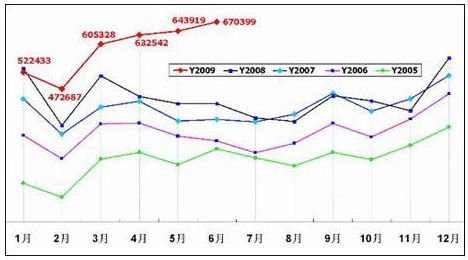
The March number is even more surprising as we are comparing to a high base in March 2009, when Chinese sales begun to skyrocket. This augurs for a record year. If the trend continues, China could break the all time sales record of 17.4m units sold in the U.S. in the year 2000.
Rao Da, general secretary of the China Passenger Car Association, agrees: “We are confident that China’s vehicle sales will surpass 17 million units this year, growing by about 25 percent.”.
Sales for the first quarter January-March are up 76.3 percent from a year ago, at 3.52m.
Forget any bubble talk. This is not a market where a couple has three cars in the garage. China has just begun to motorize. There are 1.3b to 1.5b people in China. It’s like a dry sponge sucking up water. An estimated 400m to 500m already can afford a car. That number is rising rapidly.
Jack Perkowski, China visionary and author of the book Managing the Dragon, wrote a few months ago:
“China’s auto industry will continue to show rapid rates of growth for many years because China’s total demand for transportation is already much bigger than most people think. I would argue that China’s transportation industry is actually 50 million vehicles per year, not the 13.6 million vehicles sold in 2009, or even the 15 million vehicles that might be sold this year. They represent only one part of the market.”
That other part are motorcycles, farm engines, and three-wheelers with a one cylinder engine diesel engine. Once these people have the money, they buy a car.




Now…imagine if those IDIOT RIGHT WINGERS had their way and could have allowed Ford, GM and Chrysler to completely fail during the auto crisis.
Even Conservative Pat Buchannan agreed we had to help the Big 3 weather the storm because CHINA and INDIA are huge car markets – just coming on line ready to buy cars and the BIG 3 only needed to retool so they had quality products to compete with the Chinese.
Right you are Flashpoint. With all the mistakes that GM may, or may not of made,getting thier foot in the Chinese door wasn’t one of them.
True, but they are in the process of letting SAIC cut the toes off the foot they stuck in the door.
@ psarhjinian
They already did. SAIC holds 51% of GM China.
@Flashpoint: Now…imagine if those IDIOT RIGHT WINGERS had their way and could have allowed Ford, GM and Chrysler to completely fail during the auto crisis.
1) You sound as if GM and Chrysler didn’t completely fail.
2) Ford ran faster than GM/Chrysler (from the bear); Ford would have been in a much better position had there not been government interference.
WRONG.. “wsn” if GM and Chrysler had gone T.U, Ford would have been right behind them,the supplier base would have been decimated. About two million more out of work,and we would be in a depression that would make the thirties look like an economic hic up.
“WRONG.. “wsn” if GM and Chrysler had gone T.U, Ford would have been right behind them,the supplier base would have been decimated. About two million more out of work,and we would be in a depression that would make the thirties look like an economic hic up.”
Hogwash. Yes, there would be a small hit, but Ford wouldn’t have gone under and we would’ve recovered rather quickly. Now we have Government Motors.
@mikey
If there were no government intervention, GM/Chrysler will go through liquidation. Ford, as the last man standing, would be able to attract billions of investment, from willing investors of course.
Then Ford would be able to identify the core assets of GM and will have enough capital to support the supplier chain.
Essentially, I am betting Alan Mulally > Barrack Obama in running a car company.
I’m not surprised by the huge increase, and agree that this isn’t a bubble, but motorizing too many Chinese too fast could have its consequences. I’m aware that China has an pretty excellent rail system, but are their roads and bridges up to the task of an explosion of car sales? Traffic in Beijing and the like is already a nightmare, and that’s with only a small fraction of people who can afford cars actually owning them.
China’s auto industry seems eager to provide a car to any Chinese who’ll have one, but at the same time, can the government guarantee there will be sufficient asphalt upon which to drive them, or will these record-breaking sales lead to city-crippling traffic problems?
Are they allowed to listen to Bob Dylan on all those car stereos?
It is very ironic that world leaders pressure China to increase domestic “demand”, the Chinese do so, but only for Chinese assembled cars, and the one thing that China now needs is oil (up to 4 m b/d imported) which makes gas more expensive, which cuts into the great American middle class spending crisis, which then makes the housing market weak, which then mean we have to borrow more from China to fund current budgets.
wsn: Should you want to get into the Chinese real estate market (I won’t) down payment requirements for second homes(those are the flipped ones) have been raised to 40 percent. Also, if you resell your home before owning it for 5 years, you pay cap gains tax.That period had been cut to two years in January of 2009 to boost the then falling property market. China is going through this boom/bust cycles quite rapidly.
It is a bubble.
Why? Because the auto bubble is base on the real estate bubble. The price for a typical Beijing apartment has gone up 100% in the past 18 month.
The typical late 80s early 90s Soviet style apartment would cost about US$400/sqft (or 30000RMB/sqm in local units). The typical brand new apartment would cost about US$600/sqft (or 45000RMB/sqm). Plus or minus 20% depending on the location.
Everyone and his dog and his grandma are flipping apartments now. Let’s say, he lined up in front of the sales center for 48 hours, pays 20% down payment for that 3M RMB apartment to be built in 2012. He can sell that unit right away to the unlucky guy who was in queue for only 24 hours and didn’t get the chance to buy for a net 10% profit. Which would be 300k RMB, or about 3 Honda Fits.
@wsn
“It is a bubble.”
I have an easier way to tell that it’s a bubble:
Once everyone says “forget any bubble talk” and “record” this and that and starts posting asinine videos of rockets shooting skyward and graphs bursting out of the confines of the graphic – like those magazine covers about the real estate market in the U.S. a few years ago – you know it’s a bubble about to burst.
The sad thing, for Americans, is that the American bubble burst after a 100% growth in 5 years. The Chinese one not yet burst after a 100% growth in 18 months.
It’s time to grant Chinese house flippers green cards.
The graphics on magazine covers are a great way of analyzing the trend.
I remember arguing with people that beyond price inflation due to low borrowing rates, there was no justification for the rest of the real estate price increases.
Real wages did not increase for the average American, so how could housing keep going up?
Folks, some here make the same old mistake: Just because we have something, the rest of the world should have it too.
Real estate bubble in China: Definitely. Has been here for years and getting worse. It’s more an insanity than a bubble. People buy, apartments and offices stay empty. Vacancy rate is huge. I would NEVER buy real estate in China. You don’t own the ground, you rent it from the government. The ground appreciates, the structure depreciates – especially in China. Indicator: While house prices explode, my rent has been flat for 5 years.
Chinese Car bubble: Not at all.
800+ cars per thousand (USA) = huge bubble
500 – 600 cars per thousand (developed countries) = saturated market
80 cars per thousand (China) = the beginning of motorization