



Baytown, Texas has been caught using an illegally short yellow time at the latest city intersection to be monitored by a red light camera. Tickets have been issued since January 30 at the intersection of Cedar Bayou Lynchburg Road at Garth Road where the yellow time is set to 4.0 seconds, the bare minimum acceptable amount for an intersection posted at 40 MPH according to Texas Department of Transportation guidelines. The Baytown Red Light Camera Coalition (BRLCC) uncovered the fact that the intersection approach is in fact posted with a 45 MPH sign, meaning the bare minimum legal yellow for the location is 4.3 seconds, not 4.0 seconds.
“They didn’t even bother to check the speed limit before they went ahead and put this camera up — or did they?” BRLCC leader Byron Schirmbeck said. “Camera companies are notorious for taking advantage of poor engineering situations like this.”
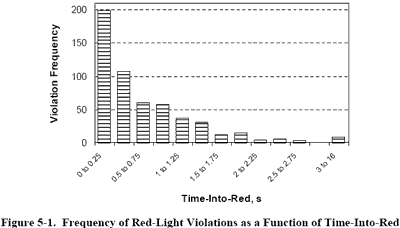
Studies show that shorter yellow times can increase the number of citations generated. According to the Texas Transportation Institute, when the yellow light timing is one second shorter than the bare minimum recommended amount, violations increase by 110 percent (view study). While 0.3 seconds seems like an insignificant amount of time, the vast majority of red light “violations” happen when drivers misjudge the end of the yellow light by less than 0.25 seconds — literally the blink of an eye (view Texas Transportation Institute chart). Confidential documents uncovered in a San Diego court trial prove that the city and its private vendor, now Affiliated Computer Services (ACS), colluded to install red light cameras only at intersections with short yellow times (view documents), thereby maximizing profits.
Baytown uses a different company, American Traffic Solutions (ATS), which operates all aspects of the photo ticketing system. In less than two weeks, Baytown residents will have the opportunity to cast an early ballot to ban red light cameras from the city. When the votes are tallied on November 2, Schirmbeck believes the failed attempts of ATS to block the vote have backfired and the vote against the cameras will be strong.
[Courtesy:Thenewspaper.com]



Slash the green light time so only rarely is the queue emptied and you create a nice pool of hapless drivers to feed into shortened yellows to maximize profits.
The ITE’s yellow guideline formula is so horribly flawed it should be banned. It never will be banned or fixed because the camera companies spend millions annually to keep it the touchstone calculation.
I love how red light cameras basically give states the green light (sorry) to break laws to increase revenues.
The flaws in the Institute of Transportation Engineers “Kell and Fullerton” formula are many.
1. The formula has zero safety factor. None. Nada. Zip.
2. The “perception+reaction” time is based on ideal laboratory conditions, not 90-percentile in the real world, and lacks the required “decision making” component.
3. The length of the vehicle is ignored unless the intersection has an “all red”.
4. The intersection width is ignored unless the intersection has an “all-red”. Even then the width is mis-calculated.
5. The deceleration rate is too aggressive.
6. Vehicle breaking capability is ignored.
7. Street material and surface condition is ignored.
8. Weather conditions are ignored.
9. Approach speed value favors short yellows, not real-world speeds.
The SAE and auto industry has published studies on real-world driver breaking. Based on their findings, the ITE formula is way off base.
The faster the speed, the less seconds you need to clear the intersection… or do I have it bass ackwards? Either way, went thru a scamera intersection at 25MPH while visiting San Bernar-ghetto and got burned. When it arrived, it got burned.
The faster the speed, the less seconds you need to clear the intersection
That’s true, but the flip side is that the faster the speed the longer it takes to slow to a stop — thus the yellow needs to be longer because there are people further out who are going too fast to stop for the light without panic braking. The time to clear decreases linearly with speed but the necessary braking distance increases exponentially with speed. At some point the breaking distance becomes the dominant factor, thus requiring longer yellows as the speeds increase.
Read somewhere awhile back that when local drivers become used to short-length yellow lights they become quicker to brake and more apt to be rear-ended thus resulting in increased wrecks or something like that.
Seems to me if true that a person rear-ended may have extra ammor for use in a lawsuit against any entities involved depending upon local circumstances.
But, this IS the USA and income before everything seems to be the major morality consideration and the mantra of the masses and the goal of bureaucrats and bureaucracies and a whole horde of etceteras.
That’s true, but the flip side is the faster the speed the longer it takes to slow to a stop
Once you’ve judged that you’ve got enough roadway to stop or are far enough away from the intersection to stop normally and without panic braking, yellow time becomes irrelevant… unless you feel you can clear it cleanly without running the red. it’s a gamble that you take even if you know that yellow well. It’s not an exactly an exact science.
With a 4 second yellow I can be 300ft before the intersection, traveling at 60 MPH, and still (barely) clear a 100ft intersection before it turns red. I could have stopped casually in less than 200ft including reaction time.
At 40 MPH and 4 second yellow, I need to either stop immediately or floor it if I’m past the point of no return. That’s why yellow times need to increase, the lower the speed limit is.
Vehicles take increased time and distance to stop at higher speeds. That’s the physics of it. Longer yellows at higher speeds account for it.
Wider intersections take less time to cross at higher speeds. This does not translate too well into saying wider intersections can have shortened yellows.
As the complexity of the “go-no go” decision increases, drivers consume more time and distance making the decision. This is the physics of the human brain. The ITE formula only acknowledges recognition+reaction and allows one second for it. The SAE and auto industry’s published studies add decision-making and allow 2.5 seconds for the three.
The camera companies are horrified at the prospect of making just this one fix.