



Red light running all but disappeared at a New Jersey intersection after the duration of the yellow light warning time was increased under threat of a lawsuit. Glassboro gave the private company American Traffic Solutions (ATS) permission to issue red light camera tickets at the intersection of William Dalton Drive and Delsea Drive on March 26. The location was so successful at issuing $85 tickets that it generated $1 million worth of notices within just seven months.
On average, 90 percent of these citations were issued to drivers in the right-hand lane mostly for making slow, rolling turns. On average, there were 191 tickets issued each month in the other lanes for alleged straight-through and left-turn violations that most consider to be red light running. Data generated by ATS and provided under a freedom of information request did not separate straight-through and right-turn violations.
Through violations plunged after ATS mailed a ticket to Mike Koestler, the former mayor of Harrison Township, for an alleged offense that took place in Glassboro. Koestler’s investigation led to the discovery that the 3.0 second yellow time on the westbound approach of the intersection was in violation of state signal timing regulations. On October 26, the borough boosted the yellow time to 4.0 seconds.
In November, the first full month following the change, the number of tickets issued in the non-right-turn lanes dropped 88 percent to 23 tickets issued. The figure dropped to 8 in December and was just 13 in January 2011. For just the westbound approach, the average number of tickets dropped from 71 per month to zero tickets through January.
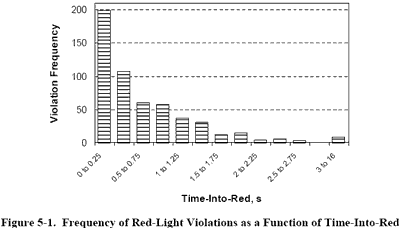
While a one-second difference in the duration of the yellow warning at an intersection might seem insignificant, the extra margin of safety is critical. The vast majority of straight-through red light “violations” happen when drivers misjudge the end of the yellow light by less than 0.25 seconds — literally the blink of an eye (view Texas Transportation Institute (TTI) chart). In most cases, a yellow shortened by one second can increase the number of tickets issued by 110 percent, according to a TTI report. Confidential documents uncovered in a San Diego court trial prove that the city and its private vendor, now Affiliated Computer Services (ACS), colluded to install red light cameras only at intersections found to have short yellow times (view documents), thereby maximizing profits. Yellow time generally does not affect the number of right-turn tickets issued.
[Courtesy:Thenewspaper.com]



I’ve driven up and down Delsea Dr (RT 47) many times in my youth. Back then much of it was a two lane road. Now it’s 4 lane or two lanes with a center turn lane. And now I find out it has red light cameras. If you locality gets them make sure they don’t reduce the yellow times to collect more fines. Then form or join a committee to get a ballot initiative to have those evil things removed.
Anybody know how “rolling right turns” are even computed? Is the system smart enough to recognize vehicle X rolled up to the line, stopped and then made a turn?
In my state, the cameras take video, not just photos, so that’s easy to check.
In Chicago the cameras generally stop taking pictures a few seconds after the light turns red, or else the CTA and Chicago Police would be paying the bulk of tickets! I would guess in the time it takes to stop and turn the camera would no longer be active.
It seems like many times when red-light-cameras are investigated – one of the little hidden secrets is that the yellow-light time has been reduced to get more “results” from the red-light-camera enforcement. There are standards for yellow-light time (related to speed limit of the road) and when the standards are followed – not enough tickets are written.
It would be interesting to see if this effect will continue to hold, or if people over time starts anticipating the longer yellows, choosing to push their luck once again. In some imaginary corner case of ten minute yellows, I somehow doubt noone would ever figure out that running a yellow would be fairly safe.
“…straight-through and left-turn violations that most consider to be red light running.”
Doesn’t everyone consider these violations to be red-light running?
That wording looks to me like an indirect assertion that turning right on red without stopping doesn’t constitute running a red light.