



The Missouri state Senate yesterday voted to require local jurisdictions to adhere to minimum standards for yellow warning time at intersections. State Senator Jim Lembke (R-St. Louis), an opponent of the use of red light cameras, introduced amendments to an omnibus transportation bill designed to limit the desirability of photo enforcement. His colleagues went along with language mandating that signals on all roads adhere to the bare minimum “nationally recognized engineering standards.”
Modifications to the bill must be approved by the House before becoming law, but the Missouri Department of Transportation (MoDOT) has already begun increasing yellow signal timing with very positive results. In Arnold, the first city in the Show Me state to use automated ticketing machines, yellow timing was increased from 4.0 to 5.0 seconds at three intersections along Missouri Route 141 on February 24. Smaller changes were made on April 15, including a boost from 4.0 to 4.4 seconds at northbound 141 and US 61/67, a 4.0 to 4.5 second change at northbound US 61/67 at Rockport School, and from 4.0 to 4.7 seconds at southbound Vogel Road at Richardson Road (4.3 seconds at the northbound approach).
The impact of the longer yellow at red light camera monitored locations was felt immediately. In January, before any signal timing had been changed, American Traffic Solutions recorded 875 alleged violations in the city of Arnold. At the end of April, that figure fell 70 percent to just 266. Jefferson County Councilman Bob Boyer obtained the ATS statistics after learning that MoDOT had extended the yellow times.
“This recent bit of information goes further to prove the point that there are other safety measures that can be implemented if safety, not money, is the focus,” Boyer said.
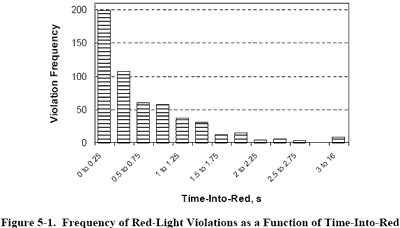
Longer yellows have a significant impact on red light camera intersections because the vast majority of straight-through red light “violations” happen when a driver misjudges the end of the yellow light by less than 0.25 seconds — literally the blink of an eye (view chart). In most cases, a yellow shortened by one second can increase the number of tickets issued by 110 percent, according to a Texas Transportation Institute report. Former Arnold Councilman Matt Hay, founder of WrongOnRed.com, believes city officials exploited bad engineering practices to make money.
“The preliminary data completely validates WrongOnRed’s position that longer yellows have the greatest singular impact in reducing red light running,” Hay told TheNewspaper. “The city of Arnold took no efforts or measures to actually reduce red light violations, and in fact, was more than willing to allow short yellows, dangerous intersections, and physics to ensure they had a steady flow of cash from unsuspecting motorists who fall victim to the trap.”
A copy of the latest violation report is available in a 50k PDF file at the source link below.
Source:  Issuance Rate Summary Report (City of Arnold, Missouri, 5/6/2011)



I’m not against red light cameras b/c it catches people who blow red lights that can lead to major crashes. I am however against the practice where municipalities have been shortening the yellow light time or not having them tuned to the speed limit of that intersection (i.e. the higher the speed limit of that intersection the longer the yellow light should be).
However I really have a problem with the overuse of traffic lights. I don’t normally like traffic lights b/c the are most often poorly timed; some don’t allow right turns on red or left without a long time to wait for green arrow; they give to much precedence to a minor road; they stop traffic to simply let someone waiting to make a right turn on red; or they don’t shut them down late at night allowing major roads to have a flashing yellow and minor cross road a flashing red.
I’m more for traffic circle and round about type intersections b/c it substantially reduces the speed through the intersection (no more people flooring it to make the red light); they are cheap and easy to maintain; require no timing equipment; people can easily learn how to use them (most common criticism is ignorance of drivers); and it adjusts to time of the day – rush hour allows people to merge and take turns entering whereas during non rush hours you don’t have to stop unnecessarily – like at 2 am waiting for a long light where there is no other car anywhere near you.
I don’t know if there are any redlight cameras in MN anymore. There were some in Minneapolis and maybe a few in St. Paul, but I don’t recall any of them since I do most of my driving in the ‘burbs. I can’t say if I would have an issue with them or not.
However, your point about timing lights late at night rings a bell because in MN, at least around where I live, main streets get switched over to steady green as far as the eye can see right around 9:30 or 10:00. They only change when there is a car in a perpendicular lane of traffic. As soon as that car squeaks through the green will remain for a couple seconds and then the affected light on the main road reverts back to steady green. It seems to work pretty well.
With regards to roundabouts/traffic circles, I’m not sure if they’ll ever catch on. I can’t tell you how many times I have been behind someone who completely stops for upwards of 10 seconds when nobody is in the circle because they don’t quite understand the concept. I personally like them because I can usually time it where I can squeaze in and go around without too many issues. I just had to teach myself to not be nervous about them and just move, because at first I didn’t quite understand them as I’d never seen them before. We would have to be weaned off of traffic lights and work our way up to the 4-lane jobs that I’ve heard about in England and many of the European nations. Otherwise I like the idea. Let’s move to a system where we only stop when necessary to keep traffic moving and not wasting gas getting up to speed.
I agree about the poor implementation. I’d love to see the major streets in my town go solid green during off-peak hours, except when a car comes to cross. We have at least one intersection that goes all red until a vehicle trips it, but it doesn’t trip until you’re nearly stopped. Stupid.
Nice to see Missouri’s legislature put the kibosh on the Crash for Cash yellow light policies of some of their communities, too bad it had to come to that.
Part time flashing yellow/red? Why not just shoot random passers-by? Too many idiots think “the other guy has to stop.” Dead wrong.
There should be a NTSB mandated minimum yellow light timing.
There is.
Whether you get there through the FHWA, DOT, AASHTO, ITE, or other traffic safety organization, you end up at the “Kell and Fullerton” yellow light equation published in three Institute of Traffic Engineers publications.
Do the math and it’s damn hard to have a yellow (or yellow+red in an “all-red” traffic signal plan) light duration less than 5.5 seconds in total.
Don’t ask me why or how cities get away with the short-yellow trick when the red light cameras are installed when their own city codes mandate they follow the law. Lawyers should be able to make a killing on this but it isn’t happening. Every crash should pin the liability on the city but that also does not seem to be happening.
Why?
Shocked!!!!! Shocked, I bellow. That Misouri’s state senate could wrench itself away from the all-important all-consuming concerns regarding written statutes ensuring that prayers can be performed publicly in pert-near any place conceivable.
However, I have yet seen any written proclamations declaring porta-potties are also sacred places and that prayers are specifically allowed therein.
Perhaps due to the humidity and heat encouraging those within to rush the time spent within.
Further taxpayer-paid studies from highly-paid experts required.
Have I ever mentioned my belief I dwell within a sick, perverted and demented, at the least, society/culture?