



1973 Ford Pinto Sportiva Concept
Is it a cliche to say that as a writer I try to avoid cliches? Anyway, I do try to avoid the word legendary (see Dash Parr on being special), but some concept and show cars are, well, legendary. Not in the sense, of course, that people tell grand tales about them but because they are remembered, ending up in books and blog posts. Some concept and show cars are, if not the stuff of legends, certainly the stuff of history. Other cars, not so much. For every memorable Cadillac Evoq, Sixteen and Converj, there’s been at least one La Espada or Aurora, cars that never really caught the public or auto enthusiasts’ imagination even if they may have influenced production cars. A concept car can cost an easy million dollars to build, but once that year’s auto show season is over, it’s often forgotten.
For a long time, after they came off the show circuit many show cars were destroyed or otherwise passed out of company hands. They were of no further use to the car companies so they were discarded. Few things become as quickly dated or as passe as last year’s concept cars. After collectors like Joe Bortz and Steve Juliano started finding and restoring those cars, though, car companies have tended to regard show cars as worth saving, if only because of their pecuniary and publicity value, though I think some folks inside the companies do have a clue as to their historic and cultural value. Today I doubt many show vehicles are deliberately destroyed and when they do let concept and show cars slip the bonds of their corporation, car companies try to get maximum value out of the transaction. As part of their centennial celebration a decade ago, in 2002 Ford had Christie’s auction off 50 concept cars from FoMoCo’s corporate collection, with the proceeds going to charity. During GM’s financial crisis and bankruptcy, in 2009 the company culled out 250 prototypes, SEMA show cars, and concepts from their Heritage collection and sold them at the Barrett-Jackson auction in Scottsdale. Since then, car companies have auctioned off a number of other prototypes for publicity and charitable purposes.
While researching Detroit’s legendary (if the shoe fits) Alexander brothers, who built a series of award winning custom cars and also made show cars for Ford in the 1960s, I came across a photo of the 1973 Pinto Sportiva Concept (not an Alexander brothers’ car, though I suppose it’s possible that Larry Alexander may have worked on it as by then he was working for Ford as a master metal modeler in Ford’s prototype shop). It’s a notchback take on the Pinto that presages the Mustang II which was itself based on the Pinto platform, and to make it at least somewhat interesting, Ford gave it a targa roof.
Did you know about the 1973 Ford Pinto Sportiva Concept? Neither did I. How about the 1988 Lincoln Machete? Putting aside the concept car itself for a second, how on Earth did someone at Lincoln think that “Machete” resonated with the Lincoln brand, or with its customers? Those cars got me thinking about obscure concept and show cars so I headed to one of my favorite places to find pics of cool cars from the past, the Chicago Auto Show’s website. The Chicago show has hired professional photographers to shoot the show since at least the early 1950s and they’ve graciously compiled a year by year archive on the show’s website that goes back to the turn of the 20th century. In recent years Robert Shiverts (Oscar & Associates) has been the show’s official photographer. The pics that Shiverts and the other official show photographers have shot over the years are a great historical record of American car culture.
I’ve gone through their dropdown menu of concept cars and picked a few whose names I didn’t really recognize (and a few that I think deserve more attention). Some of them did influence production cars even if they didn’t achieve fame as show cars, others are doubly obscure.
Many of the photos are from the Chicago Auto Show site, but I’ve fleshed out the gallery a bit with some publicity and other archival shots.
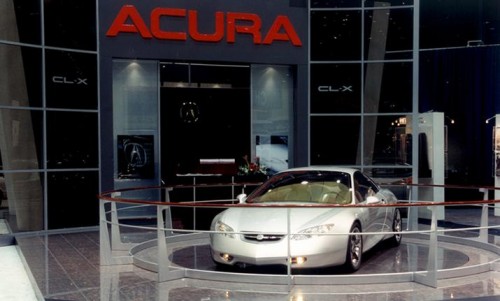 Acura’s alphanumeric production car names are hard enough to keep straight. Do you remember the 1995 Acura CL-X concept?
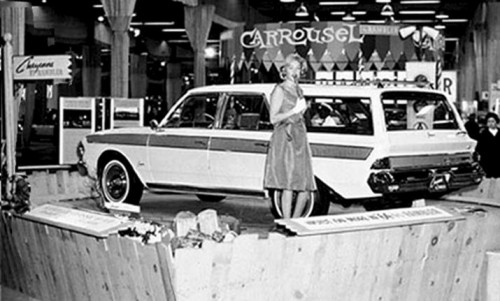 1964 American Motors Rambler Cheyenne Wagon. Western motifs were popular in the ’50s and ’60s, particularly with station wagons.
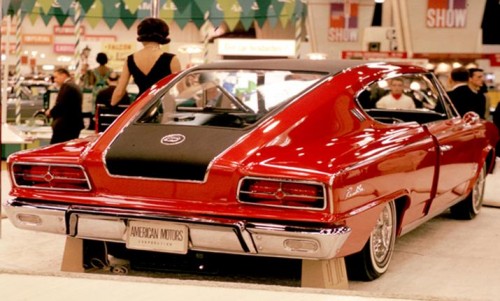 Also in 1964, AMC showed the Tarpon concept, a great looking fastback based on the compact Rambler American with an almost boattail design. Unfortunately, AMC head Roy Abernethy overruled designer Richard Teague and the roofline ended up on the midsize AMC platform as the Marlin. The proportions didn’t work quite as well. Dodge’s similarly fastback styled but better proportioned Charger outsold the Marlin by a wide margin.
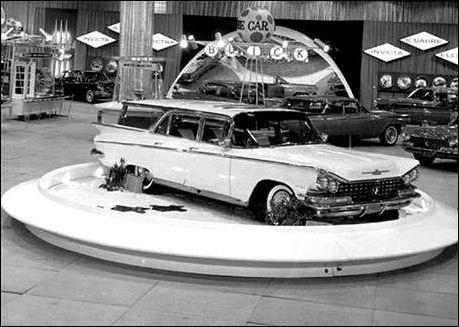 Before there was the Rambler Cheyenne, there was the 1959 Buick Texan, based on the Invicta wagon.
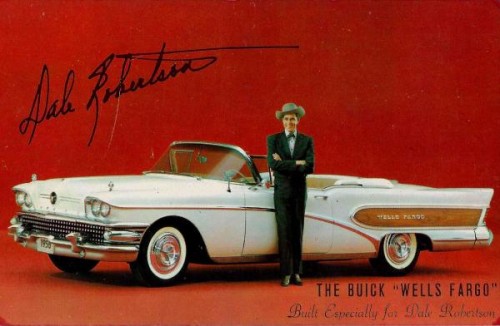 As you can see from the 1958 Buick Wells Fargo, western themes weren’t exclusive to station wagons. The Buick Wells Fargo was made especially for actor Dale Robertson, whose western tv show, Wells Fargo, Buick sponsored.
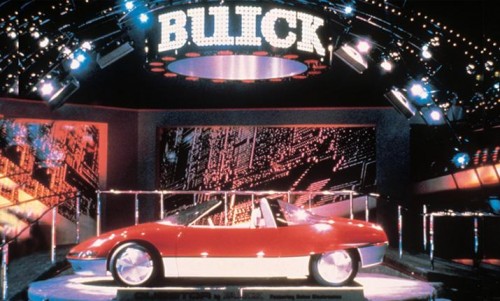 The 1983 Buick Questor had state of the art electronics, with a laser based keyless entry and a computerized navigation system. That was just two years after IBM introduced the Intel 8088 based 5150 personal computer and the same year two guys named Steve introduced the Apple IIe. Some of the Questor’s electronic features ended up on the production Buick Reatta.
 Not to be confused with Brooks Stevens’ masterful Studebaker Sceptre concept, the 1992 Buick Sceptre gave a preview of Buick’s soft curvy design language of the 1990s. It also had one of those newfangled cellular telephones.
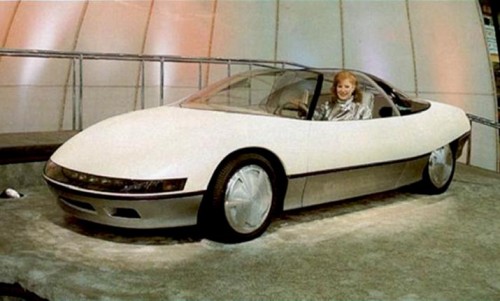 They wouldn’t go financially bankrupt until 2009 but General Motors’ creative bankruptcy was evident by 1995. It’s one thing to recycle a concept name, or another to keep a popular car on the show circuit for a couple of years, but reusing the same actual car a dozen years later with virtually no restyling shows that even the famed staff of GM Design didn’t have much left in the tank by the 1990s. In 1995 Buick revived not just the Questor name (companies recycle concept names all the time), it brought back the same car, only with new paint and upgraded electronic gizmos. It’s a little confusing because they recycled the car but by I believe that by 1995 the Questor had 14 micro-computers, automatic level, attitude and spoiler control, a “systems sentinel” to monitor the status of vehicle systems, heads-up display, computer based map and navigation system, automatically aimed headlamps, theft-deterrent system, road traction monitoring and control system, TV rear-view mirror (GM first put a rear facing tv camera on the Centurion Motorama car in the 1950s), and a touch-command system for entertainment, comfort and convenience functions. As a concept car in general, the Questor accurately predicted many of the features on today’s cars. As a concept car to promote the Buick brand, though, it didn’t do much.
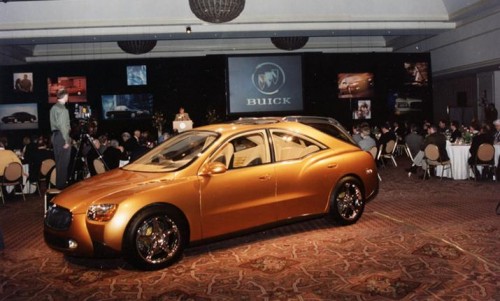 1998 Buick Signia station wagon. It’s made some ugliest cars of all time lists but I don’t think it’s that terrible. Okay, on second thought, maybe it is.
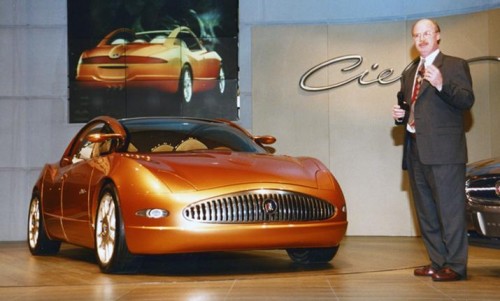 1999 Buick Cielo. Remember it? Had Bill Mitchell been alive to see it, I think he would have said that it looked like a fish.
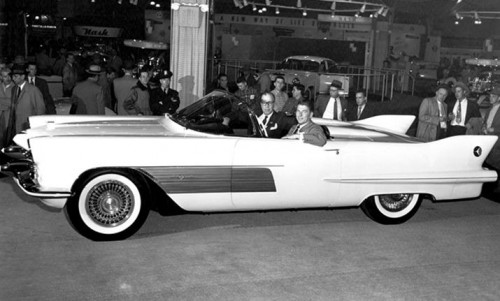 1954 Cadillac La Espada. Actor Ronald Reagan was the Grand Marshall for that year’s Chicago Auto Show. Reagan later rode in Lincolns.
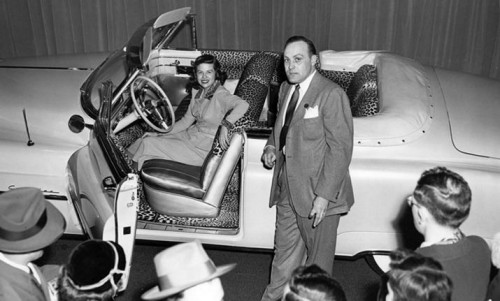 1950 Cadillac Debutante, with all unpainted interior metal plated in gold. In today’s politically correct world, would Cadillac use even fake exotic fur, let alone the Debutante’s real leopard skin?
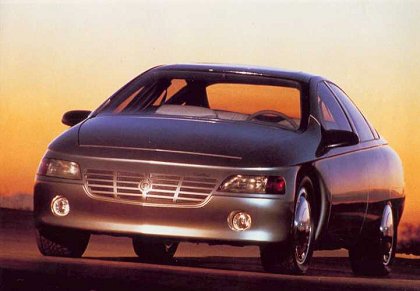 Cadillac used the Aurora name in 1990. The name would later appear at the top of Oldsmobile’s lineup.
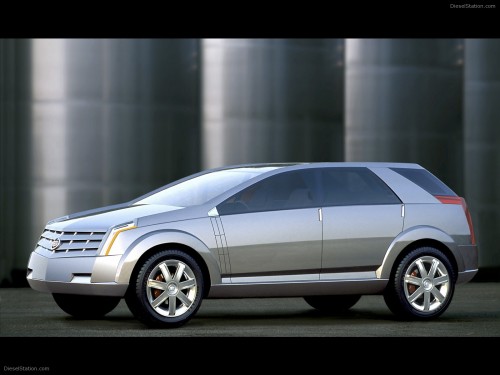 2002 Vizon Concept, a preview of the Cadillac SRX. The Vizon was an early version of Caddy’s Art & Science design theme.
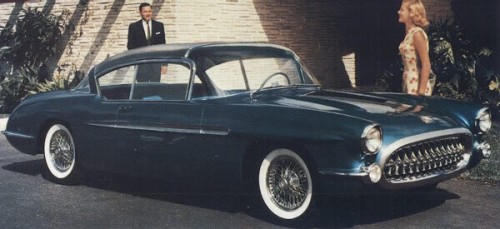 Lately there have been rumors that Chevrolet might expand the Corvette lineup to include a four seater. Expanding the Corvette line is not a new idea. At the 1954 Motorama, Chevy showed hardtop, fastback and station wagon versions of the Corvette, introduced only a year before. For the Motorama in 1957, Chevy debuted the Corvette Impala concept which seated five. Most Motorama cars look a little bizarre to my tastes, but the Corvette Impala was damn near perfect. It’s fate is unknown, probably scrapped.
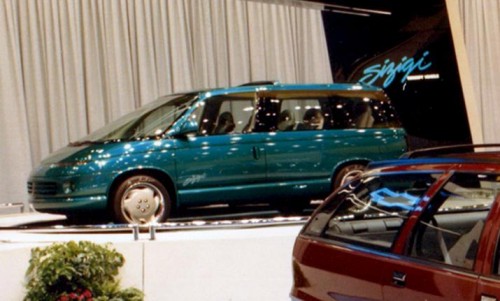 Did Chevrolet really use the obscure, difficult to pronounce and deliberately misspelled Sigizi in 1992 to introduce the dustbuster minivans? Just what two things are connected sygyzistically in this lozenge shaped vehicle?
Continued tomorrow in part 2, Chrysler to Ford.
Ronnie Schreiber edits Cars In Depth, a realistic perspective on cars & car culture and the original 3D car site. If you found this post worthwhile, you can dig deeper at Cars In Depth. If the 3D thing freaks you out, don’t worry, all the photo and video players in use at the site have mono options. Thanks – RJS



Funny that most of those ‘concept’ car never went anywhere, and the few who did lead to a production model usually isn’t very successful, in fact, were much derided, like the Dustbuster vans, and the Aztek.
These concept cars were picked and chosen for that reason. Which is great, and I really enjoyed reading it!
But, let’s not pretend this is a scientific sample. It’s a sample of concept cars intended to be fun and interesting, and it is!
Imagine if someone at Pontiac involved in making the decision to base the production version of the smaller concept Aztek on the larger minivan chassis had remembered how the well-received, smaller, American-based Tarpon concept failed miserably when it was put into production on a larger car as the Marlin.
That Sportiva deserved production. What a clean design…
Agree with you but am curious as to what’s in the trunk that’s making it sag so badly in the rear. Jimmy Hoffa disappeared ’bout that time, right??
That’s the extra gusseting to protect the fuel tank, obviously.
Besides, it’s two years too early, and everyone knows that Hoffa was buried in a Mercury. :p
Lol you’re right, had to look that one up. Ford most likely figured out the protective gusseting with the concept. The Pinto’s exploding gas tank prolly had the test dummies shooting out of the top of this thing ala James Bond ejection seat. Ford execs fixed the issue by enclosing the canopy and hiring the best Mad-Men.
Damnit… I wasn’t supposed to be right! That was mere sarcasm.
Oh, reality… living down to my expectations! :p
The AMC Tarpon is the spiritual ancestor of tha Audi A7, right?
I’m not sure that so much bulk with a low rear deck works in any era.
Thanks for posting these.
Acura CL-X–oddly enough, it looks a lot like the third and generation (2007-present) Mercedes-Benz CL.
AMC Tarpon–Considering the fact that that name is just one letter off from the term for a particular female-hygiene device, I wouldn’t have called it that
Buick Signia–We can clearly see where the disproportionate, clumsily-styled Rendezvous got its inspiration. Good thing they replaced it with the much better-looking and far larger Enclave
Cadillac Vizon–Fortunately the *production* SRX turned out far better
A tarpon is a fish – a strong, fast one too. With Barracuda and Marlin making the rounds I’m sure using Tarpon made sense at the time.
Yeah…but I gotta wit Kyree on this. Hate to have that conversation in the down-south AutoZone with Hard-of-Hearing Harry behind the counter.
HARRY (squinting at you, hoping he didn’t hear you right) “What kinna car is it again?”
You: “A Tarpon!” Its a red AMC TAR-PON!”
HARRY (looking completely befuddled and embarrased) “I think they sell them things down there at the Wall-Mart. We ain’t got them heres.”
Ha! I could completely see that happening, lol
If they had gone with the original plans to make the Tarpon a compact, it would’ve competed directly with the Barracuda. We could have ended up with compact fastback pony cars dubbed “fishy cars”.
The story goes that the original name for the Barracuda was Piranha, until some journo supposedly mentioned that the initials for the car would be ‘PP’.
The Corvette Impala is interesting. I agree with the writer, a good looking car for 1957. Too bad it was scrapped, If anything, it foretold the coming of the personal near-luxury car, Monte Carlo
It’s fascinating that GM was exploring making a 4 seater Corvette just as Ford did the same with the Thunderbird. While GM never followed through, Ford did and the T-bird went on to become a luxury coupe while the Corvette remained a sports/touring car.
That Corvette 5 seater is drop dead gorgeous. I can just picture the GM suits of the era looking at that car and say, “It’s too good to be a Chevrolet.”
I’m willing to bet that someone at Japan looked at a picture of that Sportiva Pinto and came up with the Suzuki X-90.
Good eye – I think your right.
Having owned 2 Pintos and a Bobcat I thought I knew a lot about the line, but I’ve never heard of the Sportiva. I’m sure it would have rusted just as badly as its brethren.
Thanks, I get the feeling the Sportiva would’ve rusted a bit worse with its roof-set-up let alone suffer from serious structural issues with no roof.
At the same time, you could parallel park it and no one would know which way is the front.
I was thinking someone at Ford remembered that one and said hey lets do this with an Escort! Unfortunately, it actually made it to production as the EXP…
And to save money they didn’t offer a t-top option, otherwise the early EXP’s and that Sportiva are strangely similar.
Should have mentioned what is likely the single most famous concept car of all time, the Lincoln Futura, which would become THE Batmobile. According to the Wikipedia page on the Futura, it was also featured in a movie in 1959.
Now why would I have mentioned “the single most famous concept car of all time” in an article about obscure concept and show cars? BTW, if you want to read about the Futura, Hemmings’ blog just published a piece I did about how the Futura and Corvette Sting Ray were both inspired by the same fish.
1982 Ford Probe Concept http://1.bp.blogspot.com/_oyDRus0HKls/S5Q_CpXMyNI/AAAAAAAABBs/yGti5RVzQ6U/s400/82ford_probe4_12.jpg
The Signia and the Cielo made me suddenly realize why Buick has been so successful in China.
The Sportiva is as good as the Signia rear fender/door is bad.
Yesterday I was looking at 1967 Eldorados and wiki mentioned an EldoRODo concept at the North American International Auto Show in 2000. Are there any photos of it?
I don’t know if it’s the same vehicle but at the Detroit Autorama last month, there was Chip Foose’s Eldorod, which he recently redid for the current owners. Foose designed it while at Boyd Coddington’s shop and it was the last car to be built before that shop went bankrupt. Since the first build wasn’t as he designed it, the new owners took it to Foose’s own shop and had him update it.
Thanks Ronnie. I still can’t find what wiki mentioned (which may or may not exist), but that blue and white creation of Fosse’s is gorgeous.
You’re welcome. Paul and Judy Andrews own the car – they also won Best of Show at Pebble Beach with their 1928 Mercedes Benz 680S Saoutchik Torpedo. Pics of Foose’s Eldorod and information on the car here:
carsindepth.com/?p=12124
Ronnie, thanks some more. That revised roof is a tremendously better look than the original drawing, which was fine. I don’t think it could be considered a Hofmeister since the ’48 coach/coupe had a similar notch. A perfect blue.
I believe the GM concept van was called “Syzygy,” not “Sigizi.” I mean, isn’t that obvious, since we use that word all the time? I’ve said it five times today already….
GM deliberately changed each “y” to “i” because people kept asking if they could buy a vowel.
According to the backdrop behind the vehicle in the photo above, they spelled it, ‘Sizigi’.
Thanks for posting this article, Mr. Schreiber. I love looking at old concept cars. They’re like a moment in design zeitgeist preserved. The Rambler Cheyenne Wagon and the Buick Wells Fargo, for example, are testaments to a time when the Western was the height of entertainment.
Me? I’d rather have the Cielo. Although the LaCrosse concept is remembered more fondly, the Cielo was just as cool with its whimsical its targa top.
“…I believe that by 1995 the Questor had 14 micro-computers, automatic level, attitude and spoiler control, a “systems sentinel” to monitor the status of vehicle systems…”
Man! I gotta get me a car with some of that Attitude control for my teenage girls. Does it handle rolled eyes??
It doesn’t work on teenage girls. The only thing that worked on mine was manual attitude adjustment, and the effect didn’t last very long. After age 16 it doesn’t work at all. By then, buying them a car takes care of everything, as long as it isn’t a ten year old Ford Fairmont.
My grandfather having owned a brown 77 Caprice and our family rolling in an 87 Pontiac Safari at the time, I was bowled over when I first saw the new Caprice (the wagon version visible in the Sizygy photo) in the at the Balitmore Auto Show. It was so fresh and futuristic looking, like a car from Back to the Future Part II.
And those weren’t just looks either; the LT1-powered bubble wagon my dad bought in ’95 regularly got over 20 mpg on the highway, thanks in part to its slippery shape and wheel skirts.
Does anyone else see Dodge Charger in the rear fender/door of that Buick Signia?
I see Chrysler 300 in the face.
Concept cars – I love ’em all.
That Pinto-thingy morphed into the Mustang ll – or it should have.
What a fantastic article – this obviously took a great deal of work. Much appreciated.
Thanks for the kind words. It kind of metastasized. More to follow in parts 2-5.
I still miss the Chevy Astro III show car. Even though it had a Corvair engine, the lift up rear hood with the seats attached to it was pure genius.
Does anyone else think the Sigizi looks like it is based on a mid-’80s Renault Espace?
Was the Questor a functioning car, or just a mock-up? Could they have spent the dozen years between show appearances actually developing it? Packing all those systems into an existing 2-seater sounds akin to building a ship in a bottle. Looking at everything from Buick that followed, I can see why they kept the Questor’s styling in play for as long as they could. If it didn’t do much for Buick in 1995, what did the Signia do for the brand, other than predict the Rendezvous and Enclave?
Yep, I thought the same thing when I saw the Suzuk, er, Sigizi. I suppose in the era of Benz-roofed Oldsmobiles and Chevy Celebrity Eurosports, it makes sense that GM would have tried for a “Euro” look to differentiate their new FWD minivan from their Astro/Safari vans, which were styled more like the ‘standard’ Dodge Caravan.
IMHO, it’s probably better that we got the Dustbusters as actual production vans, though, because as much as the anteaters were mocked, I think that concept design would have fared much, much worse.
Thanks for the article, I’ve always been intrigued by concept cars.
Did anyone else think there was something really weird going on with the rear roofline of the Buick Texan until they realized there was a table behind the car?
I love the HX concept, though I’m a bit biased…
How about the 1975 Chevy Monza concept named the Super Spyder II that made the show circuit in 1976?
http://monza.homestead.com/stiletto.html
Kinda slick in my book, but I’ve always like Monzas. Evidently GM still owns it and it’s trotted out every now and then.