Officials are looking to convince residents in the Washington, DC metropolitan region that converting even local streets into toll roads would be good for them. The National Capital Region Transportation Planning Board last Wednesday voted to seek federal gas tax funds to bankroll a $400,000 study on how best to sell the public on a controversial per-mile tax proposal that would raise up to $4.8 billion in new revenue.
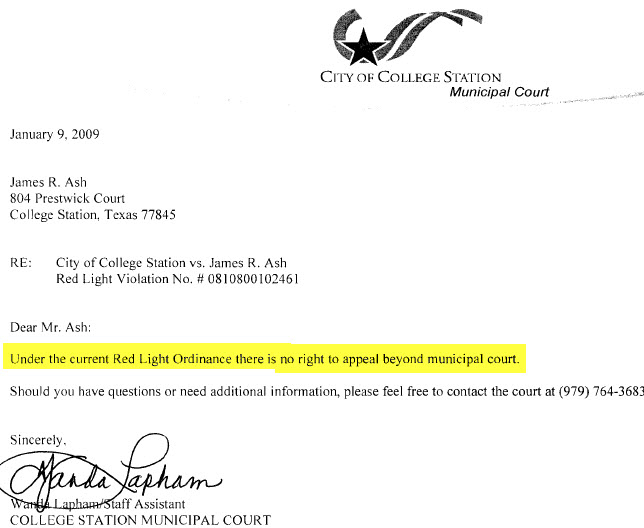
In the state of Texas, the right to a meaningful appeal in a red light camera case does not exist. While several states have allowed photo enforcement tickets to be appealed to the highest level — Minnesota’s highest court ruled on a photo ticket in 2007 and a red light camera case is currently pending before the California Supreme Court — several Texas municipalities are using an ambiguity in state law to deny challenges beyond the lowest level of the court system. “Under the current red light ordinance there is no right to appeal beyond municipal court,” College Station Municipal Court assistant Wanda Lapham wrote in a letter to Jim Ash (view letter).
The Utah Department of Transportation (UDOT) announced last week that the experimental increase in the state’s maximum speed limit to 80 MPH has been a success in terms of safety. UDOT Deputy Director Carlos Braceras testified before the state Interim Committee on Transportation that that there has been no increase in accidents as a result of the higher number printed on the speed limit signs on certain stretches of Interstate 15. In 2008, the state legislature granted UDOT permission to test higher limits on rural sections of the road. Using crash histories, engineering studies, UDOT carefully selected the areas that it believed would best handle the increased limit. The department then conducted before and after surveys of speeds and traffic volume on the three sections where the limit was changed. Although the signs permitted another 5 MPH in speed, the results showed that drivers did not ‘take advantage’ of the new limit to drive significantly faster.
Officials in College Station, Texas used $20,000 in taxpayer funds in an attempt to influence residents to vote against a referendum that would ban red light cameras from the city. The city mailed to every voter a multi-color, bilingual brochure entitled “Red Light Cameras: Voter Education” in the hopes of convincing them to support a program that generated $905,688 in revenue for fiscal 2009. “A petition was filed by a citizens’ group asking the city council to let voters decide whether to keep or eliminate the red light camera system,” the brochure explained. “This item will be on the November 3 ballot.”
Chillicothe, Ohio residents will retain the right to vote out speed cameras on November 3, thanks to a Ohio Supreme Court ruling yesterday. Fearing the public would shut down his signature program, Chillicothe Mayor Joseph Sulzer had asked the high court for an emergency injunction blocking the citizen-led initiative. Sulzer argued that this step was needed because the proposed initiative was unconstitutional and the city was denied a fair chance to argue against it before the Ross County Board of Elections (view Sulzer’s court filing). The supreme court justices unanimously rejected his complaint.
Accidents increased significantly at intersections equipped with red light cameras in Grande Prairie, Canada according to a city report completed last month. The review found that after a full year of use, cameras generated $1.2 million in revenue along with a 126 percent increase in injury collisions. “Since the installation of red light cameras in Grande Prairie, the City has issued over 6000 violation tickets since the program was initiated,” red light camera Program Manager Garry Roth wrote in his report. “There have not been significant reductions in collisions, while only a few of these collisions during this time frame, have actually resulted from a red light violation.”
The Office of the Privacy Commissioner of Canada expressed concern last week over the growing police use of technology to spy on motorists. In a letter to the Nanaimo Daily News, Assistant Privacy Commissioner Chantal Bernier emphasized that the Royal Canadian Mounted Police had not received the commissioner’s approval for the agency’s use of license plate recognition devices. Known as ANPR in the UK and ALPR in North America, these cameras use a combination of electronic databases, cameras and optical character recognition software to identify each passing vehicle. Over time, the devices create a searchable log containing the exact time and date that each automobile passed a given location.
London, England Mayor Boris Johnson is retreating from his campaign pledge to end the city’s “punishment of motorists.” Johnson’s predecessor, Ken Livingstone, lost his re-election in large measure because Johnson pledged to scale back the £8 (US $13) fee imposed on motorists entering the downtown area. Johnson announced Friday that he will boost the tax to £10 (US $16.40) to shore up Transport for London’s mass transit budget. “The proposed increase in the charge will ensure that the system remains effective in controlling traffic levels in central London, and the revenue will also help us fund the vital improvements to London’s transport network that all Londoners want to see,” Johnson said in a statement.
A single red light camera in Riverside, California issued $1 million worth of right-hand turn on red tickets in just one month. The automated ticketing machine installed in March at Tyler Street at the entrance to the 91 Freeway has become the most productive of the city’s cameras and now accounts for half of the citations issued by Riverside’s vendor, Redflex Traffic Systems of Australia. The camera helped boost the grand total of citations mailed since January 2007 to 82,448 tickets worth $32,532,203.
A recently released study concludes that Pennsylvania’s plan to toll Interstate 80 would burden taxpayers and potentially cost thousands of jobs. Grove City College economics Professor Tracy C. Miller’s analysis extended beyond the simple issue of how much money such tolling would raise for government coffers and, instead, attempted to quantify the effect of increased transportation costs on local businesses and residents. I-80 runs 311 miles across the state, serving as a vital commercial link between New York and Chicago. Pennsylvania Governor Edward G. Rendell (D) has been promoting the tolling effort in the hopes of generating $405 million in new revenue. Rendell and others refer to the toll as a “user fee,” but Miller disagreed with this characterization. “It is better understood as a tax or tariff, since much of the revenue will be used for purposes other than maintaining and improving Interstate 80 and since vehicles that use Interstate 80 already pay for using it via fuel taxes and other taxes,” Miller wrote.
The number one operator of photo enforcement in the US, Redflex Traffic Systems, engaged in a public battle of words with its three largest shareholders this week. Thorney Holdings Ltd, Hunter Hall and Renaissance joined to force a shareholder vote to remove Redflex Chairman Chris Cooper and Directors Peter Lewinsky and Roger Sawley. The renegade investors, who hold 28 percent of the company stock, are upset with the mismanagement exemplified in the Redflex stock price and the “expensive failure” of the Arizona freeway photo radar contract. “We are concerned whether the present board is appropriately qualified, experienced and competent to manage Redflex’s affairs,” Thorney Holdings stated in a letter to shareholders Wednesday. “Due to what we perceive to be a lack of transparency in Redflex’s process for director appointments, we are concerned about the absence of information on these issues.”
Officials in Winnipeg, Canada were caught this weekend defying a court ruling that outlawed the use of photo radar in work zones when workers are not present. A group of residents organized by the group WiseUp Winnipeg have decided to fight back, first by recording the automated ticketing van as it operated in a Route 90 “construction zone” on October 10 at 3:30pm with no workers in sight.
A Michigan state Senate committee voted unanimously to advance legislation that would legalize the hanging of fuzzy dice and air fresheners from rearview mirrors. State Senator Ron Jelinek (R-Three Oaks) introduced Senate Bill 276 to repeal the statute that allows police to pull over motorists using objects dangling from a mirror as a pretext. Existing law makes driving with a “dangling ornament” punishable by a $100 fine and up to ninety days imprisonment.
An anonymous vigilante in Rovaniemi, Finland destroyed a speed camera with military-grade explosives on Wednesday. Video of the assault uploaded to YouTube showed the remote detonation of a 700g charge cleanly blew the head off an automated ticketing machine on a deserted road (watch video below). The assault appears to be the most professionally executed attack recorded on tape. In 2006, a British man used thermite to damage what he thought was a speed camera, but turned out to be a police surveillance device.
A UK government group has just released a proposal that would impose a per-mile tax on motorists to rescue the planet from an imagined catastrophe. The Committee on Climate Change (CCC), a body established by the UK Parliament to advise the government on environmental issues, has set a target of a two-percent annual reduction in carbon dioxide (CO2) emissions. CO2 is a naturally occurring gas that is essential to human life. The committee believes it can reach its goal by imposing massive new taxes on drivers that will reduce demand for driving which, in turn, would reduce carbon dioxide output.





Recent Comments