



 The Edmonton Sun reports that a judge has cleared the last remaining participant in the city’s photo radar bribery scandal. Sergeant Tom Bell, 50, accepted lavish gifts from Affiliated Computer Services (ACS) between 1998 and 2004 while the company was attempting to land the right run the city’s lucrative speed camera operation.While several other Edmonton Police Service employees, including Staff Sergeant Kerry Nisbet and former Chief Darryl da Costa, accepted similar benefits, Bell alone stood accused of returning the favor. On March 1, 2004, Bell wrote a memo falsely stating that ACS alone was capable of running Edmonton’s speed camera program; the company should be awarded a no-bid contract worth $90m. Court of Queen’s Bench Justice Bryan Mahoney believed this amounted to ordinary conduct and that it did not amount to a “serious and marked departure from the norm.” For that reason, he could not find Bell guilty of taking bribes despite “some poor choices and errors in judgment.” Mahoney discarded the testimony of Bell’s ex-wife, who asserted that Bell’s wrote the false memo in the hopes that he would be rewarded financially after leaving the police force.
Posts By: The Newspaper
 A Shropshire, UK speed camera escaped serious damage last week after a vigilante attempted to set it on fire. The Shropshire Star reports that “A tyre was placed on top of the camera in Dawley Road, Arleston, shortly after 4am and a blanket draped over the top. The arsonists then poured a full can of petrol over the top and set it on fire. Sub-officer Alan Wilson, of Wellington fire station, described it as a ‘deliberate attack.'” Ya think? The plan failed, however, when the fire burned upward without generating enough heat to damage the camera housing. “Fortunately for us [the local fire department], and for those who pay for them [the people caught by the camera?], it went upwards and didn’t damage the speed camera. We think it is still working.” Don’t let the English understatement fool you; Big Brother is mighty miffed. “We would appeal for anyone with information in relation to the incident to come forward.” And no wonder…
A British Broadcasting Corporation News broadcast showing speed camera traps causing crashes has now been made public. The April 21 BBC report was meant to highlight government efforts as part of a European “crackdown on speeding” using video excerpts from the Norfolk Speed Camera Partnership. The excerpts unintentionally showcased motorists’ panic when surprised by a “talivan” operating from a freeway overpass. “He jams on his brakes when he sees the speed truck,” BBC News reporter Mike Cartwright said in describing an October 3, 2005 incident. “He smacks into the barrier and amazingly slides in between those two cars there and nobody was hurt — a very lucky escape indeed for all the drivers involved in that.” A second video taken June 18, 2007 shows a vehicle surprised by a speed camera on a wet road. “And the same thing here,” Cartwright said. “The guy jams on his brakes and he goes up the embankment.” Shortly after the news program aired, the BBC removed all copies of the footage from its website. Motorist Keith Jones enlisted the help of the Association of British Drivers to urge the BBC, the Norfolk Speed Camera Partnership and the UK Information Commissioner to release the publicly funded tapes under open records laws. The government authorities refused to do so, citing “technical difficulties.” Speaking of which…
 Following San Jose, California’s recent decision to reject red light cameras, the Los Angeles suburb of El Monte has decided to put an end to photo ticketing after five years. By a unanimous vote, the city council declined to renew its contract with Australian camera vendor Redflex. According to police, the cameras failed to produce any reduction in the number of intersection accidents. More importantly, however, the devices failed to produce revenue. “We’re spending a lot of staff time on this just to gain $2000 a month,” City Manager James W. Mussenden explained. “It doesn’t reduce accidents — that’s what our studies and results have come back.” Data obtained by highwayrobbery.net suggest the loss in revenue could be related to changes in intersection signal timing. On April 12, 2004 the city increased the yellow warning time to 3.5 seconds for the left turn movements at the intersection of Peck Road and Ramona Boulevard. The results were immediately felt. In March 2004, before the increase, Redflex mailed 665 tickets. In May, the first full month after the increase, citations dropped to 265. This small engineering improvement cut the photo enforcement system’s total profit by $1.4 million.
 Virginia’s second-largest county yesterday fired the first shot in what is likely to be an ongoing war over a state plan to toll existing lanes on an interstate freeway. The Prince William County Board of Supervisors voted 7 – 0 (with one abstention) to approve an ordinance demanding that the Virginia Department of Transportation (VDOT) answer a series of tough questions regarding its proposed transfer of the Interstate 95/395 High Occupancy Vehicle (HOV) lanes to Transurban. The ordinance reflected the board’s concern with the length of the contract (80 years) and the possibility that Virginia taxpayers may have to provide a financial “bailout” for the Australian tolling company– should the HOT lane concept not perform as promised. Chairman Stewart pointed to the warning of Fitch Ratings, which downgraded its assessment of the credit risks associated with tolling to “negative.” Stewart compared Transurban to Fannie Mae and Freddie Mac…
 So far, a total of $2m has been generated by a $1 fee assessed to Harris County motorists accused of not paying a toll. (The fee is part of the $34 fine levied for each alleged instance of toll skipping. Most pay the fine even if they have been wrongly accused due to faulty equipment.) State lawmakers intended the $1 fee to cover the administrative expenses of the county attorney for handling the fines. A KTRK investigation revealed that Harris County Attorney Mike Stafford used the fund to throw a Christmas party at Pizzinis, an Italian restaurant, at a cost of $5625. (His office spent a total of $17k in motorist fees on Italian food in a single year.) Another $100k paid for bonuses to employees who already make as much as $225k a year. Stafford also used $196k from the tolling fund to ensure his staff could always park in county lots for free. The toll road fund paid for $122,599 for office remodeling expenses under a no-bid contract with Hermes Commercial Contractors. (Leroy Hermes is Stafford’s campaign committee chairman.)
 State governments across Australia are poised to deploy noise cameras. NSW firm Acoustic Research Laboratories’ fully automated noise analysis system uses a set of microphones and cameras that continuously record and analyze activity on a neighborhood street. A computer program isolates trigger sounds from general background noise, records a 10 second clip of the offender, coordinates with automatic number plate recognition software and voile! A traffic citation to passing vehicles that exceed a predetermined noise threshold. Once configured, the machine can generate up to 10k tickets (before the on-board hard drive is filled.) According to the Roads and Traffic Authority (RTA) Annual Report, systems are active in the small New South Wales suburb of Mount Ousley. The agency is looking to expand coverage. Meanwhile, South Australia and Victoria have begun similar programs focusing on the noise of heavy commercial truck compression brakes. The ticketing system could be easily expand to issue citations for loud subwoofers, noisy exhausts or even an inopportune horn honk. Or just listen in.
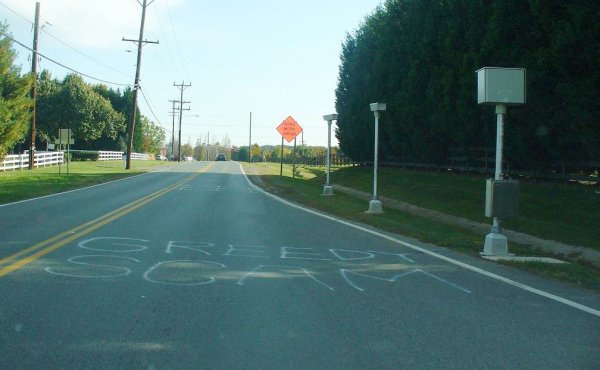
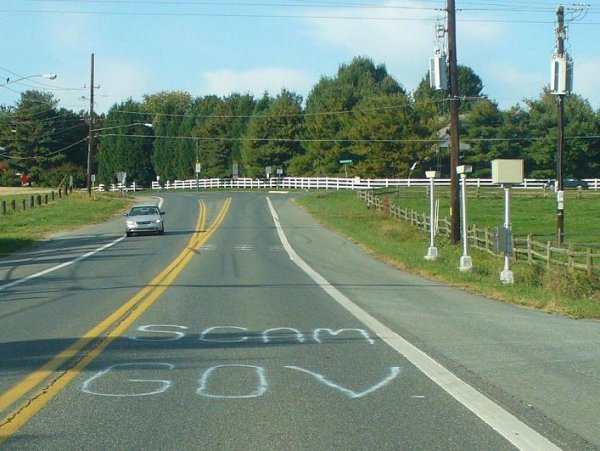
 Last week, vigilantes set fire to a Cumbria, UK speed camera. The was device located on the A590 near Witherslack in the seaside resort town of Grange-over-Sands. The attack “only” wreaked an estimated £3000 ($5200) in damage on the revenue collection safety device. Meanwhile, back In Montgomery County, Maryland, vigilantes continue to protest the use of speed cameras by writing “SCAM” in large white lettering on the street just ahead of the lucrative devices. The cameras themselves are unaffected and continue to generate revenue. At least three sites have now been targeted, with the messages “GOV. SCAM” and “GREEDY SCAM.” Photos come courtesy a local activist website that does not endorse the protest tactic. “StopBigBrotherMD believes that those who feel that speed cameras are a scam should instead use legal means of expressing their frustration,” the site’s editor wrote. “That would include writing letters to the editor, writing to your state legislature, or challenging citations in court.”
 Vigilantes painted “SCAM” on the pavement in large, white letters near a speed camera in Potomac, Maryland. The sign serves as a warning to approaching drivers that the automated ticketing machine on the side of River Road is active. WUSA television used a helicopter to capture a unique perspective on the warning. Montgomery County jurisdictions are notorious for issuing as many speed citations as possible using ticket quotas, even though the practice is banned under state law. The county program generated $7.2m worth of tickets last year. The village of Chevy Chase used cameras to nearly double its entire budget, spending a significant amount that was promised for “public safety” instead on “beautification improvements.” The latest incident marks an increase in the number of anti-camera incidents in the US. Just two months ago, vigilantes struck four speed cameras in Gaithersburg.
 The public agency responsible for operating California’s largest network of toll roads is now looking to federal taxpayers for financial help. The Los Angeles Times reports that the Transportation Corridor Agencies (TCA) have asked the US Department of Transportation for a record $1.1b in TIFIA loan support to avoid collapse. TCA’s 51-mile system of roads generated $294m in yearly revenue. Now, motorists hammered by record gasoline prices have decided to save money by avoiding the 73, 133, 241 and 261 toll routes. Still, as late as June, TCA officials insisted that their public-private partnership model protected taxpayers. “The toll roads are designed and built with proceeds from the sale of toll revenue bonds, which are repaid entirely by tolls collected on the completed road,” TCA spokesman Jennifer Seaton wrote in an email to TheNewspaper. “No tax dollars are at stake.” The construction cost of the TCA toll roads was $1.7b. Since 1998, TCA has also levied $420m through developer fees that are passed on to taxpayers. Around 23 percent of the money collected from drivers so far has gone solely to cover the expenses required to run the collection systems, according to a report by the Washington state Department of Transportation (read report). By comparison, collection cost for the state’s eighteen-cent fuel excise tax is just 0.69 percent.
 Illinois Governor Rod R. Blagojevich (D) has revealed plans to create “High Occupancy Toll (HOT) lanes” on the Illinois Tollway system. “I am proud to announce that we will be constructing Green Lanes on the Illinois Tollway,” Blagojevich said in a statement. “Not only will these Green Lanes and new interchanges help commuters, but will also pay real dividends to Illinois’ communities and businesses through massive new business development.” The Illinois Green Lane project promises to reduce road congestion by establishing three classes of motorist. Group one: carpools registered with government authorities. They could use the privileged lanes after paying the regular Illinois toll rates. Group Two: drivers in politically favored vehicles designated as “green.” They have the option of paying regular Illinois toll rates plus a reduced “variable fee” to use the Green Lanes. Group three: everybody else. These third-class motorists could use the Green Lanes by paying regular Illinois toll rates plus a full, second toll that would increase during the most congested hours. The impact of “Tomorrow’s Transportation Today” program after the jump…
On April 21, Keith Jones, a driver living in Epsom, Surrey watched a BBC News clip intended to showcase the terrible consequences of speeding. The video included footage taken from a safety camera van on a bridge overpass in Norfolk. “The first part contained the usual dire warnings about the danger of speeding,” Jones recalled. “Later in the sequence actual videos made by the speed camera van were shown. This included one video of a driver braking so hard on seeing the speed trap that he lost control and spun out all over the three lanes of the road. After some violent fishtailing the car eventually collided with the central reservation and lost a wheel.” Jones petitioned the BBC to release it. Auntie Beeb refused. Jones then asked the Norfolk Safety Camera Partnership for a copy of the raw camera footage. It refused. Jones petitioned the UK Information Commissioner to force the video’s release. The government quango ruled that “journalistic content” is exempt from freedom of information laws. The Association of British Drivers (ABD) joined Jones’ crusade, calling on the BBC to provide license payers with the video. “It would seem that the BBC is not interested in presenting facts… unless they have first been approved by the powers that be,” ABD Chairman Brian Gregory complained. “This is the kind of censorship that the BBC reports to exist in Russia, yet here we have indications of the same censorship in Britain. We call upon the BBC to re-instate this video without delay.” Meanwhile, Jones decided to recreate the incident in a humorous animation, presented here.
 In March 2007, Florida firefighter Christopher M. Baird started getting traffic citations, after the E-PASS toll transponder in his wife’s SUV failed. Although Baird had kept his address properly updated with the Department of Motor Vehicles, officials mailed a stack of sixteen tickets to the wrong location. Baird first learned of the problem while trying to renew his car registration. Despite the lack of proper notice, he was given no chance to be heard on the matter. Instead, Baird was forced to pay $1448 in fines to renew his vehicle registration and was hit with 48 points against his driving license, resulting in an immediate suspension. In April, Circuit Judge John Galluzzo found the actions of toll road officials “outrageous.” He ordered Baird’s money refunded and license reinstated, and extended his ruling to all toll violation tickets issued to motorists in Seminole and Brevard counties– as long as they held a valid toll transponder account. And then…
 The Columbus Dispatch reports that Madison Township, Ohio police have issued officer Ken Braden a written reprimanded for failing to write enough traffic tickets. Officer Braden only wrote 85 tickets last year. His most prolific fellow officer wrote 388. And here’s the kicker: Braden’s tied the record for the most criminal arrests. Police Chief Greg Ryan couldn’t give a shit [paraphrasing]. “He gets paid as much as the other officers,” Ryan told the Dispatch. “He should do as much work as the other officers.” According to Chief Ryan, in 2006, his twelve patrol officers wrote 1935 tickets and seized 194 cars (selling 41 of them for profit). And no small part of that “success” is due to Chief Ryan’s 2005 written mandate: “Effective immediately, all uniformed patrol officers are expected, as a minimum level of self-initiated activity, to issue one traffic citation, one traffic warning, and complete five park & walk business checks/residential vacation checks each shift worked,” Ryan’s memorandum stated. The local Fraternal Order of Police union is defending Braden in a complaint against the department. [click here for the full report from thenewspaper.com]
 Activists in Scottsdale, Arizona trained their own telephoto lenses on a speed camera operator at around 5pm in the afternoon on Thursday. Members of the group Camerafraud.com wanted to give the public a rare glimpse inside an active speed trap– the same view that the photo radar van’s own photographic equipment has while peering through the windows of passing vehicles. “If only there were some sort of law preventing high-powered cameras from taking photographs of unsuspecting people inside their vehicles,” the group wrote on its website. Although Scottsdale’s speed camera vans bear the markings of police vehicles, they are owned and operated by American Traffic Solutions (ATS). A paid ATS employee, Daniel P. Coon in this case, is responsible for driving the vehicle to ticketing locations and ensuring the vehicle is not vandalized. The group’s photographs showed Coon at a laptop adjusting the Axsis software that powers the lucrative enforcement program. The screen also showed that drivers at the East Chaparral Boulevard location had slammed on their brakes while passing the van, slowing to an average of just 18 MPH to avoid receiving a citation. After noticing the photographer, Coon quickly blocked the van’s windows to protect his privacy.



Recent Comments