Find Editorials by Category:
By
Paul Niedermeyer on March 10, 2010

Despite the fact that I’m not superstitious or religious, I’ve learned to gracefully accept that certain things seem to happen as if a bigger hand were at work; as though some things were preordained. One year ago exactly, I stumbled on this old Cadillac (actually a ’72, it turns out), and it inspired my first Curbside Classic. It started out about the year I turned eighteen and left home, and hitched a ride in one just like it. But it ended up as a rambling reflection on the fall of Cadillac, the economic circumstances of 1971, and how they’ve changed since then. One year and a hundred Curbside Classics later, I decided to revisit the old DeVille, to see what it might have to say to me now, and to indulge in some more musings. And what has taken up residence with it? A 1976 Toyota Corolla. A mere coincidence, of course. But one that is mighty pregnant with symbolism. Read More >
By
Paul Niedermeyer on March 9, 2010

Risky business. That defines the car business, and never more succinctly so than in the case of this car. Rarely has a desperate last-minute gamble paid of so handsomely as the “Neue Klasse” BMWs. Today’s new owners of Saab can only dream (hallucinate) about turning their business around so quickly and definitively as this BMW did. But having the guts and money to back the risk taking is only part of the equation. Most of all, it’s a matter of being at the right time with the right product, and having the smarts to recognize it. In 1962, the seemingly impossible wasn’t. Today? Good luck. Read More >
By
Paul Niedermeyer on March 5, 2010

You want to know why the Honda Accord took the country by storm in 1976? You’re looking at its ugly face. That grille looks positively unreal, like something cobbled up by a high school shop class with some leftover extruded sheetmetal. Where were you, Bill Mitchell, when this abomination was approved? In the Accord CC I said Detroit didn’t just open the portcullis with its obese “mid-sized cars” of the seventies. It actively invited the invasion, and Honda led the charge. Well, here are GM’s gates swung wide open. And the problem wasn’t just the front end, but a face does reveal much of what’s behind it. And this mug wasn’t lying. Read More >
By
Paul Niedermeyer on March 4, 2010

This is the companion piece to the Most Influential Modern Global Car: the 1975 VW Rabbit/Golf. Now if I had the same photographic luck as with the Rabbit, there would be a big American car in the same shot, say something like this. Well, the Florence Apt’s [sic] will do fairly well as a stand-in, with its traditional architecture. Because if any one car can take credit for re-inventing the traditional “American” car, it’s this Honda Accord. Read More >
By
Paul Niedermeyer on March 3, 2010

Let’s hold our nose and consider the decline and fall of the Chrysler New Yorker. Twenty years earlier, that name typified the grace, comfort, style and performance that New Yorkers had been know for since the first New Yorker ran off the lines in 1939. The energy crisis and the decline of the big car brought on a prolonged slide that should have ended with its retirement in 1982. But Lee Iaccoca would have none of that: the New Yorker would be reinKarnated! Add three inches to that infinitely malleable K-car platform, and slap on a healthy dollop of all the usual faux-luxury car trappings of the time, and presto: a mini-me New Yorker. Just in case you forgot what it looked like in its prime, here’s the before and after: Read More >
By
Paul Niedermeyer on March 2, 2010

Always hankered for a Citroen? The Subaru SVX is the closest thing we’ve gotten to one these past few decades. I find the resemblance to the XM more than coincidental. Which is a bit odd (or not) considering that the XM beat the SVX to the market by a few years (1989). And the XM was styled by Bertone, while arch-rival Giorgetto Giugiaro’s Ital design did the SVX. A case of great minds thinking alike? Or just the styling cliches de jour? Given the Subaru’s “aircraft-inspired glass-to-glass canopy” with the very unusual windows within windows, the SVX was actually more “Citroen” then the real thing. No wonder it’s such a curious oddity today. Read More >
By
Paul Niedermeyer on March 1, 2010

It’s morning on a bright summer day in Iowa City in 1962. I may have fallen asleep with pictures of Marilyn and the Corvette, but now they’re lost somewhere in the folds of my sheets. The fantasy is over, and its time to face a reality of rampant Rambler Classic wagons with wheezing sixes piloted by boozy but anything but sexy Moms. Instead of a fancy night club where a jazz band is playing, we’re off to the pool, and if we’re lucky a stop at the Purple Cow drive-in for milkshakes and floats afterward. The distinctive pattern of Rambler upholstery seared into the backs of my thighs and the stain of artificial strawberry on my trunks will be the tell-tale of having crowded in with half a dozen other hot (the wrong kind) and sticky kids in the back seat. Why did I have to find you, Rambler Classic Wagon? I was so enjoying my fantasy memories. Read More >
By
Paul Niedermeyer on February 26, 2010

The Trooper II deserves some serious respect and love. It was among the very first, perhaps the very first of the “compact” SUVs that took the US market by storm in the eighties. It was eminently practical, durable, rugged, and good looking. And it’s one of the cars on the list that I wish I had bought. Did it have any faults? Probably, but as far as I’m concerned, someone should still be making this Trooper. Read More >
By
Paul Niedermeyer on February 25, 2010

Seductive, voluptuous, hot, fast, flawed, sexy, modest beginnings, all-American, iconic, hits the big time in 1953, gone forever in the fall of ’62, immortal, unforgettable. My apologies if others have gone down this road before, but when I re-opened these Corvette pictures last night, that’s what came to mind. And I’ve learned to just go with it. Want to come along for the ride? If so, NSFW alert! Read More >
By
Paul Niedermeyer on February 19, 2010

The current fad for “four door coupes” like the Mercedes CLS and its Passat mini-me are a revival of a trend that this Buick helped usher in: the four door hardtop. It actually arrived mid year 1955, on the junior Buicks and Olsmobiles; but just like the 1949 GM two-door hardtops caught the rest of the industry off guard, so did these. Once again, everyone had to scramble and follow GM, until the four door hardtop became the victim of safety regs and changing tastes.
Read More >
By
Paul Niedermeyer on February 19, 2010

TTAC’s Steve Lang recently documented the historical “leaning” of the Camry beginning with the 1997 model here, and EN’s recent editorial on the transition from “fat” to “lean” quality standards documented Toyota’s rationale and its consequences. So when a neighbor asked me if I wanted to check out and drive a used 1990 Camry she was buying, I figured it was an opportunity to indulge in some genuine Toyota fatness. Little did I realize I was about to have the automotive equivalent of a banana split. Read More >
By
Paul Niedermeyer on February 18, 2010

The Pacer is the poster child of how questionable ideas and good intentions go awry. In 1971, scrappy little AMC was faced with a dilemma: how to capture buyers looking to downsize, when they were incapable of actually building a truly downsized car. Yup; there was no way AMC could tool up to build a genuine compact car, like the Vega and Pinto. So the solution was to stop pretending, like the execrable Gremlin that preceded the Pacer. The answer was to build the world’s first wide-body compact, a segment nobody had ever identified before, much less pined for. To add to its zestiness, break all the styling molds with acres of glass and asymmetrical doors. And then just for good measure, stick a rotary engine in it. As we’ve seen repeatedly, desperation is the mother of (bizarre) inventions. Read More >
By
Paul Niedermeyer on February 16, 2010

Zing! That word encapsulates the RX-7. The only vocabulary the little coffee-can rotary had was zing! (snick) zing! (snick) and zing again! Sooner rather than later, it zinged you for a couple of Gs when its rotor seals gave up the zing! But that didn’t come as a surprise, and it never zinged you for anything else. That is, unless you got a little too frisky in certain corners, and the live rear axle might toss you a nasty little over-zing. As long as you could live on a torque-free diet, the RX-7 was one of the best friends an enthusiast driver could hope for in its day. And there are still loyal devotees of Zing-Buddhism today. Read More >
By
Paul Niedermeyer on February 12, 2010

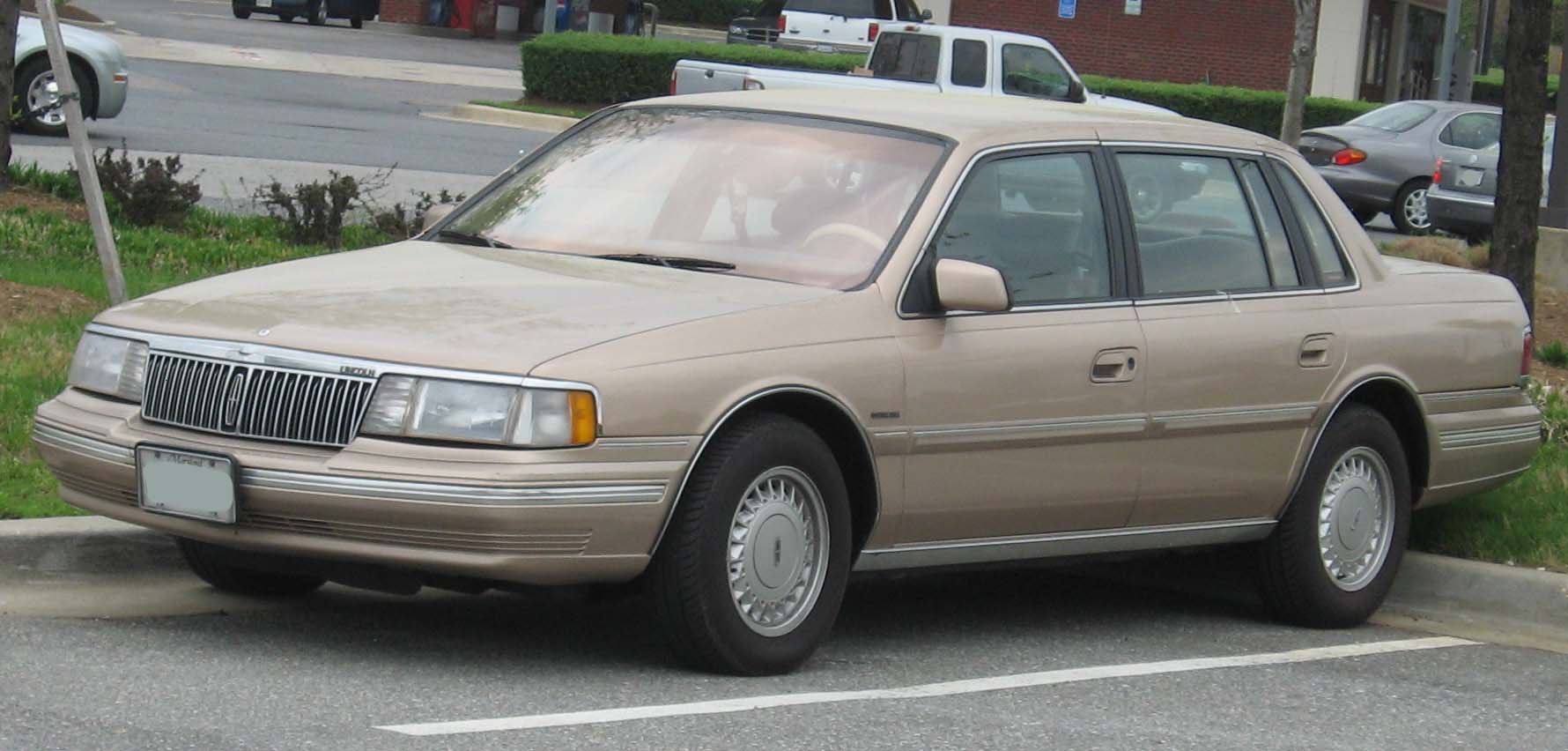
The Mark VII and the Mark VIII get a passing grade for effort, but that’s not good enough in the car business. There was no way these coupes could could begin to offset the damage that was simultaneously being done to the brand by that lame-assed 140 hp V6 powered Continental sedan. Dressing up this Taurus to compete with the Mercedes W124 and Lexus LS 400 was just a revival of the deadly sin they committed with the Versailles. There may have been enough suckers to buy this pig in a poke v.2, but they were all over seventy years old. Not the way to build a viable brand, especially in the face of the most withering competition for luxury car dollars ever. Read More >
By
Paul Niedermeyer on February 12, 2010

Deception (and self deception) is a very significant factor in the automobile business. Unless we buy a stripper Corolla (so conveniently parked here) or the like, we’re happy enough to pay more to feel like we’re not just getting transportation, but something that enhances our sense of well-being and social status. One of the biggest questions for automobile executives forever is how much of a premium folks are willing to pay for that. What’s the upper limit you can charge strictly for the sizzle when there’s little or no steak? It somehow seems fitting that we consider the most extreme real-world test of that question on Honest Abe’s birthday: the Versailles, the ultimate pig in a poke. Read More >
Receive updates on the best of TheTruthAboutCars.com
Who We Are
- Adam Tonge
- Bozi Tatarevic
- Corey Lewis
- Jo Borras
- Mark Baruth
- Ronnie Schreiber







Recent Comments