

Category: Industry

By on February 8, 2009

Rolls-Royce used to advertise the fact that their cars were so quiet that the loudest sound you heard was the [analog] clock ticking on the dash. Who said the British don’t do hyperbole? As a quiet car connoisseur, I’d have to say a Clinton-era Cadillac provided the quietest ride I’d ever experienced; if the time was one of peace and prosperity, then so was the car. Nowadays, automakers are telling us that their cars are quiet, or at least quieter than ever before. I’m not buying it. A number of recent drives have been notable for their aural uncouthness. So I set out to find the truth about automotive sonic signatures. Has nostalgia dimmed my memory (if not my hearing)? Is progress on the noise suppression front been less impressive than industry propaganda would have you believe?

The German buff book Auto, Motor und Sport recently opened its archives to tightwads. I’ve spent a few hours perusing the decibel stats. To save space, the table I’ve compiled only deals with interior noise at about 80 mph (130 km/h). It’s a civilized speed (at least here in Germany) at which one would want to be able to hold a civilized conversation, even with a back-seat passenger.

Car and model year Interior noise in dB(A) at 80.78 MPH

1995 BMW 728i 66

1995 BMW 523i 66

2003 BMW 730i 66

2009 BMW 330d 68

2009 Mercedes C350 CGI 68

2009 Renault Megane dCI 69

1996 Mercedes C280 69

2008 Mercedes C250 CDI 69

1996 Citroen XM V6 69

1995 Audi A6 2.8 69

2006 Mercedes E220 CDI 69

2006 BMW 520d 69

2000 Ford Mondeo 2.016V 69

2009 Ford Mondeo 2.5 Titanium S 70

2006 Audi A6 2.7 TDI 70

1996 Mercedes E230 T 71

2003 Toyota Camry 2.2 71

2009 Toyota Auris 2.0 D-4D 71

1995 Honda Civic 1.5i VTEC-E 72

2009 Honda Civic 2.2i-CTDi 72

2002 VW Golf 1.9 TDI 72

2009 VW Golf 2.0 TDI 72

2009 Opel Astra 1.9 CDTi 72

1996 Opel Astra 1.6 16V 73

2003 Toyota Corolla Compact 1.4 73

2009 Porsche Carrera 73

1995 VW Golf Cabrio 1.9TDI 73

1996 Ford Mondeo 1.8GT 73

1995 VW Golf CL 1.6 74

1995 Mercedes E230 74

2000 Toyota Corolla 1.6 76

2009 Ford Ka 76

1996 Renault Megane 2.0 16v 76

In some market segments (e.g., executive cars), you have to ask: where’s the progress? What, for instance, has BMW been doing since 1995? Most cars have gotten much heavier. You think that the extra heft might include some extra soundproofing. But plenty of today;s lumbering leviathans are hardly quieter than their sprightlier predecessors. What does Mercedes expect us to think about zero improvement for the C-Class in twelve years?

VW’s press release for its newest Golf calls it “the quietest Volkswagen Golf since the model series began” characterized by “first-class acoustic properties.” Yes, “a special sound-damping film in the windshield reduces driving noises, as does the newly developed seal design on the doors and side window guides.”

Significantly less wind noise is generated by the outside mirrors due to their new shape. Furthermore, special modifications were made to better isolate the engine and passenger compartments from one another acoustically. Quiet rolling tires and new engine bearings round out the noise reduction program.

Empirically, the new Golf offers an improvement of 2 dB in three car generations and thirteen years.

Small cars have gotten much better, though. Corollas and Renaults used to be noisy boxes. Intense competition in the compact field seems to be working its magic. The Auris (the more-advanced, Euro-market Corolla) is a quite soothing small car, and the Megane’s low level of noise is a marvel.

Really small cars, like the Fiat Panda or the Ford Ka, are still noisy, and are thus for me un-purchasable vehicles, since they (driven quickly) generate a clamor louder than Occupational Noise Exposure standards would allow.

A noise level of 70 dB(A) seems to be hard to crack in cars for regular folks. But this is, to my mind, a pretty tolerable loudness, unreachable a few decades ago.

You’d think with advanced computer firepower, more precise manufacturing tolerances, double-lip door seals and multi-laminate windows, cars would generally be much quieter than in the 1990s. Why aren’t they? Remember one dirty secret of the car industry: usually, each successive generation of a car is cheaper to manufacture. Cost-cutting means that progress is slow—unless the market actively demands progress.

Or unless the car maker is genuinely forward-thinking. In terms of quietness, the only revolutionary car in recent years may be the Lexus LS 600h, which claims 60db at 60MPH.

On the other hand, where are the technical advancements we’ve been waiting for? Active noise cancellation, once seen as the answer to all things cacophonous and found in Honda’s cylinder de-activating Odyssey minivan, seems to be a pipe dream. This despite the fact that BOSE et al. have been promoting its benefits for years, and Germany’s Fraunhofer Institute says it’s working on a useful system.

And what about a microphone-based, user-friendly and effective interior intercom? I’m tired of shouting at back-seat passengers (although it can be useful in the case of children, dogs and back-seat drivers). A car that used electronics to help you converse with everybody on board, without raising your voice: now, that’s something that would lead me to a showroom, and to ponder a purchase.

By on February 5, 2009

Here’s a surprise: American cars hold their value much better than other major markets, including Japan and Europe. Cost of ownership is the culprit. In the US, owning a car generates relatively little in the way of year-to-year expenses. Registration is usually about $30. Inspections are infrequent and rarely costly. While the repairs required to keep a “beater” on the road can reach four figures, they rarely exceed the value of the vehicle itself. As a result, it’s unusual to see a used vehicle in America (even “heaps”) listed for sale under $1k. Also as a result, the cash-for-clunkers proposals, as envisioned, are a horrible idea.

In an effort to boost sales, the German government has been running a “cash for clunkers” program. The government is offering 2,500 Euros for any eligible old car traded in towards a new car purchase. After some initial cheering, the program has been leaning toward scandal land. The reason for this nexus: gaps.

Gap number one: used car values. Overseas, licensing and stringent test regimes make the cost of auto parts a far more daunting proposition than it is in The Land of the Free. Tax laws favoring company/fleet purchases create [even] dramatic depreciation for mass market models. These factors mean that the market value of a “tradable” used car is much less than it’s “government” trade-in value.

The other gap—and the source of many of the “issues” surrounding the cash-for-clunkers program—lies between a car’s “inflated” trade-in value and the cost of a new car.

At best, the money garnered from the government for a clunker represents about a 25 percent down payment on a new car. That’s at the low end. For a more middle-market car, the clunker check accounts for less than 10 percent of the cleaner, greener machine’s purchase price. On top of that, the sort of person who would be buying a €10K car is the one least likely to get financing to close the “gap”.

The sharp end solution to this gap is simple: People who can afford new cars will buy (from a private owner) a “junker” to trade. The junker’s former owner will take a fee (maybe 1000 Euros) and use the money to buy a non-tradeable old car. Hopefully a better one, but not necessarily.

Despite/because of these economics, it seems that everyone wins (and the old cars get taken out of circulation). In practice, no.

The biggest problem with Germany’s cash-for-clunkers program: it takes something that is normally not very valuable (a German jalopy) and increase its value several-fold by attaching a couple of documents. Throw in the fact that the money “pool” supporting the program is “first come, first served,” and you get fraud on an impressively large scale.

TTAC’s Bertel Schmitt has been connecting the dots between the environmentalists’ and the mob’s green dreams. Apparently some of the trade-ins are doing it the Chicago way (early and often), and aren’t even getting scrapped. This makes a mess of the real purpose of the program (culling clunkers), while doing nothing to increase sales (the spoonful of sugar to make the green stuff go down easier).

It’s a stark warning to Americans contemplating the wisdom of the whole cash-for-clunkers concept. But is the devil in the details? Could CforC be done “properly”?

First, you’d need to make the scrap credit what it is: a simple payment above salvage value to take a heap off the road. Second, you need to make the payment lower (say $1,500 or even $1,000). Third, you need to extend it to ALL eligible vehicles and run it through salvage yards (therefore only one set of books to check).

In effect, the goal would be to get “heap” drivers into a slightly newer, slightly nicer “heap.”

Aside from aesthetics and a marginal pollution reduction, the greatest benefit would be to reduce the total vehicle population on the road. This will eventually help the new car market but not for a few years and not for the reason you’d think.

While new vehicle sales had been running high until last year, the “scrap rate” has held steady at about 12.5 million a year for the last decade. Sales have far exceeded that rate; that is one reason the US has 250 million cars for 200 million licensed drivers.

A targeted cull would aim to increase the scrap rate, to 15 million annually. Make no mistake, doing it right would not be cheap, I reckon $5b dollars a year (3.5 million times $1,500) ought to do it.

Reducing the absolute number of cars would help heal the damage years of “fire sales” have had on used car prices. Getting used car prices back near “normal” would help sales down the road. But would it be worth the cost? In Bailout Nation, cost owns you.

By on February 4, 2009

Post Titanic Tuesday, GM is desperate to do something, anything to move its moribund metal. I speak here not of the pricing blowouts, finance deals and BOGO offers at the sharp end. I refer to the manipulation of dealer relations. Forcing dealers to stock vehicles that no one wants to buy. Back in the day, they used to call this practice “channel stuffing.” These days, they call it “pretending we’re a viable business to our Congressional overlords.” Automotive News [sub] reveals GM’s latest contribution to the genre: the more-than-slightly-ironically named “consensus program.”

The program has two parts. First, GM assigns dealers a sales objective through March 2. Second, GM “recommends” a “consensus number” to dealers—the number of vehicles for the dealer to order. Sweet, eh?

The bonus cash payout ranges up to $1,250 per vehicle depending on the percentage of consensus that the dealer orders and the percentage of the sales objective the dealer sells, dealers familiar with the program say.

At the high end, if a dealer takes 100 percent of the consensus and sells 100 percent of the sales objective, the dealer gets $1,250 per vehicle. At the low end, if a dealer takes less than 75 percent of the consensus and sells 60 percent to 99.9 percent, the bonus is $250 per vehicle.

So, if one dealer declines The General’s “request” to show the automaker’s inventory love during the time of war, that dealer suffers. A nearby competitor (i.e., a nearby GM dealer) who takes additional inventory earns more GM bonus cash. They can charge a lower price for the vehicles he or she doesn’t sell.

The trade calls this manufacturer-sponsored internecine conflict “two tier” pricing, or, to use a more technical term, “the same old shit.”

GM justifies their most recent dealer abuse as an effort to keep their inventory under control.

At the end of January, GM had 801,000 vehicles in inventory, down 103,000 units from January 2008. Cars make up 64 percent of current inventory and trucks the rest. . .

During a sales call today, GM sales chief Mark LaNeve said supply is about 105 days and GM would like to have “a little less inventory.”

“We’d like to run more at a 75- to 90-day rate,” said LaNeve. “We keep trying to get there. We are planning production schedules to get to the 75- to 90-day supply. It’s God’s work. We have to keep after it.”

As far as I know, GM marketing maven Mark LaNeve is not a Jesus freak. I’ve never heard him inject God or, God forbid, morality into a discussion of his work. However, if this is a true come to Jesus moment, rather than simple blasphemy, one wonders why God’s son would instruct the head of GM sales and marketing to bother himself with GM’s inventory levels. As Ken Elias has pointed out, LaNeve would be far better off seeking truth and reconciliation than filling GM dealer lots with unwanted product.

Yes, sixty days’ supply is the generally accepted industry ideal. But this is pre-meltdown math. New vehicle sales sank 37 percent across the board in January. They’re heading south from there. Bottom line: Chrysler and GM aren’t building much of anything—they’re just trying to clear out their existing inventories. The “days supply rate” for today’s car market is about as useful a metric as “rolls of toilet paper” at Graceland during Elvis’ terminal constipation days.

As one of the Apostles would have said (if he’d been Welsh), get your own house in order, boyo. If LaNeve still has a purpose in life, or at least within GM, sorting out the mess that is GM’s branding is it.

Obviously, LaNeve’s not calling the shots in terms of product (who needs product?) or brand culling (who needs eight brands?). Product is Car Czar Bob Lutz’ baliwick. Brand-i-cide is CEO Rick Wagoner’s responsibility. Good luck with that. Even so, LaNeve could, even with the current lineup, help GM at least start to find its way through the wilderness.

He could define GM’s brands.

GM’s marketing maven could/should make the case for whatever brands GM decides to keep. How about a series of ads: “This is what a BLANK is” (one USP per brand, please)? The current models don’t have to actually meet the criteria. Again, nobody’s buying cars. But a tightly-focused coherent example or eight of “the vision thing” would give Americans a reason to support GM. For Joe the Taxpayer, $40b+ of long-term debt is a meaningless abstraction. Cars they understand.

These are the times that try men’s souls. By thy deeds thy shall be known. The times are making it increasingly, inescapably clear that GM is a shell of a company led by lost souls. It’s a perfect time for someone with guts, character, passion and humility to step up and show what they’re made of. Unfortunately, men without these traits continue to pilot GM to its death.

By on February 1, 2009

As a man with his finger on the pulse of the autoblogosphere, I can report that there’s a groundswell of critical coverage of The Big 2.8’s credibility. TTAC is no longer a lone voice. Questions are being asked. Issues raised. One of the most critical: why can’t Chrysler, GM and Ford just ditch their unwanted brands? Answer: state-by-state dealer franchise laws that heavily favor the dealers—thanks to their political clout. The Big 2.8 can’t live with ’em, they can’t afford to live without ’em. The Colorado Statesman’s Jerry Kopel does some deep diving into this devilish dilemma and provides some important insights on this life-or-death (well, C11 anyway) issue. 

Car dealers are “local,” known politically to legislators both in Colorado and other states. Whatever Lola wants, Lola gets. The same is true for locals, especially fundraising and fund-giving locals. In 1937, Colorado was among the first states to start interfering in arrangements between dealers and manufacturers. It is still on the books as CRS 112-6-201 to 213, the Antimonopoly Financing law. In 72 years, just one section has been amended.

Inactions have consequences. Here’s the money shot. 

“The sale and distribution of motor vehicles affects the public interest and confidence of the purchaser in the retail dealer from whom the purchase is made and the expectancy that such dealer will remain in business to provide service for the motor vehicle purchased.

“Proper motor vehicle service is important to highway safety and

(1) the manufacturers and distributors of motor vehicles have an obligation to the public

(a) not to terminate or refuse to continue their franchise agreements with retail dealers

(b) unless the manufacturer or distributor has first established

(i) good cause for termination or noncontinuance of any such agreement,
(ii) to the end that there shall be no diminution of locally available service.”

The manufacturers have the burden of showing “good cause,” but even if they do, they also have to show “no diminution of locally available service.”

(Note to the drafting office: “Good cause” is not defined in the statute. “Good faith” is.)

As a result, car dealerships have gained territorial monopolies (called geographic areas) from their manufacturers, fending off anyone who might want to muscle in by opening a competing franchise. So if Chrysler merged with Ford, who gets to sell the Chrysler cars? Does territorial integrity mean Chrysler franchises lose out, or that Ford franchises must defend themselves from lawsuits across the country?

And if that’s enough to make it impossible (i.e., extremely expensive) for an automaker to terminate a dealer and be done with it, Colorado is strengthening its laws in anticipation of just such an eventuality.

Romer’s SB 91 is assigned to the Business Affairs Committee. Here’s a sampling of the various amendments in the bill:

1. The manufacturer “who disapproves of a sale or transfer of a franchise shall reimburse the prospective purchaser and seller for any actual costs incurred in attempting to sell or transfer the franchise.”

Which means that there is no down side for the seller or purchaser. Payments must be made for lawyer or accountant fees. No wording has been added requiring “good faith” on the part of the potential purchaser or seller.

2. Temporary ownership of the franchise.

Present law allows the manufacturer two years to make the transition to another dealer. The bill cuts that in half to one year, providing less time to determine the credibility of applicants.

3. Termination of franchises.

Manufacturers with “good cause” are presently out of pocket for payments to the bad franchiser by statute. The Romer bill adds to that: The unused portion of the facility lease costs and “goodwill value.”

In addition, in order to prove “good cause,” manufacturers must submit a great deal of information for termination to occur. The Romer bill sets a time limit of 30 days for the manufacturer to submit that information.

Pragmatically, it would be smarter to pay off a bad franchiser than to try to meet the requirements of Colorado’s car franchise statute.

4. Squeezing the best out of ANY promotion.

A manufacturer, to save one franchise from going under in South Carolina, might offer a unique concept, such as offering trade-ins at no cost to either the dealer or the consumer. Under the Romer bill, the manufacturer would have to make exactly the same offer to each of its franchises in Colorado.

There’s no wiggle room here. A manufacturer operating in Colorado seeking to cull a brand or four or trim a dealer or 50 must either fork-out a fortune to terminate a franchise, slowly starve the dealers to death, convince Uncle Sam to write a law over-riding the state’s franchise regulations or file Chapter 11. Which would eliminate ALL this fancy footwork at a single stroke. Guess which one makes most sense?

By on January 28, 2009

President Barack Obama has announced that the EPA should go ahead and review California’s request to set national fuel economy standards. As reported here, California’s waiver would allow the state to legislate CO2 emissions, which would create a de facto fuel economy standard under the guise of keeping the planet cool. While environmentalists and the Pelosi wing of the Democratic Party view the Golden State hat tip as a seminal victory for Mother Earth, it’s actually a set up. It’s all part of the Obama administration’s plan to clean up the U.S. automobile industry by throwing GM and Chrysler into Chapter 11.

Once the EPA grants California’s request, the former republic and the thirteen states that follow its vehicular emissions requirements will dictate the kinds of cars all Americans will drive in the future. Never mind the Old School California-only models; there’s not a chance in Hell that any automobile manufacturer will make separate vehicles for The California 14 and then again for 36 other states. Lest we forget, California alone represents roughly one in every eight cars sold in the US.

Although automakers overwhelmingly oppose the EPA waiver– including Japanese and European manufacturers– their reticence flies in the face of logic.

Since the 70s, when California first confronted its smog problem, the federal government has issued waivers from federal emissions legislation to the California legislature. Of course, other states jumped on the California’s strictler, less gentle clean air bandwagon. And sure enough, all the manufacturers made their vehicles compliant with California regulations. For at least thirty years, California emissions standards have been the de facto standards for any vehicle sold in the U.S.

The MSM and even the Detroit papers have missed this call. All questioned whether the timing of Obama’s announcement couldn’t be worse– given Detroit’s dependence on trucks, which bring down fleet averages. And we know that Detroit doesn’t have a spare dime to develop the technology needed. Washington gives on one hand, and takes away on the other.

Yes and no. On one hand, it’s certainly true that neither GM nor Chrysler have the cash needed to retool to fully comply with California’s higher-than-the-feds fuel efficiency standards (never mind successfully compete with other automakers forced to do the same thing). Even split just three ways, the Department of Energy’s $25b retooling loans are, in automotive terms, a pittance.   

The President of the United States knows that GM and Chrysler have to go bankrupt to survive. This is no secret. But his administration doesn’t want to be the author of that scenario– at least not without a “soft landing.” The California waiver is a sign that Obama has found a “hook” that will allow him to do what politicians have wanted to do since they signed the first check for GM and Chrysler: control the companies’ products.  

So Washington will provide more money to help GM and Chrysler survive. But the rationale for doing so is undergoing a sea change. The bailouts are no longer about protecting American jobs. They’re about protecting American manufacturing by creating green jobs. 

The green bankruptcy angle is also the perfect cover to avoid messy trade disputes with foreign countries. While Detroit has argued for years that Japan underhandedly supports their domestic car companies, little came of it as Japan Inc ate away at Detroit’s share of the pie. Americans bought their cars, subsidized or not, by the Japanese government. And we know that Detroit failed to respond on the product front.

Now the tables are turned on Japan. In bankruptcy, the Federal government can dictate the terms of financing which they will provide to Detroit. That means more fuel efficient cars that meet California’s requirements. It’s open and direct subsidy – but one that has to be given under the guise of rescuing a key industrial economy. So Detroit actually gets a “two fer”: money for reorganization and for new vehicles. Japan can moan and groan, but Detroit will come out ahead, subsidized by taxpayer dollars.

And here’s how it will go down…

For a start, the government’s car czar will dictate the merger (via shotgun) of GM and Chrysler. From there, it’s straight to bankruptcy for American Leyland. That makes for a clean slate in an expedited reorganization. Fewer car models, fewer dealers, little debt, and a competitive union contract. Decades of poor management decisions get wiped clean.

And then new government money – provided as Debtor in Possession – starts the rehabilitation process of the New GM. The money will go for cars which will meet California’s de facto national standard.

So in one swoop, President Obama will fully pacify the far left wing of his party and find the justification for government funds to get Detroit where it needs to be, politically speaking. One major question remains – what happens to Ford?

By on January 27, 2009

The current recession has done a fair job of turning the world upside down. Instead seeing tragedy repeated as farce, we get a mega-dose of farce with the tragedy hanging over it all. Exhibit A:a letter intercepted by Automotive News reveals that FIAT CEO Sergio Marchionne and a team of Fiat senior executives visited Chrysler HQ on Saturday morning. “This was a very positive meeting,” Chrysler CEO Bob Nardelli wrote. “This potential alliance is very promising, but getting there is totally contingent on meeting the viability plan required of us by the U.S. Treasury.” So the FIAT deal depends on meeting the viability plan, which depends on the Fiat deal? Chrysler has stopped making sense.

Chrysler is struggling– thrashing about some might say– to find a way to justify its continued existence. Not to its customers (real or imagined). To the legislators who are now entirely responsible for its day-to-day survival. To that end, Chrysler has told tales of a hook-up with Nissan( to build a small car and/or rebadging the Ram to replace the Nissan Titan). There’s also been talk of a deal with China’s Chery to import Hornets (or something). Just before the bailout hearings, Chrysler trotted-out a fleet of prototype electric vehicles. Did I forget possible tie-up with BMW? Or PSA? Someone should.

The FIAT hook-up is a charade: the last act of a desperate company. As Justin pointed out yesterday, this is the sort of development that would be laughed out of a producer’s office. Bringing in small cars from FIAT is somehow going to rescue Chrysler? How? Making money off of small cars is not impossible in North America. But it’s close. More importantly, how are 150k cute little Italian job MINI’s going to prop up a company with a 1.5m vehicle market footprint?

How bad an idea is this? Not too many years back GM paid FIAT $2b NOT to take them over (added to the $2b already “invested”). Now granted, this doesn’t exactly make the list of 100 greatest business decisions ever. Not even the top 1000. But while GM’s guys may not know marketing from muesli, they know finance (they’ve been known to squeeze a nickel till it screams). If they decided paying off was better than taking on Fiat’s baggage, there must have been some issues. The success of the new Cinquecento made this look doubly foolish, but don’t pop the bubbly just yet.

FIAT got the 500 and derivatives essentially “for free”. The next big thing will have to be paid out of pocket, and the guys from Torino have some serious debts to work off. Right now FIAT has 5.4b Euros of debt and a bond rating one step above “junk.” They may not be as bad off as Chrysler, but they share a very similar boat. And they’re playing a similar game: telling their backers THIS IS HOW WE DO IT.

FIAT doesn’t have much presence outside Europe (certainly not in the “major” markets). Bad as the American market looks, things across the pond look just as grim, and recovery seems further off. Getting some North American volume sounds like a winner, but expanding into a down market is like cutting production in an expanding one. Again, for both playas, appearance is all.

The biggest obstacle to this alliance is time. Federalizing and/or designing small cars for the U.S. will take [taxpayer] money, and money is time. How long will the American taxpayer be willing to wait for these Italian-derived vehicles? So far, the meter says $4b. Soon, it’ll be another $3b. That’s $7b over four months– without spending a dime on building Fiats. And it doesn’t include the money spent on GMAC or Chrysler Financial or Department of Energy retooling loans.

At some point, the American taxpayer will look at the meter and says “You know what, I think I’ll walk.”

Chrysler is hoping against hope that United States representatives, senators and the newly-elected president are stupido. Meanwhile, absent anything like a genuinely credible “viability” plan, Chrysler CEO Bob Nardelli is doing what the scourge of Home Depot does best: cut…. in the name of FIAT!

Nardelli’s letter told employees that Chrysler’s got to do what a Chrysler’s got to do “to make the alliance work.” He’s seeking price reductions from suppliers [on the brink of bankruptcy]. He wants them to freeze material cost increases for 2009. At the same time, Nardelli’s minions told dealers at the National Automobile Dealers Association convention that the automaker’s reducing dealer margins and reviewing dealer payment terms. No more free gas in the tank of new cars, either.

All this while the FIAT chief swans around Auburn Hills like it was 1996. it isn’t. And it never will be again. The only “alliance” that Chrysler will realize will be a shotgun wedding with General Motors. Chry-Fi? Think American Leyland. Where’s Pagliacci when you need him?

By on January 21, 2009

2008 was supposed to be a banner year for Hyundai. The company predicted a huge sales jump and promised a new flagship. And then 2008 actually happened. Sales were, well, you can guess that one. From a sales and PR point-of-view, the new, V8-powered Genesis was well received. From a sales perspective, not to much. Still, as one Hyundai Marketing VP put it, “if [consumers] aren’t forced to reconsider us, they won’t.” To paraphrase Elvis, perhaps we ought to give Hyundai a little more time. Meanwhile, the comparison between Hyundai and a young Toyota seem to have faded from view. In fact, you could make the case that Hyundai is more GM than Toyota. Well, if not you, me.

Perhaps one of the biggest similarities between GM and Hyundai: a disfunctional relationship with its organized labor. Actually, the comparison leaves the GM-UAW relationship looking downright touchy-feely. In 2006 alone, Hyundai lost 118,293 vehicles worth $1.75b due to strikes and walkouts alone. When it refused to pay year-end bonuses of 1.5 times the monthly pay (even though the production goal wasn’t met… due to strikes and walkouts) workers (wait for it) walked out.

Hyundai caved a few days later, with bosses calling the bonus as a “fresh deal” and “an opportunity to clearly recognize that appropriate remuneration can only come after workers achieve the goals.” But Hyundai management is well-trained by now. Their notoriously militant union has held a strike every year since 1987. Except for 1994. Maybe NAFTA scared them for a year. In any case, if the brand that was launched by Rodney King wants to join the Toyotas of the world, something will have to be done about its labor relations.

But Hyundai management doesn’t have much moral high ground from which to fight. The antics of President Chung Mong-koo would make Blagojevich blush. Mong-koo was convicted on $100m embezzlement and bribery charges–and then freed on the grounds that he could “contribute to the company and the national economy one last time.” Although his son Chung Eui-sun has left the top spot at Kia, he’s still considered the dynastic heir apparent to his headline-grabbing father.

Kia was supposed to provide an opportunity for Eui-sun to prove himself. That hasn’t panned out. High steel prices in Asia and union turbulence have played merry hell with Kia’s thin profit margins. “Kia’s profitability this year and its longer-term competitiveness depend largely on labor flexibility,” says Stephen Ahn of Woori Investments. His theory: it will be better for Eui-sun to keep his hands clean. With another Hyundai strike looming and some serious coming to terms with economic reality ahead, he may be right.

So Eui-sun will stay on as head of Kia’s overseas operations, busying himself with successful Slovakia operations and a giant factory under construction near West Point, Georgia. While basking in the glow of Kia’s new products, from the current Euro Cee’ds to their forthcoming cousins, the Soul, Forte/Spectra and YN. But even on the product front, more symptoms of “Big  Company Syndrome” loom for the Hyundai conglomerate.

If the Genesis got people thinking differently about Hyundai, a super-Genesis will bring in the few remaining skeptics, right? That seems to be the thinking behind the Equus, the troublingly named, packed-with-technology, S-Class fighter. The car will clock-in with a reported price tag north of $95k. Luckily for Koreans, recent rumors of a stateside debut for the Equus means grey-market imports a la Genesis can begin.  

Even at a lower price, the Equus reeks of “Big Company Syndrome.” Whereas the Genesis adds least some enthusiast rear wheel-drive panache to the Hyundai brand, the Equus is a staid limousine. Its owner (Chung Mong-koo?) will likely never stray from the back seat, as he or she is shuttled from payoff to “political fundraiser.” More importantly, a $96k car in the midst of an economic downturn doesn’t say anything positive about the Hyundai brand that the Genesis doesn’t. A budget S-Class is one thing, a Hyundai Maybach is another. And that’s before you start on the name.

In reality, Hyundai is letting Kia take over as the purveyors of cheap and cheerful. And as the “junior brand” picks up its game with the Forte and Soul, Hyundai is chasing the American brands with SUVs, Crossovers and RWD offerings. Product overlap between the two brands, a coming labor confrontation and untimely upmarket ambitions by Hyundai may be enough to take some shine off the Hyundai-Kia juggernaut. Moody’s is eyeing a credit rating cut for Hyundai-Kia, as a weak Won kept things from getting too nasty in 2008. This year will be tougher still.

By on January 14, 2009

First, I visited the Eco drive event in the basement. In past years, they stuck suppliers and the Chinese down here. This year, with Nissan and Porsche absent and others asking for less space, most everyone moved to the main floor. So what to do in the basement? How about a lavishly landscaped road course on which to sample hybrids and such?

The public will only be able to ride along; it’s been deemed too risky to let them drive. The press gets to drive, but only up to 10 mph, with a guide in the passenger seat. One guide talked my ear off– you’d think I’d never driven a car before- but the others were mercifully silent. Up to 10 mph, most hybrids and EVs feel like… any other car with lifeless steering (nothing but electric-assist systems here). To their credit, the vehicles’ brakes all felt natural; a welcome improvement from older hybrids. I sampled a Chevrolet Equinox powered by a hydrogen fuel cell. Yep, felt just like a regular Equinox, at least at these speeds.

Next, I stopped by the presentation of the “Eyes on Design” awards. Unlike most “the media are the massage” awards, the Design gongs are meaningful. Dozens of actual designers vote to decide the best vehicles at the show. Four awards are given: two for concepts and two for production cars. Unlike past years, nothing distinguished the two winners in each category. Not even first and second place.

The concept category winners were no surprise. The Cadillac Converj, based on the Chevy Volt, easily had the strongest reaction of any concept during the show. And the Audi Sportback was chock full of interesting details The only other concepts that deserved a shot were Chrysler’s 200C EV (photo in earlier post) and Volvo’s S60 precursor (photo below). Other concepts were either weird (Lincoln’s) or uninteresting (the precursor for Subaru’s next Legacy). There weren’t many concepts this year. Not much money to spend on them, and all that.

The winners in the production category were a surprise, at least to me. First up, the Audi R8 5.2. Sure the V10 is new, and I believe the body was lengthened a bit to include it, but the design isn’t new. In fact, one wonders how it even qualifies for consideration. Well, if the Malibu could win car of the year when it was a reskin of the previous year’s winner (Saturn Aura), anything’s possible.

The other winner: the BMW Z4. Which is good mainly to the extent that it isn’t bad-i.e. Bangled like the first-gen Z4. There’s nothing particularly new or exciting about it. So if an already familiar Audi and cleaned-up BMW scooped design kudos, what does this say about the designs Detroit is counting on to save it? I’m not a huge fan of the exteriors of the Buick LaCrosse, Cadillac SRX, Chevrolet Equinox, Ford Taurus or Lincoln MKT, but some of them do more for me than the BMW. Then again, the same could be said for a bar of soap.

The interiors of the Buick and Lincoln are the best yet from their manufacturers. Still, it seems that designers weren’t enthusiastic about Detroit’s 2010s. Also absent from the winners: both of Fisker’s Karmas. Apparently designers aren’t impressed when one of their own starts his own company from scratch. Or maybe they’re just past pastiche.

Finally, Tesla presented. How did they end up as the only manufacturer presenting on this sparsely attended third day? Clearly someone didn’t do their job. Or is it cheaper to present on the third day?

The focus of CEO Elon Musk’s presentation: Daimler just gave Tesla permission to announce that the Silicon Valley start-up will be supplying batteries and chargers for the upcoming Smart EV. Which will enable Tesla to reap greater economies of scale, and advance the day when electric propulsion is cheap enough for the masses. In theory.

Questions centered on Tesla’s reliance on a large number of small cells, the planned S family sedan, and what Elon Musk has learned from his venture.

Economies of scale are much greater with small cells, so it’s cheaper to use them for at least the next few years. The S sedan will cost $49,900 after a tax credit of $7,500, and will be introduced two years after they get a hoped-for Department of Energy loan. My pricing analysis: this price makes it about half that of the Fisker, so the two won’t directly compete. The Volt will be a direct competitor. In theory.

After investing $70m of his own money, Musk learned you need car people to run a car company; nearly the entire executive team has been replaced. Mr. Musk seemed a bit worn out, and less confident than the bunch across the aisle at Fisker.

Tesla also showed video of an upcoming higher-performance variant of their Elise-based roadster. Acceleration time to 60 will improve from 3.9 to 3.7. No one in the press corps seemed to care.

By on January 13, 2009

As Detroit’s struggles prove, life is a fight for resources. If you can’t get enough resources, you die. Well, in Motown’s case, you receive massive taxpayer subsidies and then you die. Taking it down to the personal level, the resources needed for survival form what Abraham Maslow called “a hierarchy of needs.” The most basic of these are lumped together: air, water, food and sex. Yup, sex is at the bottom of the pyramid. So it’s no wonder that exhibitors at The North American International Show (NAIAS) pay young, attractive females to pose next to their vehicles. It appeals to the mostly male jobbing journos’ most basic needs (after securing shrimp), drawing their attention to the automakers’ vehicles. It’s effective, morally reprehensible and now, self-defeating.

The worldwide auto industry is undergoing a major makeover. For the last few years, government regulation, economics, media fashion and (arguably) public opinion have led to the de-Luztification of the business. In other words, the horsepower uber alles halo cars worshiped by GM’s septuagenarian head of product development as a young man are no longer the sine qua non of vehicular excellence. These days, environmental responsibility is the name of the game.

High gas prices or low, good times or bad, green is the new black. Imagine this year’s don’t call it The Detroit Auto Show without the new Toyota Prius and Honda Insight hybrids vying for primacy. Today’s auto shows are all about the mpgs and alt power. To wit: would NAIAS have welcomed former coach-builder (i.e. Mercedes SL and BMW 8-Series reskinner) Henrik Fisker on center stage if his sports sedan holstered a V12 engine rather than a hybrid “Q-Drive”? Clearly not.

Sure, sheetmetal queens like the Fisker Karma still get attention, regardless of their fuel efficiency. But again, these days, even the sleekest of the sleek are swathed in the mantle of federally-mandated planet protection. If the Cadillac Converj concept car has an engine underneath its stunning creases– which I highly doubt– it’s supposed to be GM’s forthcoming if not theoretical Voltec electric – gas hybrid powerplant.

“Time was the big auto show in Detroit was all about glamorous gas guzzlers on turntables,” NPR’s intro to an interview with Car Czar Bob Lutz interview pronounces. “and models pointing suggestively at fins and fenders. Not this year…”

Yes, this year. While the gas guzzlers are conspicuous by their absence, the booth babes are still there, undermining the automakers’ credibility. The media talk about NAIAS’ new found “austerity” and “de-glamorization.” The shrimp may be smaller, but the booth babes’ dresses are just as tight and revealing. And their presence reveals the truth about these taxpayer-funded cutbacks: the carmakers still don’t “get it.”

While I’m no fan of political correctness (hence the name of the website), the debate over the morality of using women to sell goods and services was fought over forty years ago. The “sexual objectification” of women was roundly, stridently and publicly denounced. The practice was defeated. Depicting women as mindless eye candy more-or-less whoring for a product joined racial stereotyping as one of those things you just don’t do.

In practice, society reached a compromise: women can be objects of sexual desire in sexual situations. A flexible concept to be sure, but easy enough to identify. Victoria’s Secret models, OK. Booth babes, no. (Beauty pageants, as always, lost in the middle.) In other words, draping nubile women over automobiles is a throwback to– and a carry-over from– an earlier, less sensitive time.

Whether they’re hawking EVs or SUVs (God forbid), booth babery illustrates and symbolizes the auto industry’s arrogant refusal to adapt to society’s needs. Well, norms.

As I’ve pointed out in previous years, booth babes are also self-defeating. They intimidate the average showgoer and discourage female attendance (for obvious reasons). By adorning cars with attractive girls who know little to nothing about the vehicle nearby, women who don’t work for the company producing the product, the manufacturer inhibits serious discussions about the car itself. In fact, the carmaker is showing an active disregard for anything other than the vehicles’ surface.

I would be remiss if I didn’t point out that TTAC fell into this same trap with a spate of cheerleader pictures, whose ironic intent– illustrating the automotive media’s attempt to “sex up” bad news– offended our audience. Commentators rightly pointed-out that the tits and ass snaps had nothing to do with TTAC’s core mission. It lowered the site’s tone and robbed us of the one thing we depend on for survival: our reputation. We admitted our mistake, ceased the practice and moved on.

It’s time for the “serious” car shows to lose the titillation. Not because it isn’t a welcome distraction from the hype, hot air and hypocrisy that surrounds the event. But because it is.

By on January 12, 2009

The first presentation I attended on the second day of NAIAS was for Lincoln (no mention of Mercury). The MKT crossover has a roomy interior that manages to look and feel more upscale than that of the MKS sedan. Stitched upholstery on the center stack and center console are an improvement over silver-painted plastic. As in the MKS and the related Ford Flex, seats in the first two rows are very comfortable. So what’s not to love? That would be the clunky, chunky exterior.  

It’s not that the MKT is a bad design. It’s worse than that. Lincoln’s cetacean snout looks slightly ridiculous on its cars. On a crossover, it’s tacky enough to demand a Russ Meyer remake: faster pussycat; krill, krill, krill! From Lincoln I went to GM’s stand, where CEO Rick Wagoner announced that the batteries for the Volt would be manufactured in Michigan. And that GM was going to make battery technology a core competence, with a new 31k-square foot engineering center. And that LG Chemical (of Korea) has been selected as the supplier of the battery cells. One of these statements doesn’t fit with the others.

Then things started to really not add up. BYD, a Chinese battery and vehicle manufacturer, announced it was going to be offering a five-passenger pure electric vehicle with a 250-mile range. The vehicle in question strongly resembles Honda’s Asian-market Odyssey. (All of BYD’s cars strongly resemble someone else’s car.) The technology that makes this possible? BYD’s breakthrough “ferrous” battery technology. Now, ferrous means iron. Who knew that iron was such a good basis for a battery? Also, batteries usually combine two elements. What’s the unnamed second element? Hype?

On the subject of knockoffs, the Chinese aren’t the only ones doing it. The photo above isn’t a BYD knockoff of a second-gen Toyota Prius. It’s a Honda knockoff of a second-generation Toyota Prius. Only even more ungainly. Meanwhile, Toyota introduced the third-generation Prius, which is much better looking than both the current car and Honda’s facsimile. Check out the attractive five-spoke 17-inch alloys. The high point of the roofline has been shifted rearward by four inches. While the official reason for this is more rear seat headroom, it also greatly improves the car’s proportions. Inside, the new Prius has more room and a more nicely finished interior.

Yesterday, Lexus introduced its first efficiency-focused hybrid off the Prius platform: the HS250h. Which also happens to be the first U.S.-market Lexus with a four-cylinder engine. I took a look today. The interior is Lexian, but the exterior makes the previous generation Corolla look like a suite at the Ritz. Call me El Finesse, but I’m not seeing a Lexus in this exterior. Or in the powertrain– unless driveability is way up from the second-gen Prius.

LastIy, I attended Henrik Fisker’s presentation, where his company introduced a strikingly attractive (top up or down) hardtop convertible. The former Aston designer promises his hybrid hottie will be available for discerning customers in 2012. I’ve had a number of questions about their Karma foor-door (hint: don’t call it a sedan):

1. How can Fisker manage to offer a stylish, luxurious, large (124.4-inch wheelbase, 196.3-inch length, 78.1-inch width) four-door car with a powerful hybrid powertrain (260 horsepower turbo four plus a pair of electric motors good for 400 horsepower) and monstrous 22-inch tires for conventional S-Class money? (Base price: $87,900)

2. Can GM’s rorty turbo four possibly behave as an engine in a $90,000+ sedan is expected to behave?

3. How can such a car go 50 miles on a charge? A huge battery pack would add weight and cost. See surprisingly low price above.

4. How can a car with such swoopy sheetmetal comfortably accommodate four adults.

Well, after today’s presentation I was able to sit in the Karma four door. It’s C3 Corvette tight in the front seat, and even tighter in the back seat. (For reference, I’m 5’9″ and the front seat was perhaps and inch farther rearward than I’d set it.) There’s considerably more room inside a Mazda RX-8, which has far more compact exterior dimensions. Getting in and out of the Mazda’s rear seat is also easier. Getting in and out of the the Karma is a head-and-knee-bumping chore thanks to a low roof and small door openings. 

I will grant that Fisker’s made the seats as comfortable as possible given the low seating position and limited interior volume. Still, a third-gen Prius is a limo in comparison. The trunk was closed to the public. When I asked about cargo volume, they responded, “Enough for two golf bags.” So perhaps 8 cubic feet. That’s what happens when a designer is running the show. The Karma sedan is very much a four-door coupe-a Mercedes CLS taken to the extreme, with all of the compromises that implies.

By on January 12, 2009

Auto execs NAIASWell, the first day at the 2009 North American International Auto Show wasn’t such a bust in the end. I began the day by attending the Intro and North American Car of the Year Awards. During the intro talk the Detroit show sought to demonstrate that it was still relevant by trotting out senior executives from the auto companies that didn’t opt to skip this year’s show. Among the execs from GM, Ford, Toyota, Honda, VW, and so forth was… Henrik Fisker. “Which one of these is not like the others…” started running through my head. Pretty good for a guy who reskinned SL’s and 8’s until he figured out it was better to ride the green gravy train. But that’s the way Detroit rolls these days.

Looking over the finalists from my place amidst a press release of journalists, I wondered what the G37 was doing amongst them. The Infiniti’s engine is new for 2009, but the rest of the car is entering its third model year. Well, it wasn’t the Infiniti. The car in question was a Hyundai Genesis, which won the award. Apparently, when you can only see the top half of the car the resemblance is rather strong.

I then attended the General Motors presentation. A couple years ago, when the then-new Cadillac CTS was introduced, I commented that it was nice to see the people involved in creating the car up on stage with it. Especially since I knew some of them. This year, GM kicked itup a notch. They brought in a crowd of 100+ employees to stand behind the seated press and engage in a pep rally. Holding signs that said things like “here to stay.” The foreign journalist besides me asked who the prostesters were.  

The presenting GM execs called for a cheer from said cheering section each time a car rolled up on stage– and they paraded about 15 of them. A couple of times the exec called for a louder response. A bit much.

2010 Chevrolet Equinox instrument panelSome of the new GM cars were surprisingly impressive. The interior of the 2010 Equinox compact SUV is the best interior in a Chevrolet so far. It’s much nicer than that in a Toyota RAV4, and I’d also place it ahead of the Honda CR-V. Seat comfort is also excellent, front and rear. Why aren’t the seats in the larger Lambda crossovers nearly this good?

2010 Chevrolet EquinoxI actually found the firmer seats in the Cadillac SRX less comfortable than those in the Chevrolet. There’s also less rear seat and cargo room in the SRX. Overall, while the Cadillac’s interior is nicer than the Chevrolet’s, it will also be much more expensive. I expect the Cadillac will have a much harder time achieving its sales targets.

2010 Buick LaCrosse exteriorThe new Buick LaCrosse is a mixed bag. The exterior doesn’t quite work for me. The “sweep spear” comes up too high on the overly tall front fender. As a result, your eye is pulled in one direction by the beltline (base of the windows) and in the other by the “sweep spear.” Beyond this, the proportions of the front fender are generally forced and awkward.

2010 Buick LaCrosse door panelOn the other hand, the interior of the new LaCrosse is outstanding, the best yet from GM– better even than that in the Cadillac CTS. Real stitching on the instrument panel and door panels has been achieved at a Buick price by molding the stitching into the polymer panels. The panels aren’t actually upholstered as they are in newer Cadillacs, but they look upholstered. The center stack is nicely executed, with a definite upscale appearance. The curvy door panels are exceedingly well done. They combine a nicely padded armrest with a comfortable door pull, flowing organically into the instrument panel.
Is an outstanding interior enough to get people under 70 to consider a Buick sedan? Probably not.

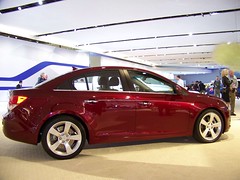
2010 Chevrolet Cruze exteriorLooking back across the GM area, I wondered what a previous generation Audi A4 was doing there. Another case of mistaken identity: the Chevrolet Cruze. In the metal, the Cruze looks great– at least when it’s fitted with 19-inch five-spoke alloy rims. Inside, the instrument panel in the Cruze is trimmed in a woven fabric. This might not be to everyone’s taste, but it’s a huge step up from most compact car interiors.

2010 Ford Taurus exteriorFord has thoroughly revised the Taurus. The new car looks much more upscale, inside and out. Though the new grille is a bit too Subaru nondescript, the rear fenders have strong Bentley overtones. Viewed from the side the car has more presence than a Taurus has any right to.

2010 Ford Taurus door panelThe interior of the 2010 Ford Taurus is not far off the related Lincoln MKS’, but not up to the level of the Buick LaCrosse. The panel fits aren’t as tight or as precise, and the materials seem a bit cheaper. I was surprised to hear that features such as adaptive cruise control and massaging seats– usually only available on expensive luxury cars– will be available on the Taurus. On the downside, the interior is much less roomy than that of the current Taurus. Inside, it does not feel like a full-size car.

Chrysler 200C EVI skipped the Chrysler presentation, figuring the company had nothing in the pipeline. I later learned they’d shown a possible next-generation 300, billed as the 200C EV with an alt fuel powertrain. This concept’s much more curvy than the current 300; a huge advance over recent Chrysler efforts like the Sebring. But is there enough trunk space inside the sportily bobbed tail?

That’s it for today. More tomorrow.

By on January 9, 2009

“Hi Mr. Baruth. First, I would like to thank you for the opportunity to assist you and please feel free to email or call me at the number provided if you have any other questions you need answered. I have a vehicle with a MSRP of $29,995. I can sell you that for $29,482.” Interesting. In the middle of the American automotive market’s worst implosion in living memory, what car could possibly be so valuable, so desired, so smoking hot that the maximum negotiating room possible would amount to an ungenerous five hundred and thirteen dollars off sticker? Give up? It’s a Pontiac G8. A 2008-model Pontiac G8. 

My first exposure to Pontiac’s Holden-by-any-other-name came at the San Diego press launch last summer, and I was so smitten that I permitted myself to be videotaped by the General’s PR flacks gushing incoherently about how the G8 “challenges the BMW 5er on home ground and carries away a win on value” or something equally inane. I also made a call from the hotel that evening to my younger brother, a multiple-Mazda owner and SCCA National Solo trophy recipient, suggesting that he investigate the possibility of buying one himself. I knew he’d been interested in the G8 from the moment the first photos appeared but had been waiting to hear the full scoop on the faux-Pontiac’s over-the-road capabilities. 

“Go ahead and buy one,” was my advice, “and the V6, if you’re so inclined, is almost as good as the V8.” That’s true, by the way: it would be perfectly possible for a so-called “performance buyer” to enjoy driving the plain-Jane G8. During my evaluation of the V6 model in the curvy canyons south of San Diego, I utterly humiliated a group of hardcore Ducati-mounted sportbikers in such egregious fashion that I received a written reprimand after the event from a GM corporate toad for “dangerous vehicle operation”. A good car, solidly executed. 

I flew home from San Diego full of hope that Pontiac finally had a car for which very few excuses need be made. Yes, the G8 had a few weak spots – flimsy interior pieces, unfortunate color choices, a visual distinction between the “standard” and GT models so miniscule that GM’s own flunkies repeatedly mis-identified the two during the press event – but it also had solid pretensions of automotive greatness. It was worth buying.

Ay, there’s the rub: buying the thing. In the six months that followed, my brother learned firsthand about the misery of dealing with Pontiac dealers. This is the same group of people, remember, who effectively held the first batches of 2004 GTOs hostage, demanding ten-grand markups and no-questions-asked deposits before finally panicking and selling the backlog of unwanted Goats for invoice minus holdback in enormous, humiliating newspaper ads which inadvertently slaughtered the car’s residual value. The attitudes of these domestic dealer ding-dongs, seemingly formed during the brief halcyon days where the Grand Am was GM’s best-selling automobile and served as the exclusive transport option of every stripper, Wal-Mart cashier, and three-hundred-pound, trailer-park-bound, human hippopotamus in the Midwest, could best be described as “aggressively unfriendly”.

My brother’s experience started with an attempt to “pre-order” the car. He was assured time and time again that the cars would be “impossible to get” and that only a sizable deposit would guarantee a spot in line. When the G8 began to pile up in dealer lots despite the predicted shortage, he was repeatedly denied a test drive despite being a respectable-looking thirty-year-old who wore Canali suits and appeared with his wife and young son in tow. After multiple incidents where dealership personnel made it plainly obvious to him that it would be doing him a favor to let him so much as sniff a G8, he gave up and bought another Mazda. I can’t blame him.

Still, hope springs eternal in the human breast, particularly when the human breast involved spent hours watching “Knight Rider” as a child and longingly watching the third-generation Trans Am “GTA” roll thunderously through the neighborhood. With nearly half the G8s ever produced still silently flat-spotting their tires in dealer lots, my brother thought he’d try one more. Again, he visited, called, emailed tirelessly, serenading his office with the sound of the various dealers’ on-hold music via his desk speakerphone, waiting for a low-options G8 GT at a reasonable price. The e-mail which opened this article represents the best offer he’s yet seen.  Mark my words: when the last Pontiac dealership in this country is either razed to the ground or ignominiously remodeled to sell Chinese crapwagons, it won’t take a Heinrich Schliemann to discover the story of why GM’s Excitement brand found itself stripped of its flaming chicken wings and buried in the cold, dead ground.

By on January 9, 2009

“The first real casualty of the current recession may well be the middle-priced automobile. For years it not only provided transportation for the middle class but was a firm steppingstone on the stratified pyramid of personal material progress.” That’s from Time magazine, 1958. A different recession, in a different era. But there can be value in gazing back. That’s how we’re supposed to learn, right? To keep from doing the same stupid things over and over? Or maybe you’re more in the Conway Twitty camp. His message from the same year: It’s Only Make Believe.

Reading some of the coverage of the recession 50 years ago is eerie. You’ve got to keep checking the date of the article to make sure you didn’t accidentally pick up (or click on) something from last Tuesday. Car sales fell 31 percent, unemployment in Detroit hit 20 percent. Lots of people said “worst since the Great Depression.” As with our current recession, prices didn’t fall across the board. Wholesale prices actually rose 1.6 percent. The Democrats made huge gains in Washington.

The differences surface as you drill down. No housing bubble; this one started as commodity prices dropped off. Hedge funds didn’t tumble like Sputniks. Credit did not get tighter than Annette Funicello’s sweaters. When it comes to the automotive industry,  the story’s as fresh as ever.  The Time article continues:

“[Sales of mid-range cars] are down 51% from the same period last year, far more than other sections of the industry. Production of Oldsmobile has dropped 44%; Buick, which was once in third place, 40%; De Soto 77%; Mercury 64%; Pontiac 31%; Dodge 70%. Ford’s middle-priced Edsel, brought onto the market last year, is a flop.”

The names have changed, but not to protect the innocent. In the first recession following the post WWII boom, half of America’s middle class ducked a new car purchases. De Soto took it hard. Dodge wouldn’t have made it through if hadn’t been part of Chrysler. The axe hung over Olds for another 40 years.

Economics isn’t the whole story.

In 1958, Detroit suffered a design gap. Tastes switched quickly. Suddenly, Motown wasn’t making what the bulk of American’s wanted. (Sound familiar?) As the economy grew from 1945 to 1955, American cars grew as well. Your basic Chevy lengthened by two feet in ten years. Ford grew four feet.

In terms of scale, amenities and prices, entry-level cars moved up, in many cases surpassing what would once have been considered the near luxury or luxury class. The process left nothing beneath. In 1958’s recession, the choice wasn’t between a small Plymouth or Chevrolet. It was between holding on to your current car or taking the bus. This pattern repeats itself for the next 50 years, tracing every boom/bust cycle until it seems inevitable.

As inevitable as the invasion of foreign cars. While nascent after the War, overseas marques were steadily attracting fans. The foreign car market-– British and German, mostly– rose 110 percent, as the market for Detroit iron fell. The European brands were smaller, more fuel-efficient and, people were learning, still fun to drive. The massive increase percentage-wise meant fewer than a quarter-million cars, but another part of the pattern formed. People sampled Volkswagens and MGs and didn’t go back to Impalas and Imperials.

Albert E. Birt, president of Manhattan’s Hambro Automotive Corp., sold 24k British cars in the US in 1957. In 1958, Birt said “The imported-car market might increase to 300,000, but I can’t believe it will go beyond that.” Detroit believed imports carried the threat of hula hoops.

Nor did Motown believe in America’s sustained desire for small, economical cars. The late 50s were a blip. In terms of labor, design, marketing and advertising, small cars were not going be all that much cheaper than full size cars. So why bother?

In the end, American automakers were half right. The pendulum swung in the early 60s. For another decade it was all about size and power. Funny thing about pendulums, though. They keep swinging. GM, Ford and Chrysler weren’t ready for the tune to change in 1972. They weren’t ready for it now. In every downturn, imports make gains. And hold them.

The 1958 recession ended quickly. The lesson– to hedge, to put your eggs in like three or four baskets– was never learned.

“Since its beginning,” Time reported in ‘58, “the U.S. auto industry has narrowed from more than 2,000 different automobiles to 17 makes turned out by five major companies that produce 96% of all cars sold in the U.S. In the future, many of the overlapping models produced by the big five may also disappear.”

Remember the big five? Yeah, next time around no one will remember the big three either.  Or, as Connie Francis put it, Who’s Sorry Now?

By on January 6, 2009

When I went car shopping in the early ‘90s, my priorities were fun-to-drive, reliability, and economy. Style— not so much, or so I thought. But the first time I saw a Saturn, I knew instantly what it was, although I’d never seen a photo, since the car was conspicuously absent from the ads. As soon as Consumer Reports gave Saturn a preliminary blessing for reliability, I gave it my consideration. Ultimately, I became so smitten that I didn’t bother to re-look at the Integra after I discovered to my great chagrin, in the dealer’s lot, that the turning circle was nearly as big as the namesake planet’s diameter.

Nonetheless, my Saturn, a ’93 SL2 5-speed, was a hoot to drive. Once a honking Nissan SUV tried to pace me on Cape Cod’s exceptionally scenic and winding Old County Road. He could catch me on the straights, but I lost him easily in the twisties. The Saturn steered precisely and cornered flat with virtually no understeer, aided by its low mass, less than 2500 lbs. Like the vorpal sword in Jabberwocky, the switchgear went snickersnack. The gas mileage: 35 on the road. Although a google search failed to find the quote, some reviewer, somewhere, I swear, had dubbed Saturn “the practical person’s sporty car.”

Yet, within a few years, when people asked me what I drove, I found myself apologizing for the bland… uh, brand. The first time I saw generation-2, I didn’t know whether I was looking at a Hyundai, a Tercel or an Olds. In the same way that peoples’ faces lose definition as the high cheekbones and clear jaw lines of youth disappear under the sagging skin of old age, so the Saturn’s appearance lost its sporty edge.

So did the driving dynamics. On my first drive, on a moderately hard turn which my Saturn would have taken with aplomb, the car leaned way over, and the rear let go.

What happened? My theory was that after the quasi-independent Saturn Corp. was yanked back into the Mother Company in 1994, there had been a turf war between Saturn on Pontiac over which would be the “sporty” division, a status Pontiac had claimed since the first GTO. The evidence: the ‘96 Pontiac Sunfire looked exactly like they’d taken the first gen Saturn, and tweaked the lights.

Dick Danjin, who did two stints as UAW rep in charge at Spring Hill, tells me the problem was far more general (no pun intended). In the vision of GM president Roger Smith, Saturn was to take over where NUMMI left off, teaching old, sclerotic GM all the new Japanese tricks. Collaboration rather than conflict would characterize labor-management relations. This meant, among other things, that the cars would come off of the line properly assembled (a.k.a. “first time quality”) instead of post-assembly fixes, as was the norm on Big 3 assembly lines.

According to “Comeback: The Fall & Rise of the American Automobile Industry,” GM’s $3.5b Saturn investment made it the object of jealousy among the other divisions. Indeed, the autocratic Smith had practically forced Saturn down GM’s intake manifold. With Smith’s departure in 1990, soon after launch, Saturn lost its patron.

But even during pre-launch, Smith couldn’t keep the bean counters from nickel and diming Saturn. Even after suppliers had been vetted and given contracts, accounting would enlist new ones in their quest to shave pennies per car, and quality would suffer, says Danjin.

Saturn was launched before it was ready, says Danjin, who adds that he and his original corporate counterpart, Jay Wetzel, the vice president of engineering at Saturn, had protested vainly. Brake discs warped easily, and there was an oil use problem.

Soon after his second Saturn stint began in 1994, Danjin found that first time quality was a pathetic 38.7 percent, and 300 people were working in the post-assembly fix-it shop 20/7. The quest to achieve black ink through high production was forcing levels of overtime that corroded quality. Danjin says his letters to Saturn corporate Kahuna Skip LeFauve, with carbons to his UAW boss Steve Yokich and GM president Jack Smith (no relation to Roger) barely boosted first time quality to a lackluster 51 percent.

Bottom line: its status as corporate stepchild prevented Saturn from receiving sufficient financing to successfully launch a new car company. Once Saturn lost its quasi-independent status, it lost its way. The original Saturn sold a record 286k units in 1994, placing fifth in car sales that year. Twelve years later, five Saturn models, the Aura, Ion, and Sky automobiles, and the Outlook and Vue SUVs sold a combined total of just 240k units.

Hacks blamed the genesis of Saturn’s slide on letting the original style go stale, and lack of other models. But nearly 20 years on, the gen-1 styling still looks fresh. Had Saturn remained true to Roger Smith’s vision: an import fighter with steadily improving quality, technology, and driving dynamics, and had they kept the original’s great looks, I’d still be on Planet Six.

By on January 4, 2009

There are all sorts of end of the year automotive lists. The ten best this and the ten worst that. My favorite list is not a car gong per se. The Darwin Awards are given to those who improve the gene pool by removing themselves from it. As you might imagine, automobiles figure prominently in this roll call of death by stupidity. To wit: Ivece Plattner of Italy. Plattner was driving a Porsche Cayenne (which is already a bit of a red flag), stuck in traffic on a railroad crossing, waiting for the light to turn green. When the crossing barriers came down, they trapped the Cayenne.

Onlookers said he didn’t realize he was stuck until the train was approaching. In desperation he opened the door and jumped out of the car. Instead of getting out of Dodge, Plattner started running up the tracks, in the train’s path, waving his arms and screaming. The engineer hit the brakes, but inertia and momentum working the way they do, the train hit the Porschephile and threw him about 100 ft. Plattner was survived by his Porsche Cayenne, which he loved more than life itself.

In a story from the Talmud (tractate Shabbat 31a), a potential convert approached the great rabbi Hillel and asked him to sum up the Torah “on one foot.” Hillel replied “what’s distasteful to you don’t do to your neighbor, that’s the entire Torah, the rest is commentary, go and learn.” Too bad a couple of ranch hands on a lonely country road hadn’t learned that lesson…

The telephone company had been burying lines. To allow traffic to pass, they dug up half the road at a time and put up warning barriers with flashing lights to direct traffic to the safe side. After they laid the cable half way, they’d fill in that side and then do the same on the other side. Pranksters had moved the flashing lights to the good side of the road.

Speeding late at night and way over the legal blood alcohol limit, the ranch hands drove straight into the hole and died. Because of the moved lights the Sheriff’s accident analysis turned into a criminal matter. Crime scene analysis of tire tracks and footprints on the dirt road revealed that the pranksters were the ranch hands themselves, on their way to the bar. 

I don’t think that rabbi Hillel would have put it this way, but payback’s a bitch. The next automotive Darwin award also involves a pickup truck, this time pressed into service as a winch.

It seems that someone had cut down a fairly large tree at the base of an embankment. For some reason, instead of just tying a cable to the tree and his hitch and pulling the tree up the slope he decided to use his rear axle as a winch. He jacked up the truck and replaced one tire with a bare rim he had in the bed hoping to wind the cable on the rim as it spun. He went over to the cab and had one foot on the gas and another on the ground, with the door open, so he could observe his handy work. He put it into gear, hit the gas and the truck lurched back, swinging the door on him and trapping him as the truck went down the embankment.

[From an automotive standpoint, this Darwin may be the most interesting. The Darwin Awards are based on submissions and votes at their web site and there’s a forum where people can discuss the different stories. This one generated a long and interesting thread on differentials, friction and torque.]

The final automotive Darwin Award for 2008 involves a dangerous combination: young males with a SUV, a shopping cart and a passionate desire to do something they saw on an internet video.

Cameron Bieberle, an 18-year-old Winter Park, Florida man decided to take a ride in a shopping cart, hanging on to his friend’s SUV as it drove through their apartment complex parking lot. While speed bumps are but a nuisance to a SUV, shopping cart suspensions have a bit less wheel travel. Bieberle was bounced from the cart and landed on the pavement headfirst. DOA.

With car sales so deep in the toilet that Toyota and Honda are both losing money, while the domestics live hand-to-mouth on government subsidy, it’s nice to know that there are still worse ways to mess up with cars than running a car company. As they used to say on Hill Street Blues, be careful out there. Or, the gene pool you save may be your own.

Recent Comments

  • Lou_BC: @Carlson Fan – My ’68 has 2.75:1 rear end. It buries the speedo needle. It came stock with the...
  • theflyersfan: Inside the Chicago Loop and up Lakeshore Drive rivals any great city in the world. The beauty of the...
  • A Scientist: When I was a teenager in the mid 90’s you could have one of these rolling s-boxes for a case of...
  • Mike Beranek: You should expand your knowledge base, clearly it’s insufficient. The race isn’t in...
  • Mike Beranek: ^^THIS^^ Chicago is FOX’s whipping boy because it makes Illinois a progressive bastion in the...

New Car Research

Get a Free Dealer Quote

Who We Are

  • Adam Tonge
  • Bozi Tatarevic
  • Corey Lewis
  • Jo Borras
  • Mark Baruth
  • Ronnie Schreiber
