Find Editorials by Category:
By
Steve Lynch on October 16, 2014

It ceased being fun working at American Honda around the summer of 1993. Most of our senior managers in the sales division had recently been fired. In May, the New York Times published the first story about our executives soliciting bribes from dealers. The Justice Department was snooping around our US headquarters in Torrance, CA. The year before, our geniuses in Japan had dropped the ground-breaking CRX two-seater and stuck us with the dull del Sol. Over at Acura, our Honda Division castoffs were busy trying to figure out why the tepid 5-cylinder Vigor was not selling.
We were still stuck in the Civic-Accord-Prelude-del Sol mode. “We will never build trucks,” our execs had often proudly proclaimed. Now we found ourselves caught flat-footed as we followed the success of the Ford Explorer, Nissan Pathfinder and Toyota 4Runner SUVs. We needed a sport-ute yesterday, and it would take us a minimum of four years to develop one. We did what any self-respecting, high quality, loved-by-its-customers car company would do in this situation.
We called Isuzu. Read More >
By
Murilee Martin on October 16, 2014
 The tales of the many flavors of rebadged Chrysler Europe and Mitsubishi products sold as Plymouths and Dodges remain perennially fascinating for me, what with all the Chryslerized Simcas and Hillmans and so forth, and one example of this breed that appears to have disappeared from the face of the earth is the Plymouth Champ. The Champ was a fourth-generation Mitsubishi Mirage, a gas-sipping front-driver that received Colt nameplates for the Dodge side of the showroom floor, and I found one a few days ago at a Denver-area self-service yard. Read More >
By
Jack Baruth on October 15, 2014

Welcome to our new feature, Ask Jack! I’ll be answering your questions on pretty much any topic that has a vague relationship to cars. Send me your questions and make sure you let us know if you want to be identified!
Our very first question comes from a fellow who wants to know what he should do about lease mileage on his Camry. As fate would have it, I was a Red Carpet Leasing Professional(tm) in another life and I am ready to help!
Read More >
By
Murilee Martin on October 15, 2014
 This being Colorado, I see quite a few Volkswagen Vanagons on the street and in local wrecking yards. Mostly I ignore them for this series, because their local popularity means examples that show up at a Denver self-service yard get stripped immediately and aren’t very interesting photographic subjects. So far, we’ve seen just this exquisitely stereotype-reinforcing Steal Your Face Edition ’83, and that’s it prior to today’s find. An ordinary Vanagon with most of the parts gone, I’m not shooting it. A Vanagon Syncro (which I believe to be the most unwise money-pit available on four wheels or a Westfalia Camper, on the other hand, I’m always willing to photograph those rare birds. Here’s a squalid ’81 Westy that I found at a Denver yard last week. Read More >
By
Sajeev Mehta on October 15, 2014

Gregg writes:
Sajeev,
I have a 2006 Tacoma with 50K miles and anti-lock brakes. I feel it is time to change the brake fluid as a preventative maintenance measure. I have the tools and have bled numerous non-antilock brake systems and have done some research into what it would take to fully refresh the fluid. Some forum people suggest the usual bleeding procedure followed by causing the antilock feature to react by stopping quickly on a dirt road or similar circumstances and then re-bleeding the system. Also mentioned is using a code reader to actuate the antilock system. Read More >
By
Ronnie Schreiber on October 14, 2014
Click on the settings icon in the menu bar to select 2D or your choice of stereo 3D formats
Last year in a post about Ypsilanti’s Orphan Car Show I had noticed that some of the 1960s vintage Citroens still had access holes so that, if needed, the cars could be started with a hand crank. I asked our readers what the last model car was sold with a hand crank and the immediate answer was “Lada”. As if to prove a point, at this year’s OCS, parked just outside the show entrance was a fairly late model Lada Niva in great shape, with a hand crank inserted through holes in the bumper and front fascia. There is a Niva that is in the show just about every year but that one’s about in the condition you’d expect from an Eastern Bloc 4X4 based on Fiat mechanicals subsequently exposed to Canadian winters and North American road salt. Except for the CHMSL that appeared to have come loose from its moorings, the blue Niva looks like it could almost be part of a Lada CPO program (to our Russian readers, does Lada have a CPO program in their home market). Read More >
By
Ronnie Schreiber on October 13, 2014

Over at Bloomberg View, Megan McArdle, in a post titled “Employees Are Not Your Customers” happens to use one of the more enduring myths of automotive history to prove her point. That myth is that Henry Ford started paying his famous $5 a day wage in 1914 so his employees could afford to buy Model Ts. She was using the story as an example to make a specific point so Ms. McArdle doesn’t tell her readers the real reason why Henry started paying a more livable wage. That gives us an excuse to learn some history. Read More >
By
Sajeev Mehta on October 13, 2014

I was wrong about the 2015 Camry: it’s a handsome family sedan. But not for us, for the Russians. Read More >
By
Sajeev Mehta on October 13, 2014

TTAC regular psarhjinian writes:
I just bought a E46 3-Series that needs some care (hey, it was cheap!) and snapped off both bolts holding the alternator to (I think) the oil filter housing. I’ve gotten the alernator off, but the last inch-or-so of the threaded section of one bolt is broken off. Thank you, BMW for using steel bolts in an aluminum block. Read More >
By
Ronnie Schreiber on October 12, 2014
Sorry for missing an important automotive anniversary, but ’tis the season for those of the Mosaic persuasion. On October 1, 1908, at least according to some sources*, the first production Model T was assembled at the Ford Piquette Avenue factory, Henry Ford’s second plant for his third, finally successful, automobile company. There are lots of myths about Henry Ford. Some of them are actually true, but many are the stuff of legend. For example, people think that the Model T made Henry Ford a wealthy man. Henry was a very wealthy man before he started making the Model T. He was one of the leading automobile producers in the world and he was the leading automaker in Detroit. Ford Motor Company was a success almost from the outset and when Henry hit on the idea of a simple, inexpensive car that folks who weren’t affluent could afford with the Model N and then the Model S, the Model T’s immediate precursors, he was selling thousands of cars a year. Read More >
By
Jack Baruth on October 12, 2014

“Well, I’m glad we got off-track without anything terrible happening,” I sighed, with no small amount of relief. “You did a good job of controlling the situation. A lot of people really panic when their brakes go away at ninety-five miles per hour or so. If the pedal comes back up you can probably nurse it home, as long as you’re careful. How far do you have to go?”
“Well, I live in New York,” he replied, “but if you’re okay with trying another session, I sure am.”
Oh.
Read More >
By
Murilee Martin on October 10, 2014
 I’ve just driven a couple of modern electric cars, the Mitsubishi i-MiEV and the Tesla Model S, and they’re real cars. Actually, the i-MiEV is a perfectly serviceable short-distance commuter and the Model S is the best street car I’ve ever driven, but I was ready to hate both of them a lot, because all my previous experience with EVs had involved growing up in the San Francisco Bay Area in the 1970s and hearing a lot of eat-yer-vegetables talk from earnest green types about how electric cars are good for you, when in fact those cars sucked stringwart-covered pangolin nodules. Then, of course, there are all the flake-O electric conversions from the 1980-2000 era that I’ve seen, a fair number of which appear in self-service wrecking yards as long-abandoned EV conversions are towed out of back yards and driveways. In this series, we’ve seen this EVolve Electrics 1995 Geo Metro and this 1988 Chevrolet Sprint Electric Sport, and there have been others too stripped to be worth photographing. Today we’re going to look at a California-based Ford Ranger that still has just about all its electric running gear. Read More >
By
Matt Gasnier on October 9, 2014
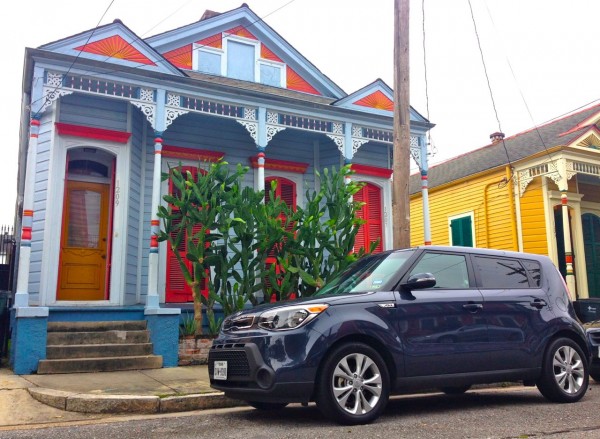 The Hero in Town: the Kia Soul
You can follow all US Coast to Coast Reports here
We have arrived in New Orleans, Louisiana, also called NOLA or, more affectionately, The Big Easy. A very different experience than all other American cities I crossed so far, especially given the fact I was there on a Friday night… Bourbon Street with all its performers, singers, live music, good vibes, cheap (so cheap!) alcohol and deliciously spicy jambalaya is an experience I had not thought possible in the US and one I don’t think I will see again in this trip. Of course, NOLA has its own very particular vehicle landscape, slightly different from Louisiana – as is often the case for big cities compared to the rest of the State they are located in. The Top 5 ranking and full landscape description/photo report is below.
Read More >
By
Sajeev Mehta on October 9, 2014

Justin writes:
Sajeev,
First I wanted to let you know that nearly everyday on my lunch break I check TTAC and each time I see a Piston Slap article I always make sure to read through it. I admire your knowledge and have learned quite a bit from your articles. I guess that I have a two part question.
The first part being since when has it become “acceptable” that a modern (low mileage) engine can consume a quart of oil in less than 5K miles. Audi and VW jump the front on my mind with their 2.0T mills, but I hear more and more through the woodwork about engines drinking oil. The second part of my question probably has more to do with correlation than causation but it seems like direct injection plays a role in this IMO unacceptable oil consumption.
Thanks!
Read More >
By
Murilee Martin on October 8, 2014
 When the Mazda Familia first came to North America, it had rear-wheel-drive, its chassis was very similar to that of an RX-7, and it was called the GLC, for “great little car.” By 1981, the GLC had switched to front-wheel-drive, and later in the decade it became known as the 323. In this series, we’ve seen this ’80 hatch, this ultra-rare ’81 sedan, this ’83 sedan, this ’84 hatchback, and now today’s interestingly decorated ’84. We’ve also seen what’s probably the most original GLC in the country, courtesy of Mazda HQ in California. Read More >
Receive updates on the best of TheTruthAboutCars.com
Who We Are
- Adam Tonge
- Bozi Tatarevic
- Corey Lewis
- Jo Borras
- Mark Baruth
- Ronnie Schreiber





Recent Comments