


 California accounts for a huge chunk of America’s new car sales (at least for the transplants). And 13 other states (Arizona, Connecticut, Maine, Maryland, Massachusetts, New Jersey, New Mexico, New York, Oregon, Pennsylvania, Rhode Island, Vermont and Washington) follow its vehicular emissions laws. Put them together and they account for just under half of all American new vehicle sales. And now, thanks to President Obama’s decision to grant California a waiver from federal emissions regulations, they’re going to call the shots for the entire U.S. automotive industry.
President Obama will free California impose its own vehicular tailpipe regulations. Those rules, already drafted, consider CO2 a pollutant. (Global warming and all that.) Manufacturers wishing to sell vehicles in California and its legislative clones will have to meet a new, fleet-wide CO2 standard. As CO2 emissions are directly related to fuel economy, CA et. al. will be, effectively, directing the carmakers to sell higher mileage vehicles. Significantly higher.
“The California law, which was originally meant to take effect in the 2009 model year, requires automakers to cut emissions by nearly a third by 2016, four years ahead of the federal timetable,” The New York Times reports. “The result would be an increase in fuel efficiency in the American car and light truck fleet to roughly 35 miles per gallon from the current average of 27.”
There are two schools of thought on the effects of this move. First, not only can Detroit and the rest of them meet the higher standards, but it’s about fucking time.
“This is a complete reversal of President Bush’s policy of censoring or ignoring global warming science,” Daniel J. Weiss, director of climate strategy at the Center for American Progress in Washington, told the Gray Lady. “With the fuel economy measures and clean energy investments in the recovery package, President Obama has done more in one week to reduce oil dependence and global warming than George Bush did in eight years.”
For environmental activists, the idea that automakers can meet the new California standard is a given. Another shibboleth: carmakers would have already done so if not for their greedy, SUV-pimping, foot-dragging ways. The fact that $4 a gallon gas did more for the environmentalist’s cause than decades of federal corporate average fuel economy (CAFE) standards is shoved aside. As is the fact that the electorate voted with their wallets.
There’s a planet to be saved; free markets be damned. From this perspective, the federal waiver is a victory for Mother Earth that will be fully vindicated by its non-impact on the auto industry and its immeasurable impact on the earth’s climate. One way and the other, decades hence, people will wonder what all the fuss was about.
Alternatively, the decision to empower California to set national fuel economy standards will, as the automakers have warned, wreak havoc on a fragile industry, drive-up prices for consumers and, ultimately, fail.
There’s no way automakers selling cars in America can meet the California mob’s higher, fleet-wide fuel economy standards within the deadline without chopping low-mileage models from their lineup within the relevant states. (The fuel-sucking CUV halfway house, for example, just became an evolutionary dead end.) Detroit News columnist Daniel Howes described the CA mandate as the involuntary hybridization of the nation’s fleet. That sounds about right to me.
Whether manufacturers would offer low[er] mileage vehicles for sale outside of the 14-states is a tricky question, given the intersection of politics, PR and commercial reality. Whether those non-CA-friendly vehicles could be “imported” into the 14-state cabal is even trickier. And speaking of tricky…
As The NYT points out, the new laws mean “automobile manufacturers will quickly have to retool to begin producing and selling cars and trucks that get higher mileage than the national standard, and on a faster phase-in schedule.”
Has anyone looked at the U.S. new car market recently? Who’s got money for that shit? And who’s going to pay cash money to buy these newfangled fuel misers? What if these wonderful machines don’t sell?
All of which highlights the small matter of what “we” (i.e. taxpayers) are going to do about GM and Chrysler, currently (and for the foreseeable future) sucking on Uncle Sam’s teat.
While the Department of Energy is preparing to dole out dole worth $25b for retooling “loans” to build these more left-coast compliant vehicles, this turn of events suggests that Uncle Sam will be on the hook for even more more money for GM and ChryCo. Hey, you want us to build way cool fuel efficient vehicles? You gotta pay. I mean, loan.
I understand the rationale behind California’s zeal and President Obama’s support. But there’s no doubt that they’ve just invoked the law of unintended consequences. Thought politically toxic, a gas tax hike would have been a far more effective solution. As we shall soon see.


 1. How can Fisker manage to offer a stylish, luxurious, large (124.4-inch wheelbase, 196.3-inch length, 78.1-inch width) four-door car with a powerful hybrid powertrain (260 horsepower turbo four plus a pair of electric motors good for 400 horsepower) and monstrous 22-inch tires for conventional S-Class money? (Base price: $87,900)

 Well, the first day at the 2009 North American International Auto Show wasn’t such a bust in the end. I began the day by attending the Intro and North American Car of the Year Awards. During the intro talk the Detroit show sought to demonstrate that it was still relevant by trotting out senior executives from the auto companies that didn’t opt to skip this year’s show. Among the execs from GM, Ford, Toyota, Honda, VW, and so forth was… Henrik Fisker. “Which one of these is not like the others…” started running through my head. Pretty good for a guy who reskinned SL’s and 8’s until he figured out it was better to ride the green gravy train. But that’s the way Detroit rolls these days.
 Some of the new GM cars were surprisingly impressive. The interior of the 2010 Equinox compact SUV is the best interior in a Chevrolet so far. It’s much nicer than that in a Toyota RAV4, and I’d also place it ahead of the Honda CR-V. Seat comfort is also excellent, front and rear. Why aren’t the seats in the larger Lambda crossovers nearly this good?
 I actually found the firmer seats in the Cadillac SRX less comfortable than those in the Chevrolet. There’s also less rear seat and cargo room in the SRX. Overall, while the Cadillac’s interior is nicer than the Chevrolet’s, it will also be much more expensive. I expect the Cadillac will have a much harder time achieving its sales targets.
 The new Buick LaCrosse is a mixed bag. The exterior doesn’t quite work for me. The “sweep spear” comes up too high on the overly tall front fender. As a result, your eye is pulled in one direction by the beltline (base of the windows) and in the other by the “sweep spear.” Beyond this, the proportions of the front fender are generally forced and awkward.
 On the other hand, the interior of the new LaCrosse is outstanding, the best yet from GM– better even than that in the Cadillac CTS. Real stitching on the instrument panel and door panels has been achieved at a Buick price by molding the stitching into the polymer panels. The panels aren’t actually upholstered as they are in newer Cadillacs, but they look upholstered. The center stack is nicely executed, with a definite upscale appearance. The curvy door panels are exceedingly well done. They combine a nicely padded armrest with a comfortable door pull, flowing organically into the instrument panel.
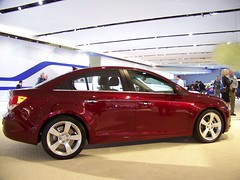 Looking back across the GM area, I wondered what a previous generation Audi A4 was doing there. Another case of mistaken identity: the Chevrolet Cruze. In the metal, the Cruze looks great– at least when it’s fitted with 19-inch five-spoke alloy rims. Inside, the instrument panel in the Cruze is trimmed in a woven fabric. This might not be to everyone’s taste, but it’s a huge step up from most compact car interiors.
 Ford has thoroughly revised the Taurus. The new car looks much more upscale, inside and out. Though the new grille is a bit too Subaru nondescript, the rear fenders have strong Bentley overtones. Viewed from the side the car has more presence than a Taurus has any right to.
 The interior of the 2010 Ford Taurus is not far off the related Lincoln MKS’, but not up to the level of the Buick LaCrosse. The panel fits aren’t as tight or as precise, and the materials seem a bit cheaper. I was surprised to hear that features such as adaptive cruise control and massaging seats– usually only available on expensive luxury cars– will be available on the Taurus. On the downside, the interior is much less roomy than that of the current Taurus. Inside, it does not feel like a full-size car.
 I skipped the Chrysler presentation, figuring the company had nothing in the pipeline. I later learned they’d shown a possible next-generation 300, billed as the 200C EV with an alt fuel powertrain. This concept’s much more curvy than the current 300; a huge advance over recent Chrysler efforts like the Sebring. But is there enough trunk space inside the sportily bobbed tail?



Recent Comments