

By on April 18, 2009

In November 2007, VeeDub head honcho Martin Winterkorn announced his version of the Schlieffen Plan. Dubbed “Strategie 2018,” Winterkorn plotted the overthrow of GM and Toyota from the top of the worldwide sales charts. Winterkorn called for VW to rule the world in sales, profits, innovation and customer satisfaction by 2018. When the plan was announced, the MSM feted it, insiders (this reporter included) rolled their eyes and denounced the announcement as the usual hubris of an incoming CEO, a suit who’d be busy collecting his pension by the time 2018 rolled around. In any case, by 2018, the Generalstabsplan would long be forgotten and superseded by at least five other grand strategies.

A month ago, the worker’s council at Volkswagen said that the plan has merit. “All at Volkswagen agree that the targets of Strategie 2018 haven’t changed and that we will reach them,” said workers council chief Bernd Osterloh. That story didn’t get much traction. The few who read it sighed. Through plain dumb luck and the incompetence of others, VW may be closer to “mission accomplished” than anybody dared to think.

It’s a done deal: VW will surpass GM in sales this year to become world number two, behind Toyota. Now, Reuters reports that “Volkswagen AG may have overtaken Toyota Motor Co to become the world’s top-selling carmaker in the first quarter, thanks to government incentives that fueled demand in VW’s major markets.”

VW’s overall deliveries to customers worldwide fell 11 percent to around 1.39m vehicles in Q1. Others fell faster and harder, enabling VW to increase its share of the global passenger car market by 130 basis points to 11.0 percent.

“Toyota has given no forecast for retail sales, but its latest estimate for shipments for the 2009 first quarter is 1.23m vehicles, down 47 percent from a year earlier,” Reuters says.

“Volkswagen has the luck of being strong in the markets that are currently growing, while Toyota is exposed to those that are collapsing,” says motor mouth Ferdinand Dudenhoeffer in a rare case of seeing the obvious. VW’s failure to get anywhere in the toxic US market is now its savior. Where you have no significant sales, you cannot have significant losses.

Volkswagen has a very strong position in the world’s only significant growth market, China. In the PRC, VW surpassed the 1m mark last year. It produced more cars in China than Germany. Toyota has seen sales fall every month of this year in China, its third-biggest market. Volkswagen is benefiting from government stimulus plans for the car industry that have boosted demand in Germany, China and Brazil, its three biggest markets that together accounted for half of all group sales in the first quarter.

While VW is lucky to be in the right place at the right time, Toyota definitely finds itself in the wrong places at the wrong time: Toyota’s first-quarter US sales fell 36 percent, while sales in Japan for the core Toyota brand plummeted 31 percent. The two markets account for just under half of its global sales.

Volkswagen China’s Winfried Vahland quickly positioned himself as the top general in Volkswagen’s audacious plan to subjugate Toyota. “We have launched Strategy 2018 in line with the long-term objectives of the Volkswagen Group in China,” Vahland said to China Daily. Note the “We have launched.” Vahland said he would increase annual vehicles sales in China from the current 1 to 2 million units as well as enlarging its fleet by least four models per year by 2018.

The former controller, Vahland, had an uneventful career at VW and his dispatch to Beijing as head of the Volkswagen Group in Beijing was widely seen as a promotion to Volkswagen’s Siberia. The real power centers of VW China are at SAIC in Shanghai and FAW in Changchun. Now, Vahland basks in the limelight of being the frontline general of Volkswagen’s attack on a weakened Japan.

In Germany, VW benefited from the Abwrackprämien boom. Deliveries rose 4.5 percent to about 251,500 vehicles during the quarter. More than 160,000 new orders were booked as owners turn in their clunkers for a new one and €2.5K from the government.

Even in cratering Russia VW grows. Despite a 39 percent contraction in overall Russian demand, Volkswagen grew its volume by 14 percent, making VW the fourth-largest manufacturer in the country.

NPR can’t believe their ears: “Come on? Volkswagen? The world’s top selling automaker? That sounds impossible. Last year, Toyota crushed VW, selling almost three million more cars and trucks. But in the first quarter, Volkswagen sold more vehicles than Toyota even estimates it shipped. Analyst John Wolkonowicz at IHS Global Insight calls it a fluke.”

The disturbing news of the arrival of the former axis member at the gates of Aichi, Nagoya, results in grave head-nodding in the land of the rising sun. “Volkswagen is a big competitor for Toyota,” said Koji Endo, auto analyst at Credit Suisse in Tokyo. “Audi is strong, Volkswagen is strong, and they’re making good use of their small cars.”

The stock market greeted the news by lifting VW’s tock price. VW has also moved up in stock value ranking, grabbing the No. 2 spot behind Toyota, whose market capitalization of $133b still outstrips the German carmaker’s $100b. For now.

By on March 27, 2009

Our president recently hit the late-night talk show scene, giving all a taste of the “Washington Bubble.” He’s not alone: Judging by the comments around the Interweb, every red-blooded American automotive journalist totally hearts the 2010 Taurus SHO. But does the journos’ wish for a reincarnated SHO jibe with the harsh reality of Ford’s market demographics? Or to paraphrase Norm MacDonald, “while the SHO may not prove anything, it certainly does nothing to disprove the theory that Volvo-based Fords are a waste of money.” Yeah, it takes brass balls to knock a car you’ve touched, but haven’t driven. But the circumstances around the all-new Taurus give me pause . . .

First off, how often to you hear about the regular Taurus? One key to the SHO model’s original success: The bread-and-butter version stood on its own for three years before the SHO’s arrival. But the average 2010 Taurus is almost old hat: We’ve seen this story unfold the past five years and nobody (with an open checkbook) cares one way or the other. Just like its 2005 counterpart, the latest version of the Taurus will be a respectable car. But this does nothing to disprove my theory that Volvo-based Fords are a waste of money.

Second, what makes lightning strike twice? Styling. Much of the first model’s interpretation of the Euro-Sierra worked. The 2010’s “kinetic” energy comes from the Mondeo. Only not so much. In pictures and in person, the Taurus fails to inspire. It’s no flying jellybean: There’s a Subaru-ish nose and a host of sheetmetal adaptations of the badass Ford Interceptor concept on the dorky hard points of the D3 chassis. Yet Peter Horbury, Ford’s North American design director, proclaims, “like the 1986 original, the new 2010 Taurus differentiates by combining style with substance.”

Too bad about that. There’s an obvious difference between a clean-sheet creation and a quickie conversion of a (failed) platform. Even worse, the 2010 Taurus redesign loses the previous model’s quarter window for black C-pillar trim, giving the illusion of a sleeker profile from a longer DLO (daylight opening). Which almost works—if you ignore the fat-assed beltline and tacky faux ventiports. No surprise, cash is tight and the basic badness of the D3 must remain intact.

The first two generations weighed around 3,300 lbs.; the engine put out torque-steer-free 220 hp; and there was a readily available manual transmission. The Taurus SHO was stupid fun in any dynamic event. Plus, the previous 100 percent American chassis scored safety ratings on par with Volvo sedans of the time.

The latest SHO is the Fat Elvis of sport sedans. The engine stumps up 365 hp, there’s mandatory all-wheel drive and automatic transmission, and a curb weight around 4,300 lbs. (300 lbs. over the Pontiac G8). The safety is stellar (because it is a Volvo). Given the feature creep of the Ford Flex, the SHO could sticker north of $35 large. With options, maybe over $40 grand. How great is that? I’ve voiced these concerns to pistonheads around the web and one answer comes back: Nobody pays sticker for a Ford, just wait for the discounts. So maybe this is a Taurus after all.

And if taking the Ford Taurus up to a dee-luxe apartment in the sky was bad enough, Ford didn’t learn from others’ mistakes. The Toyota Cressida/Avalon and Nissan Maxima prove that unique platforms for poser luxury sedans are out of the question. Mulally loves the Taurus, but he forgot its intrinsic appeal. The four-door was the go-getter working late nights in a cubicle, not an endowed trust-fund baby overdressed in a tuxedo at a garden party.

Not to mention the critics were proved right when calling out Ford’s decision to split the original Taurus’s market with two nameplates on two foreign chassis. It was a colossal falure in 2005. And 2008.

Come 2010, it will be three strikes against Ford’s great experiment. And even with the SHO’s halo, the market for Volvo-Fords over $30K is not promising. Which spells doom for the company spending millions (billions?) supporting a unique platform that’s yet to justify its existence to a fully leveraged Blue Oval. And with Volvo on the chopping block, what exactly does Ford expect to gain from billions of dollars in sunk cost?

If this “cut and run” attitude sounds unpatriotic, consider what Dearborn’s finest could’ve done with the money spent on the Taurus’s three generations of continuous improvements. With Mulally’s blessings, the Blue Oval Boyz could have used the money to make a Camry-killing sedan by now. But the saving grace now belongs to the Ford Fusion and its Hybrid halo. The writing is on the wall: Nobody gets a free ride. If the 2010 Taurus fails to SHO up with some cheddar, this dead weight has gotta go.

By on March 5, 2009

Was Aston Martin’s expansion into lower reaches of the luxury automotive food chain a good idea? The development of the AM V8 Vantage was at best a dangerous move. Why risk devaluing a storied brand? Looking at top line figures, it seems as if Aston’s “entry level” model is a solid success. Aston Martin’s sales have increased to levels the company hasn’t experienced since . . . ever. Thanks in part to the AM V8, Aston Martin turned a profit in the two years prior to its removal from the FoMoCo family. But looking one level deeper, the British automotive brand’s move down market triggered several less-than-savory consequences. They may be returning to bespoke, fragrant leather coops, but the prodigal chickens are back, and they’re bad.

When a luxury brand faces introduces a substantially cheaper offering, it “pulls forward” potential sales. Aston’s cheaper alternative to a previously ultra-exclusive automotive product gave people who very much wanted to buy into the brand a chance to do it a lot sooner. This sounds exciting to the marketing folks, both in terms of total revenue generated and brand prominence. But the fact that AM intenders were fulfilling their yearning for a luxury product at a much lower price got lost in the buzz.

In other words, in a related, unintended, but hardly unpredictable consequence of lowering the barrier to entry, Aston’s V8 sales reduced the pool of potential customers. Did the AM V8 attract buyers who would otherwise never have thought of an AM? Unlikely. But by putting more people into a cheaper AM, the company ran the very real risk of those customers failing to upgrade to a more expensive model later on. The chances are high that the Vantage V8 fully scratched their owners’ AM itch. Oops.

You can see the same thing happening over at Porsche. Although the Boxster/Cayman twins are cheaper, less powerful and less prestigious than the 911, they’re damn fine automobiles in their own right. If you really love your Boxster or Cayman, why not save yourself some money and stand pat? Which is exactly what has happened.

The 911 is a vastly more profitable car for Porsche. Hence Stuttgart fought nail and claw against this happy-Boxster owner dynamic. It took, what, 13 years before the Germans offered a limited slip differential in their mid-engined marvel? And yet, they caved anyway, offering the usual minor upgrades on their lower-priced model, giving Boxster/Cayman owners an excellent reason not to make the jump to hyper-price.

Note: the Boxster and Cayman did not cannibalize 911 sales directly. I highly doubt many Porsche owners traded down from a 911 to a Boxster. If you look just at the sales numbers, there was no initial negative effect from the Boxster. Armchair analysts tend to forget that Porsche was on the ropes when the Boxster was launched, and customer loyalty meant that 911 sales were relatively robust and stable. However, when the economy boomed in the ’90s and early 2000s, the 911 sales bump was way under expectations, exactly because of the Boxster.

Let’s have a look at Aston Martin’s numbers. [Click here for AM sales chart]

In 2006, the take-off of DB9 and Vanquish sales (seen in 2004 and 2005) reversed abruptly. When the V8 Vantage came to market, the 2005 levels of the high margin cars effectively halved. [I apologize for having only the European numbers in the graph, since I do not have access to global sales ones.]

It’s a familiar story. Jaguar XJ sales effectively halved with the arrival of the S-Type and never recovered. S-Type sales dropped by 40% with the introduction of the X-Type. Other premium brands have perhaps not experienced as pronounced an effect, simply because the much cheaper offering sold in much higher numbers (declines of 30-50 percent For the Bentley Arnage and Lamborghini Murcielago upon the arrivals of Conti GT/Flying Spur and Gallardo). Are these brands really better off for opening the gates wider?

For Aston, the answer seems pretty obvious. If nothing else, Aston residuals have started dropping rapidly. Most of this is due to the current economic crisis, but pre-AM V8 Vantage, the fall would not have been nearly so dramatic. When a seller gets rid of a two-year-old V8 Vantage for $60K, this drives down residuals for the DB9s and Vanquishes as well.

The new Aston Martin Rapide aims to add some luster to a brand tarnished by its own short-sighted model management. Oddly, both Porsche and Lamborghini are following the exact same trajectory at the same time. In all three cases, the brands are ignoring Ben Franklin’s sage advice: it takes many good deeds to build a good reputation, and only one bad one to lose it.

More than that, just as you can’t unring a bell, you can’t drag a brand back upmarket—at least not without waiting a long time for the dissonant echoes to fade.

By on February 25, 2009

Over the years TTAC has witnessed many skirmishes in the war between those who support car dealers (mostly car salespeople) and those who oppose car dealers (the rest of the known sentient universe).  It’s time to put this particular argument to rest. Car dealers suck. Here’s why: buyers never know what kind of deal they got.

It really is as simple as that. Sure, there’s anecdotal evidence up the wazoo about pushy, intimidating, lying, cheating, incompetent, scummy salespeople. But here’s a little secret: Mother Theresa could be the salesgal and Gautama Buddha could be the F&I guy for Allah’s Ford Lincoln Mercury dealership and I still wouldn’t trust that I got a good deal.

Between sticker price, invoice price, dealer add-ons, incentives, rebates, discounts, hold backs, various employee/college grad/military/loyalty/your mama cash backs, weekly/monthly/yearly manufacturer-to-dealer quota deals and the other probable dozen or so on-again, off-again programs of which I have no knowledge, trying to make a good deal with a car dealer is a bit like trying to make a good deal with the devil himself.

Even when I think I made out like a bandit there’s always that lingering smell of rotten eggs in the air. And if I think I got a good deal shouldn’t I just be happy? Aren’t dealers entitled to make a profit, too? Absolutely not. Given the choice between thinking I got a good deal and knowing I got a good deal, I’ll take the knowing each time.

Unfortunately, after hearing twenty different price quotes from half a dozen dealers, each one implying it was as good an offer as I could get (until the next one, evidently), the knowing is nigh impossible. And even if the dealer is absolutely, positively, completely, 100%, without-a-doubt losing their shirt on the deal, 1) I’m not going to believe it because over the last hour(s) of sales negotiations you’ve lowered your price more than once so I’m getting the sense that there’s wiggle room, and 2) my concern isn’t whether or not you lose money, but rather that I get a good deal.

Car dealers, are you getting the point here? I don’t care if you don’t make a single red cent. I don’t care if the new salesguy I’m working with hasn’t made his first sale yet or if you go out of business and can’t feed your kids because of that great deal I just got (okay, I actually do care about the kids, but not enough to buy rust-proofing). I want to know I didn’t get ripped of while buying my brand-spanking-new massively depreciating “asset.” That’s it.

And assuming for just one infinitesimally small moment I actually did care if you made a tidy profit, just why exactly would I trust you to determine for me what a fair share of my money in your pocket is? I don’t know what you paid for the car, what it costs you to keep the car on the lot, or what kind of money/bonus you’ll get from the manufacturer when you sell it to me.

I have zero knowledge of your financial situation—except for the fact that you want to maximize your profit on the car you are trying to sell me. Which is absolutely groovy and above board given this wonderful free market society we live in. But don’t expect me to like it when your profit comes from my (non-self imposed) ignorance.

Yes, ignorance. Despite the plethora of pricing information on vehicles available online, there’s absolutely no way for the buyer to be aware of what a car costs you, and thus, what a fair deal for you would be.

A quick aside: while we’re all busy celebrating and abiding by that wonderful capitalist free market system, let’s not look too far behind the curtain at all those laws you passed in your state legislature to make sure that you were the only way I could continue to get my fix on those shiny dollops of addiction we call new cars.

If I never know what kind of a deal I got then I don’t know if I can trust you and if I don’t know if I can trust you then I’m not going to feel comfortable in my dealings with you and if I’m not going to feel comfortable in my dealings with you you’re either going to have to learn to deal with all the negative backlash that’s thrown your way or find a better way to do business and I guarantee you the only thing longer and more painful than this run-on sentence is the truth of said same.

I’m tied to you for new car sales and warranty work and the only ones who want it that way are you. That sucks. You suck. I’m done. We’re done.

By on February 21, 2009

Public relations people say the darndest things. Shills for the car companies that chose to speak to the press at the 2009 Dallas Auto Show were no exception. The folks at Chevy are still “excited about the Camaro” a full three years after they excitedly announced the product. What impressive stamina they have. Buick intends to “shatter the myth that Buick only builds sedans for old people” Good luck with that. Chrysler Corp. claims twenty-four new cars and trucks are under development. “If taxpayers can support us, we’ll have some sweet products for you to test drive.” Goodie, maybe I’ll get to drive another redesigned Sebring. That’d be super sweet! But the biggest story coming from the show is what the PR refused to talk about.

“We’re here to talk about product,” the Dodge mouthpiece declared. “Any questions ’bout the company will be referred to Corporate.” This was a common theme. GM’s hackles shot up when a writer asked whether the new Lacrosse would be marketed in China, where the interior and electronics were designed and tested. “We can’t comment on what GM plans to do or not do in China,” the PR hack tersely said, cutting off the questioner. The phrase most oft uttered at the Ford, Buick, and Dodge press conferences: “We’re not prepared to comment on that.”

Other automakers simply didn’t even bother to speak to the press at all. This year’s itinerary of scheduled press conferences was only six manufacturers long and concluded by lunchtime. In recent years we have heard from Toyota, Cadillac, Nissan, Lexus, Hummer, Aston Martin, Saleen, Infiniti, Honda, and Subaru. All of these manufacturers were all present at the show (except Saleen); they just had nothing to say to the press corps.

Furthermore, the first two press conferences, Ferrari and Lamborghini, weren’t press conferences at all. The media assembled at the Ferrari display but there was no presentation so everyone dissipated. It wasn’t until later that I realized that one of the individuals gathered there was actually a soft spoken Ferrari rep. Ditto Lamborghini. Don’t the Italians have anything to tell the public about their cars, how their product is evolving, and all of the rest of the PR drivel that is communicated in a proper press conference?

But enough of all that. Here are the 2009 DAS winners and losers:

Winner: Buick Lacrosse. I’m not saying that this car will save Buick or GM or that it will even sell well. But The General certainly put his best spit-shined boot forward with this car. American styling built by Canadians on a new European developed platform with Chinese innards, this is truly an international car. The car bests Buick wannabes from Toyota and Lexus with dynamic styling and matches them with an outstanding interior. If this car drives half as well as it looks, it could be a contender. Buick claims to be in the midst of a “design renaissance.” That bit of hyperbole might actually be true.

Loser: Acura. Would somebody light that car a cigarette? The grille blighting every new Acura has the expression of Iron Man aglow in post-coital ecstasy—not something I want to see.

Winner: Ford Taurus SHO. Ford designer Earl Lucas shows that Americans can design a mature and subtle executive’s performance sedan. The car possesses the power and elegance of an NFL linebacker in a tuxedo. The D-sized sedan had the press mob drooling on the SHO’s exclusive Atlantic Green paint.

Loser: Chevrolet Camaro. The car is beautiful. The power is impressive. The price is right. The timing is awful. Look for the 2010 Camaro to makes its debut later this year. Its launch coincides with Transformers: Revenge of the Fallen, the sequel of the movie that it starred in two years ago (along side the lovely Megan Fox and the dopey Shia LaBeouf). The Camaro has been so prominent at auto shows and in GM advertising for so long that it’s already due for redesign.

I sat on the front row in the Buick press conference admiring the contemporary look of the 2010 Lacrosse. As I did so I realized that GM could not have produced a car of this caliber ten years ago. Neither could Ford. Life or death competition has forced these companies to break from many of the lazy and lardy practices of their past.

It might be too late for GM to right its ruptured and sinking ship, but the positive and constructive influence of free market pressure is in full display in their latest products. On the other hand, Chrysler remains distinctly unimproved. For every one thing they do right, they are doing five things wrong. This is about the same ratio of incompetence that they operated under two decades ago.  No amount of marketing spin masks that.

By on January 12, 2009

Auto execs NAIASWell, the first day at the 2009 North American International Auto Show wasn’t such a bust in the end. I began the day by attending the Intro and North American Car of the Year Awards. During the intro talk the Detroit show sought to demonstrate that it was still relevant by trotting out senior executives from the auto companies that didn’t opt to skip this year’s show. Among the execs from GM, Ford, Toyota, Honda, VW, and so forth was… Henrik Fisker. “Which one of these is not like the others…” started running through my head. Pretty good for a guy who reskinned SL’s and 8’s until he figured out it was better to ride the green gravy train. But that’s the way Detroit rolls these days.

Looking over the finalists from my place amidst a press release of journalists, I wondered what the G37 was doing amongst them. The Infiniti’s engine is new for 2009, but the rest of the car is entering its third model year. Well, it wasn’t the Infiniti. The car in question was a Hyundai Genesis, which won the award. Apparently, when you can only see the top half of the car the resemblance is rather strong.

I then attended the General Motors presentation. A couple years ago, when the then-new Cadillac CTS was introduced, I commented that it was nice to see the people involved in creating the car up on stage with it. Especially since I knew some of them. This year, GM kicked itup a notch. They brought in a crowd of 100+ employees to stand behind the seated press and engage in a pep rally. Holding signs that said things like “here to stay.” The foreign journalist besides me asked who the prostesters were.  

The presenting GM execs called for a cheer from said cheering section each time a car rolled up on stage– and they paraded about 15 of them. A couple of times the exec called for a louder response. A bit much.

2010 Chevrolet Equinox instrument panelSome of the new GM cars were surprisingly impressive. The interior of the 2010 Equinox compact SUV is the best interior in a Chevrolet so far. It’s much nicer than that in a Toyota RAV4, and I’d also place it ahead of the Honda CR-V. Seat comfort is also excellent, front and rear. Why aren’t the seats in the larger Lambda crossovers nearly this good?

2010 Chevrolet EquinoxI actually found the firmer seats in the Cadillac SRX less comfortable than those in the Chevrolet. There’s also less rear seat and cargo room in the SRX. Overall, while the Cadillac’s interior is nicer than the Chevrolet’s, it will also be much more expensive. I expect the Cadillac will have a much harder time achieving its sales targets.

2010 Buick LaCrosse exteriorThe new Buick LaCrosse is a mixed bag. The exterior doesn’t quite work for me. The “sweep spear” comes up too high on the overly tall front fender. As a result, your eye is pulled in one direction by the beltline (base of the windows) and in the other by the “sweep spear.” Beyond this, the proportions of the front fender are generally forced and awkward.

2010 Buick LaCrosse door panelOn the other hand, the interior of the new LaCrosse is outstanding, the best yet from GM– better even than that in the Cadillac CTS. Real stitching on the instrument panel and door panels has been achieved at a Buick price by molding the stitching into the polymer panels. The panels aren’t actually upholstered as they are in newer Cadillacs, but they look upholstered. The center stack is nicely executed, with a definite upscale appearance. The curvy door panels are exceedingly well done. They combine a nicely padded armrest with a comfortable door pull, flowing organically into the instrument panel.
Is an outstanding interior enough to get people under 70 to consider a Buick sedan? Probably not.

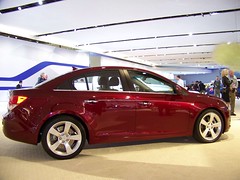
2010 Chevrolet Cruze exteriorLooking back across the GM area, I wondered what a previous generation Audi A4 was doing there. Another case of mistaken identity: the Chevrolet Cruze. In the metal, the Cruze looks great– at least when it’s fitted with 19-inch five-spoke alloy rims. Inside, the instrument panel in the Cruze is trimmed in a woven fabric. This might not be to everyone’s taste, but it’s a huge step up from most compact car interiors.

2010 Ford Taurus exteriorFord has thoroughly revised the Taurus. The new car looks much more upscale, inside and out. Though the new grille is a bit too Subaru nondescript, the rear fenders have strong Bentley overtones. Viewed from the side the car has more presence than a Taurus has any right to.

2010 Ford Taurus door panelThe interior of the 2010 Ford Taurus is not far off the related Lincoln MKS’, but not up to the level of the Buick LaCrosse. The panel fits aren’t as tight or as precise, and the materials seem a bit cheaper. I was surprised to hear that features such as adaptive cruise control and massaging seats– usually only available on expensive luxury cars– will be available on the Taurus. On the downside, the interior is much less roomy than that of the current Taurus. Inside, it does not feel like a full-size car.

Chrysler 200C EVI skipped the Chrysler presentation, figuring the company had nothing in the pipeline. I later learned they’d shown a possible next-generation 300, billed as the 200C EV with an alt fuel powertrain. This concept’s much more curvy than the current 300; a huge advance over recent Chrysler efforts like the Sebring. But is there enough trunk space inside the sportily bobbed tail?

That’s it for today. More tomorrow.

By on January 11, 2009

Not only does Richard Colliver admit that ’07’s sales were a bubble– a bubble that has permanently popped– but the executive vice president of Honda America says the bailout billions thrown at banks, aspiring banks and automakers hasn’t had any impact on the credit availability underpinning the U.S. new car market. Colliver also told Reuters that HoMoCo’s given up forecasting ’09 sales. “We’re not even forecasting because whatever we forecast, we would be wrong. If you look at the last 120 days, if that trend continues then we’re looking at a significant reduction (from 2008).” So Honda’s battening down the hatches, cutting inventory to 65 to 70 days of supply in the next three months (from the current 100 days). At the same time, Honda’s planning on boosting its leasing penetration from 23 percent to 27 percent of total U.S. sales. As for the impact of Motown’s meltdown on Honda…

Read More >

By on January 3, 2009

 Maranello, we have a problem. Ferrari sales are down – way down – and waiting lists are evaporating. It’s not difficult to lay the blame for the sales meltdown on the “global credit crisis.” But the Scuderia must shoulder a good portion of the blame. Demand for the F430, particularly the Spider, has virtually disappeared following the arrival of the Ferrari California retractable hardtop. As it turns out, most F430 buyers didn’t care so much about the F430’s mid-engined balance, peerless on-track performance or Schumacher-tested suspension. They were buying the F430 because it was the cheapest Ferrari. And now that there is a cheaper one, they’re buying that instead. What we have here, as Strother Martin might say, is failure to understand the customer. 

Behind the public façade of three-martini lunches and the endless drone of blabbermouthing focus-group research, automotive-industry marketing is a tough job. The marketing man (or woman) is caught between the Scylla of fickle customer demand and a Charybdis of stubborn engineers, stingy accountants and mercurial management. His product is rarely the best one available. He must increase sales by reaching out to new buyers without infuriating current customers.

Our intrepid marketroid may surmount all of these obstacles, triumph over the previous generation’s reliability record, obscure the unfortunate styling of the wagon variant, and convince the press to report favorably on cupholder count while neglecting to mention the fifty-dollar Korean original-equipment tires, only to see his baby stumble over the final, most critical hurdle: the omnipresent gap between perception and reality.

This is the black magic of the marketing biz, what Orwell called “doublethink,” the Nurburgring of metal-moving. Every brand, every model, every trim level is sold to two buyers: the imaginary buyer and the real one.

The impossibly beautiful and perfect forty-year-old woman who fairly bubbles out of her Christmas-morning negligee upon spotting a red-ribboned new Lexus SUV in her driveway; the square-jawed, Vacheron-Constantin-wearing man’s man who attentively pilots his Nine Eleven down a rainy autobahn; the quartet of twenty-something models without which no Jeep Wrangler would be complete-– imaginary buyers, all of them.

Next to them we find the ephemeral best selves presented on the Internet: the fellow who claims to dominate twenty trackdays a year in his Elise but in reality holds up the hind end of just a few Novice sessions; the people who have ten cars in their “sig” but neglect to mention that nine of them are in the actual possession of distant relatives; the woman who faithfully buys the same car her neighbors do while claiming safety, reliability, or economy as the reasons. 

Real buyers are far less interesting. They’re primarily concerned with the cheap shine of perceived prestige, the dimly understood terror of major mechanical difficulty, and the hard graft of discounted pricing.

Many marketers make the classical mistake of falling in love with their own creations. Who would have thought that a relatively unlovely, pudgy-hipped hardtop convertible would displace the disco volante F430 Spider? Only somebody who understands real Ferrari owners. 

It’s a mistake made by manufacturers far less romantically inclined than the Scuderia. Stung by criticism of the tepid first-generation “Quaalude,” Honda slaved to make each successive Prelude faster, more involving and more perfectly attuned to the sensibilities of its enthusiasts– only to see the model’s sales slaughtered by the Accord Coupe. The imaginary Prelude buyer was a corner-carver; the real Prelude buyer wanted a two-door Honda with a trunk.

Cadillac, as a brand, is almost indelibly associated with the V-8 engine. But once the 3.6 direct-injection mill arrived in the STS, the Northstar version of the same car became showroom poison. Real Caddy buyers are more than happy to cut the cylinder count and save a buck.

Ford’s marketing corps had distinct customers in mind for the Edge, Flex, and Taurus X; in reality, eighty percent of the buyers for any of the three are also serious buyers for the others. 

Every time Toyota allows the Camry to grow bigger, heavier, cheaper, and floatier, they stray further from the tidy perfectionism of the landmark 1992 model – and the car finds its way into more garages as a result. 

As the American automotive market goes from bad to worse in 2009, expect more and more manufacturers to demand additional pragmatism from their marketing departments. 

From the enthusiast perspective, automakers may soon trim big engines, manual transmissions and thirty-two-millimeter swaybars from new-model programs. Since most people can be bullied into buying a silvery-greyish car with a grayish-black partial-leather interior, automakers’ current (and despicable) lack of real color and interior-material choices will become even more restrictive.

Voltaire warned us that “the best is the enemy of the good.” The reverse is also true. The poseur Ferrari California is the enemy of the poised F430; the clumsy Scion tC was the death of the sublime Celica GT-S; the everyday Accord Coupe drove a stake into the exquisite Prelude’s heart. 

Or perhaps that’s wrong. The American car buyer finds himself in the position of Fight Club’s narrator at the movie’s end. We “see” the pistol held to our head by the manufacturers, the dealers, the marketers. But they aren’t really holding the gun. We are. If you want the automakers to keep building the kind of cars you really want, buy one.  

By on November 6, 2008

Environmental exploitation is here to stay. Even the threat of industry collapse has failed to take the collagen out of American automaker’s eco-friendly lip service. In this they are hardly alone. The litany of firms running advertisements professing their undying love for our Mother Earth, and building concept cars to show their unconsummated devotion, continues apace. 2008 is the first year that the SEMA has set aside a portion of its annual show for green trendiness. It’s not a concept that sits well with the show’s ethos of excess. But never underestimate the power of hypocrisy. And America’s ability to co-opt controversy to unite our society under the banner of the almighty buck. Amen.

Make the long trek to the very back of the second floor of the Las Vegas Convention Center’s South Hall this week, and you might see a sign advertising SEMA’s “Making Green Cool Zone.” As if the 20-minute walk through spray-on bedliner and rhinestone Aston badge frame peddlers weren’t distraction enough, a pair of GM hybrid SUVs block all sight of the Zone’s inhabitants as you approach. As it turns out, these “green” sentries could not have been better chosen.

Venture past GM’s four-wheeled answer to a question no one asked and you’ll find yet another HUMMER-on-treads. Of course. This one looks ready, will and able to guzzle as much biodiesel as a 6.5-liter engine needs to push several tons of H1 to the South Pole. The thought of this brute chewing through miles of untouched Antarctic landscape and gallons of shipped-in biodiesel suddenly filled my heart with hope for the future of the planet.

After several more minutes of zoning-out, it became clear that the Zero South HUMMER was SEMA’s shade of green. Specifically, biofuel capability is the major qualification for what “makes green cool.” From yet another military-themed biodiesel H1, to the VegiRam (how kiny is that?), to the Vegistroke Harley-Davidson F150, to the E85 ALMS Corvette, the Zone’s offerings were SEMA business-as-usual with a vegetable twist. In fact, A123 Systems’ $10k Prius PHEV conversion kit was the sole non-agricultural contribution to the cause.

Of course, SEMA’s “Green Zone” press conference (RPG-free) shied away from anything as crass as corn ethanol-boosterism. The many limitations of biofuel as a renewable and environmentally-friendly gasoline alternative were glossed over with more casual ease than Adriana Lima’s pout.

Having waded through the acres of status and power-enhancing merchandise, I pondered the long-term future of SEKA’s belated and half-assed courting of “green” credibility. Do the savvy businesspeople who make up the automotive aftermarket really believe that demand for chrome grilles and 28″ wheels has more growth potential than mileage-improving mods? Apparently so. The market has spoken.

I have overheard more than a few comments this week to the effect that this year’s SEMA show is smaller and less vibrant than past years. Listening to exhibitors, the specter of economic malaise seemed to hide behind every cautious assessment of the industry’s future. So if a consensus has been reached that the market for slammed, lifted, flashy and loud has been saturated (based on credit availability), why aren’t more companies offering mileage-improving products?

The problem with SEMA’s approach to “green” appeal is emblematic of the trends which are causing their industry to retract. Putting lambo doors on a Prius may “make green cooler” than converting gas-swilling monstrosities to biofuel-swilling monstrosities, but clearly even this is a myopic approach to an economic opportunity which will only improve over time.

Besides A123 solutions, the only hint of true vibrancy in the environmental aftermarket came from Electrojet, a tiny Michigan-based firm which isn’t even listed as a SEMA exhibitor. Their world-beating idea? A low-cost electronic fuel injection system which can bolt onto the small motorcycle engines which provide most developing-world personal transport. These tiny engines create a disproportionate amount of pollutants, creating a huge potential demand for cheap aftermarket solutions.

But SEMA was too busy “making green cool” to fully embrace the many possibilities for such game-changing aftermarket developments. Yesterday the culture of machismo and excess that permeates the SEMA show seemed like poignant self-parody. Today, I saw the true cost of this addiction to hype, quick profit and shallow glitz. A huge opportunity for a challenged industry, reduced to a few disingenuous tokens hidden away in the back corner of a huge convention hall.

I know there is more to SEMA than the garish beasts which define the automotive aftermarket in the minds of the public. The hard-working, unheralded engineers and fabricators who sell their seemingly mundane components from pedestrian booths are as important to SEMA as the dub-peddling jokers and their flashy displays. If these people take on the “green” challenge with practical, affordable accessories, they won’t just make money. They will change the entire face of the automotive aftermarket. And not a moment too soon.

By on August 19, 2008

Monlithic maybe. But successful, definitely. (courtesy media.bzresults.ne)With Chrysler’s slide well underway, it’s only a matter of time before Honda becomes America’s fourth largest automaker (behind Toyota, GM and Ford). Honda will then hold the same rank stateside as it occupies in Japan– behind Toyota, Nissan, and Suzuki. While Honda’s relative success in its home territory may surprise some American industry watchers, the automaker’s contrasting strategy in the Japanese Domestic Market (JDM) reveals a hidden “secret” to their U.S. success.

The outlines of the Japanese car market are simple enough. Toyota OWNS the JDM, with a 50 percent market share (GM at its 1960 level). Many automakers have tried to go head-to-head with ToMoCo. Mazda tried; Ford had to take over to bail them out. Nissan has been chasing ToMoCo for over 50 years. It almost killed them. Honda was Japan’s number two at that point. But once Renault got Nissan back in shape, Honda faded back to third (and recently fourth).

It should be remembered that Honda is Japan’s new kid on the block. Taking the top slot at home simply doesn’t hold the same thrill for them as it does for their older rivals (the motorcycle market is another matter.) Considering what has happened to the challengers, it’s probably a sensible decision. 

At the moment, the total Japanese market accounts for 3.2m units a year, equivalent to around 20 percent of total U.S. production. Honda's share: somewhere between 500k and 1m. It’s the breadth of Honda’s JDM lineup that's the most interesting aspect of its home market. Honda sells three sizes of Minivan, Kei-cars with engines that would embarrass motorcycles, station wagons, sedans, compacts, crossovers, you name it. 

Honda Japan offers most of the models familiar to North American buyers, but often in strange configurations (e.g. all-wheel drive Odyssey minivans and Civic sedans and hatchbacks). Only the Pilot is notable by its absence; the boxier and cheaper (than the CR-V) three-row “Crossroad” serves in its stead. 

In stark contrast, the most interesting thing about Honda’s North American offerings is what the brand doesn’t offer. Compared to most of its competition, Honda is missing several sizes of vehicle. Other car companies moving the metal in The Land of the Free sell four sizes of car. Honda has three. Other makers have two kinds of two-row S/CUVs. Honda has one (in three varieties). Even little Mazda has three different mini-vans. Honda NA has one.

A glance at Honda’s oversea website shows that the Japanese automaker produces the vehicles it needs to match the competition, model-for-model. So why hasn’t Honda they brought reinforcements from the land of the horse chestnuts? The answer lies within Honda NA’s option lists.

As far as conventional options go, Honda follows the classic “Japanese import” option path. Every model has two or three basic trims that differ mostly in terms of cosmetic and “convenience” items (CD-changers, moon roofs, alloy wheels etc.). Electronic Stability Control (ESC) is standard across most of the range. Honda's only real “factory” options are satellite navigation and driven wheels (2WD/AWD for the S/CUVs). 

The CR-V, Honda’s perennially popular CUV slash wagon, is available in two-and-a-half trims, plus a pair of “niche-y” cousins. They all come with the same four-cylinder engine (Acura gets a turbo-charger) and two rows of seats. Almost all its rivals offer a V6 engine; several (including Toyota), and provide an optional third row. Despite this supposed deficit, the Honda CR-V has outsold the Toyota RAV-4 for a decade, and looks to be thriving in a bad market (sales on target for 200k).

Minivans? Same deal. Toyota will sell you an AWD mini-van, Honda NA doesn’t. And yet the Odyssey out-sells the Sienna.

This lack of choice is the "secret" key to Honda's success. And it's aimed– rightly– at Honda dealers, rather than the brand’s U.S. customers. By limiting options, Honda keeps it dealers focused on making volume sales, rather than gorging on limited editions. Keeping the models distinct also prevents new vehicles from eating the old. Witness what the Nissan Rogue is doing to the Murano.

Honda’s policy points up its strength (premium prices) and weakness (lack of capacity) in the NA market. Honda sells vehicles that use either 80 to 90 percent or 10 to 20 percent of their production line’s capacity. There is little “sharing.”  Filtering in additional models and variants would increase sales, but it would take a larger percentage of capacity (flexible manufacturing or no).

Honda’s is not the only formula for success in NA. BMW makes plenty of profits by selling dozens of variants of a handful of platforms, with expensive options aplenty. But then, the Bavarians play at a different price point. Selling generic (if loaded) vehicles works well in the American mass market. And no one seems quite as focused on that task as Honda, regardless of their market share here, or at home.

By on August 15, 2008

ChryCo, the Demon Dealer of Fleet StreetAll car manufacturers would like you to believe they're turning their back on fleet sales. It simply doesn't pay to be known as a "pile 'em high and sell 'em cheap" automaker– even if that's exactly what you are. Hence manufacturers' quarterly reports that highlight models whose rental sales have fallen. I repeat, rental. Lest we forget, companies and government agencies are also significant bulk buyers. So, BS aside, who leads the pack in the fleet sales that all carmakers say they don't rely upon to drive up their numbers and keep the factories humming?

Surprise! Chrysler is the admiral of the fleet. Statistics for the first half of the year reveal that fleet sales make up 35.6 percent of their total 2008 sales. Of those, fully 75.1 percent went to the rental companies. Jeep's fleet sales are low, but if you look at the Dodge division, 39.4 percent of their production went to fleets, led by the lame duck Magnum (75.4 percent) and Avenger (65.5 percent). 

That's nothing compared to Chrysler Division, though. Just under half— 44.9 percent – of their '08 model year cars have gone to fleets, with 63.8 percent of PT Cruisers and 66.1 percent of Sebrings at the head of that line.

Ford claims decreased fleet sales is one of the main reasons their sales are down this year. Yet 32.7 percent of their ‘08 sales sailed with the fleets. As Crown Vic and Town Car sales are restricted to taxi and livery use, only 41.5% of Ford's fleet sales have been to rental companies. 

Breaking it down by division, the Crown Vic is the undisputed leader, with 94.2 percent of production serving fleet duty. Taurus and Taurus X are next, with 48.1 and 54.8 percent respectively, accounting for 34.1 percent of the nameplates' total sales. Bulk buyers scarfed 55.3 percent of Grand Marquis sales. And that helped drive 31.5 percent of Mercury's sales to the fleets. There is some good news for FoMoCo. Even with 59.9 percent of Town Car production sold for fleets, Lincoln's overall fleet share is only 23.4 percent of production

GM may have cut fleet sales, but over a quarter (26.4 percent) of their production found its way into fleets. Over half of those (57.8 percent) went to rental companies. Excluding models built specifically for commercial use, Chevy's Impala led the parade; 49.9 percent of total production sold to fleets. Trailblazer (39.6 percent) and Cobalt (38.7 percent) were next. Even though GM says the new Malibu is going great guns, 33 percent of the ‘08's went to fleets. Overall, 31.5 percent of Chevy's production ended-up in the fleets.

Pontiac is GM's hands-down fleet champion. Four out of every ten ‘08 Pontiacs ended up in the hands of fleet managers. They're loading the fleets with Grands Prix (64.6 percent of production), G6's (44.8 percent) and G5's (30.5 percent). The other GM divisions averaged less than 15 percent fleet sales.

Most of the imported nameplates also averaged below 15 percent total fleet sales. Kia led the imports, with 34.3 percent of U.S. cars going to fleets, the majority of which went to rental companies.  Sedona and Rondo are almost tied with 46.2 and 45.6 percent fleet sales respectively. 

Mitsubishi was the second most popular fleet queen amongst the import brands. A bit over one quarter (25.7 percent) of Mitsubishi's sales were to fleets, almost exclusively for rentals. The Galant the most popular (45.3 percent). Endeavor was a close second (42.6 percent). 

Mazda was close third, trailing Mitsu by 0.4 percent (25.3 percent). Like Mitsubishi, almost all of the fleet sales ended up in rental lots. The Mazda6 and Mazda5 were the most popular models, with 59.5 percent of 6's and 47.7 percent of 5's available for daily use at a nominal charge.

Hyundai used the fleet market to sell 23.9 percent of their vehicles, again with almost all going to rental companies. Forty percent of Sonatas and 25.3 percent of Azeras were fleetward bound. 

As for the other transplants, there were a few interesting data points– even if the manufactures didn't show anything surprising overall.

Toyota (who says they restrict sales to fleets) unloaded 25.6 percent of their Avalons in that manner, mostly to rental companies. Volvo found fleets to be a good dumping ground for S40 (48.9 percent) and S60 (45.5 percent). And although the overall sales numbers are low, 20.2 percent of Jag X-types joined them. 

There may be some real interesting results once July and August's figures are posted. For example, Nissan's inventory of Titans dropped from a 400+ day supply to just over 100 days in July. Toyota and other manufacturers have huge numbers of full-sized pickup trucks they also need to off-load, stat. Anyone fancy a Tundra for a company car?

By on August 6, 2008

When the name equals the sales, maybe then they\'ll admit they have a problemJuly's temperatures may have been hotter than Hell, but U.S. new car sales were in Hell. Rising gas prices have thrown the entire American auto industry into turmoil, flooding the market with used SUVs and pickups, cratering residual values and trapping millions of consumers in light truck limbo. At the same time, automakers can't ramp-up production quickly enough on those fuel-sipping models that are leaving the lots. Incentives aren't moving the metal, but NOT increasing them would be worse. The downturn is widespread. And despite what the automakers say, it's going to get worse. Soon. For now, here's the damage report. 

Overall, U.S. light vehicle sales were down 13.2 percent from last July, down 10.5 percent overall from last year. That breaks down into a 0.3 percent drop in passenger cars and a 25.8 percent drop in truck sales. Year to date (YTD), car sales are down only 1.5 percent. But Detroit's still-truck-centric Big 2.8 are taking it on the chin, with truck sales off by 19.3 percent. 

Family Sedans

Chevy's Malibu* continues its strong showing against last year's lackluster model; up 78.6 percent in July and 37 percent YTD. Ford's Fusion also booked a healthy increase, up 13.5 percent for the month, 11.9 percent for the year. Chrysler's 300 continues its slide into the dumpster, dropping 57.6 percent below last July and 39.1 YTD. The Toyota Camry* leveled off, finishing July 1.5 percent; it's a wash YTD. Honda Accord sales continue to outpace last year, finishing the month 11.4 percent ahead and 12.6 percent better YTD.

Compacts

Compacts' popularity continue to soar. The Chevy Cobalt was up 3.5 percent, 16.4 percent YTD. The Focus is once again Ford's most popular car, racking up 15.6 percent more sales, up a full 26.2 percent YTD. The Dodge Caliber bucked the trend, dropping 9.4 percent for the month, down 1.2 percent YTD. The Toyota Corolla** increased sales by 15.9 percent, but fell down 1.3 percent YTD. The Honda Civic* was up 4.6 percent, 16.1 percent YTD. The Nissan Sentra finished the month up 16 percent, 5.3 percent YTD.

Subcompacts

The up-and-down Chevy Aveo was up 16.9 percent ahead of last July, but only 1.4 percent YTD. Toyota's Yaris showed a  6.1 percent increase for the month and a 34.1 percent jump YTD. The Honda Fit also experienced a meteoric rise. Sales were up a staggering 93.4 percent in July, 72.9 percent YTD. Nissan's Versa rose 14.4 percent above last July, up 19.6 percent YTD.

Prius

Toyota Prius ' demand continues to outstrip supply. Sales in July were down 8 percent from last July.  Annual sales are down 3.9 percent.

Pickup Trucks

And now the bad news… Chevy's Silverado* plunged 29.8 percent from last July, down 26.1 percent YTD. The Ford F-Series isn't doing quite as badly. Sales off 20.6 percent on the month, down 22.4 percent on the year. Even with dealers running half price sales, the Dodge Ram sank 27.2 percent, down 30.0 percent YTD. They're all doing better than the Tundra. ToMoCo's full-size pickup dropped 42.1 percent from last July. Sales are down 15.2 percent from last year.

Truck-Based SUVs

There's only one thing that can make pickup sales look good: SUV sales. Chevy's Tahoe* is down 35.1 percent for the month, off 27.8 percent YTD. The Ford Explorer has lost its way, finishing the month down 51.8 percent, minus 35.6 percent YTD. The biggest loser: the Durango. The Dodge Boys sold all of 384 units in July. Sales tumbled 84.5 percent, down 51.3 percent YTD. Toyota Sequoia sales continue growing, with an increase of 62.9 percent from last July, up 32.8 YTDr.

CUVs

The once and future Next Big Thing wasn't. Sales of the GMC Acadia, the best selling of the Lambdas triplets (soon to be quints), dropped  5.2 percent. Healthy sales from earlier in 2008 kept the model 6.6 percent ahead of last year. The Ford Edge continues edging down, dropping 6.5 percent. Again, it's a recent phenom; sales are up 13.8 percent YTD. Even with a hybrid model available, the Toyota Highlander* dropped to its lowest level in three years. July sales slid 23.7 percent, down 7.4 percent YTD. The Pilot made a strong "contribution" to Honda's 22 percent drop in truck sales; it was off 43 percent, down 21.1 percent YTD.

By Manufacturer

Deep breath. GM sales plunged 26.1 percent for the month, down 17.7 percent YTD. Ford had the best showing of the D3, dropping "only "17.1 percent. Year to date, they're off 14.8 percent. Chrysler didn't have a lot to start with, but they still managed to finish 28.8 percent below last July. For the year, ChryCo is down 22.8 percent. Toyota's starting to get used to the negative side of the sales ledger, falling 11.9 percent, down 7.6 percent below last year's mark. And, showing they're not invulnerable, Honda lost 1.6 percent from last July. They're still 3.2 percent ahead of last year.

Down the Road

Here come the "please God clear this lot of '08s" rebates and  incentives. While Toyota, Honda and others are selling all the small cars they can produce, GM, Ford and Chrysler can only respond to current demand with the promise of new, highly competitive small cars. They won't come on-stream in force until 2010. Meanwhile, August is going to be brutal and then… winter. What's beyond brutal?

*Include Hybrid models
** Includes Matrix

By on August 4, 2008

\"This flabby, fat, flatulent looking Scion...\"  Oh wait -- John Norton was talking about Queen Victoria, not a Toyota.With great size comes great stupidity. General Motors' fall from grace– from world's largest and most profitable company to bailout bait– illustrates the point perfectly. And while it's about thirty years too early to suggest that GM's replacement will fall victim to the same size-related atrophy, there are already hints that the profits powerhouse known as Toyota is capable of massive miscalculations. I speak here not of the full-size Tundra pickup, but of Scion, the brand that should have never made it out of a focus group.

In June, after a staggering three month rise, Scion sales suddenly slipped by 5.3 percent (11,870 units sold). This despite offering two new models: the redesigned xB (down 10.9 percent) and the all-new xD (replaces the xA).  While ToMoCo's "youth brand" is up eight percent on the year, the timing of its surge and the overall trend indicates a dead cat bounce, due to rising gas prices. Prior to this uptick, from last September through January, Scion's sales declined for 17 straight months.

Searching for clues to Scion's struggle, their not-so-entirely-wonderful products may have a little something to do with it. The super-sized gangsta xB is thirstier and way uglier than the car it replaces. The xD is only marginally more exciting than the now-extinct xA (a.k.a. fish-faced Echo)– and that's saying something (or, perhaps, nothing). The tC has gone from a fixer-upper to a blot of the automotive landscape, dragging Scion down with a 36.2 percent drop in June (off 29.3 percent year-to-date).

Speaking to Automotive News, Scion's manager of sales and promotions addressed the brand's struggle and talked about… sales and promotion. "We have to refresh our message," Jeri Yoshizu asserts. "And move our picture to the new 18- to 24-year-olds." In other words, the buzz within Toyota is that Scion's problem is that it's not cool with the kids anymore; clever marketing can sort that shit out.

That's worrying stuff. You'd think that Toyota, of all automobile manufacturers, would know that great advertising starts with great products. And that great products transcend demographics, or, if you prefer, find their own fans. But then Scion has always been an ass-backwards endeavor: a brand born of marketing aspirations and birthed via stylized badge-engineering, rather than formed in the crucible of a relentless pursuit of engineering excellence. 

Clearly, remarkably, Toyota has not yet learned its lesson on this one. Just as Scion's supposed target market is a moving target, so is the automaker's justification for prolonging Scion's time on this earth. Jack Hollis, the brand's vice president, tells AN that his measure of Scion's success is "not sales numbers but whether Scion is luring new, young customers to Toyota." If so… they're fucked. The number of 18- to 34-year-olds shopping the brand has declined sharply.

Perhaps Hollis should have a word with his boss. On its fifth anniversary, ToMoCo Prez frames Scion's core mission without referring to its intended buyers' age. "The original Scion goal was all about transparency and reducing time to purchase cars and vehicle personalization," Jim Lenz told AN. "And none of that has changed. Scion still remains relevant today."

"How do we expand without making Scion into a traditional car company?" Hollis asks, relevantly. "Experimenting with an automotive brand is tricky in a down market because it magnifies the risk. But if you don't try anything, then you are just the same as the entire industry."

In other words, being different for difference sake is Scion's raison d'etre. Of course, anyone who's spent time inside a Scion xB or xD could take one look at the odd instrumentation and reach the same conclusion. Whether or not Scion's products fit the "quirky is cool" remit– in the metal or consumer's gray matter– it's not exactly a secure footing for a car brand.

Just as importantly, Hollis' query contains the bizarre and grandiose suggestion that Scion is a car company, not an automotive brand. The fact that Scion "dealers" live within Toyota showrooms ought to indicate that Scion is an extension of the Toyota brand; nothing more, nothing less. And a deeply misguided one, in the GM product overlap sense of the word. However you target them, however you personalize them, Scions compete with Toyota products both new and used in the same dealership.

Toyota's Lexus brand made perfect sense: Toyota reliability, distinct upmarket branding, big fat margins. Scion is a non-starter. At best, it can get people to buy Toyota's who wouldn't normally buy a Toyota– and won't even after they do (if you know what I mean). Alternatively, Toyota selling Scions is like those WASPs who wear lime green trousers at the golf course club house just to show they're not really as boring as everyone (including themselves) knows they really are.

If Toyota kills Scion, we'll know they're not General Motors. If ToMoCo persists in this, we'll know that they could well be doomed to repeat GM's history.

By on July 29, 2008

Won\'t be much use for these guys in a few yearsIt comes as no surprise that GMAC and Chrysler Financial no longer offer leases in North America. Ford Motor Credit now joins the "no lease" club by pricing its leases sky high making them unaffordable. Why now? It's simple; the captive finance arms can't get the funding to support these transactions due to the deteriorating credit of the finance arms and their parent automakers. 

Let's review. A retail lease transaction represents nothing more than a long-term rental contract of a depreciating asset. The consumer never "buys" – takes title – to the asset; it remains the property of the lessor, the finance company. (When you finance a car purchase, you get the title, the lender has a security interest in the vehicle only until the loan is repaid.) The lessee (that's you!) pays for the depreciation used of the vehicle and the interest costs on the funds advanced by the lessor to acquire the vehicle.

At the end of the lease contract period, the lessee returns the vehicle to the lessor (walks away) or can purchase the vehicle at the stated residual value. This is the so-called "closed end" lease – which is the way all consumer automotive leases are written in the USA. 

Leasing makes sense for a certain group of automotive consumers. We won't go into the reasons here; there are plenty of other websites that explain the benefits. But leases also make sense for automakers as well.

First, they put consumers into a revolving door of trading for a new vehicle every few years (typically three to four years). Second, by nature of the math on a lease, monthly payments come in much lower versus traditional financing over the same period. (Heck, even if a car loan is for a longer term that the typical lease term, the lease is usually still cheaper. The break point depends on several factors such as interest rates, residual percentage, and credit quality of the customer.) This allows the consumer to acquire "more" car – which usually has greater profit contribution to the automaker.

Third, subvented leases (a term which means nothing more than "factory dollar support" on a lease contract) hide the incentive spend thus making it look better than a "fire sale" on slow selling units. Luxury brands tend to use subvented leases instead of consumer cash rebates to avoid tarnishing their brands.

Consumers do respond to leases, especially for brands that have high residual values or lots of subvention (hence cheaper leases). You get more car for less money. When you can lease a BMW 328i for less monthly payment than a loaded Chevrolet Malibu on a comparable term loan (assuming zero down on both), which would you choose? (Ok, I hear it now, at the end of the Bimmer lease you own nothing versus having equity in your Chevy – I say, who cares?  After four years, do I want a new car or keep driving my now way out of warranty [except for the drivetrain] beater?)

With The Big 2.8 now out of the leasing business, sales will fall even if they come up with more money to support cheaper loan payments (mostly through rate buy downs). Why? Cause some people just like to lease – and the IRS also helps the self-employed who lease by allowing a complete write off of the lease payment (consult your tax advisor). 

For GMAC in the first quarter of 2008, leasing comprised 21% of all of GM's retail business in North America. Some portion of those consumers won't come back to GM without a lease program.

While the automakers' captives may point to falling residuals as the reason for exiting the lease market, the real reason is the credit deterioration of the automakers and their captives. Leases generally remain on the books of the captives, they can't be sold into secondary markets in the form of asset-backed securities. So the captives have to fund those leases themselves.

To do so, either the captives generate the funds internally (from profits and existing lease run off) or borrow from others. Well the captives aren't profitable for a host of reasons and leases are definitely unprofitable due to the meltdown of residuals. GMAC's fixed charge coverage in Q1/08 stood at only 0.82 – it didn't generate enough profits to cover its own borrowing costs!

Second, there aren't lenders to the captives who want to see long lived assets of questionable value on their borrowers' balance sheets, especially given the fact that the automakers themselves live on shaky ground.

The captive finance arms of the Big 2.8 cannot support leasing any longer. Sales will be lost as lease customers seek alternatives. No matter what alternative financing scheme Detroit comes up with, it still won't be a lease. So the import competitors now have a choice – raise their own lease rates due to falling supply of available lease product or capture more market share. Hmmm. 

By on July 29, 2008

Schwing!In the aftermath of Black Hole Tuesday (June ’08 sales numbers), a big story got lost in the vortex. Yes, The Big 2.8 tanked, Toyota and Nissan took hits to the jaw and Honda was proclaimed the new Messiah. But June’s unsung winner puts Honda’s accomplishments to shame. In the midst of a violently contracting U.S. new car market, Hyundai-Kia (“HK”) kicked ass. And that butt-whooping is a direct threat to Detroit’s survival.  

Forget Honda’s 1.1 percent June increase. HK sakes jumped 3.5 percent; its best month ever. Its 28 percent profit growth in the first quarter dwarf’s Honda’s eight percent increase. Even more significantly, HK knocked Honda out of the global number five spot. And ominously for GM and Ford, Hyundai’s dramatic growth has become a crucial obstacle to success with their belated shift to smaller cars.

For decades, Toyhondissan has represented the evil empire eroding the reign of the house of Detroit. But as the Johnny-come-lately party crasher, Hyundai-Kia’s damage has been swift, surgically-precise and (potentially) deadly. HK’s share of the US market is up to 6.6 percent, surpassing Chrysler’s passenger car share (5.2 percent) and closing in on Ford’s 10.2 percent.

Hyundai’s Sonata handily outsold GM and Ford’s great white hopes, Malibu and Fusion. Add in the similar Kia Optima, and the HK twins are right at Altima levels (24k/month). Yes, HK’s larger SUV/CUV’s were not immune to the market shift, but their smaller cars more than made up the difference: Accent up 70 percent, Elantra up 50 percent.

And it’s not just the bigger and older brother in the family that’s hitting on all its (Tau V8) cylinders: Kia also had its best month ever, selling 28k cars, up 7.6 percent.

But the really big show is on the global stage, and that’s where HK is kicking serious butt.

HK is by far the fastest growing major car manufacturer, period. Rising from the number eleven slot in 1999, HK passed Nissan in ’05. In ’07, it passed Honda to join the ranks of the G5: Toyota, GM, VW and Ford. Although the jump from HK’s 3.9 million global units to Ford’s 5.9 million is daunting, don’t assume HK are happy where they are.

What’s driving HK’s industry leading global growth? Sheer will-forces, it would seem. The rapid Korean industrialization literally created the term “Asian Tiger.” And while Korea Inc. has clearly had Japan Inc. in its visor, Hyundai has Toyota in its. It may be indulging in stereotypes, but Koreans are noted for their stubborn and tenacious aggressiveness. Does that not perfectly describe Hyundai?

Here’s a company that boldly plunged into the U.S. market just over twenty years ago, setting records for a new brand introduction– only to have their hats handed to them over quality and reliability issues with the Excel. But they tenaciously stuck with their program of continuous improvements (I’m looking at you GM) to shed their shoddy image.

And now HK have an enviously complete line-up of cars and CUV’s including the rather remarkable rear wheel-drive Genesis sedan and Coupe (2009). Yes, TTAC’s review of the Genesis gave it three stars for its vanilla flavor. But the Genesis program is another substantial step forward. Keep in mind, Hyundai aspires to be the next Toyota, not BMW. In that context, the Genesis sedan is a remarkable accomplishment.

The Genesis Coupe raises the bar even higher: a potential segment buster; something that Toyota can only look enviously upon. And there’re more goodies in the pipeline: the Kia Soul looks a potential gen1 xB successor, and the Kia Forte just looks…good.

While HK has carved out an enviable and solid position in the US, its global growth and reach is much more dramatic. The new i10 is the hot new developing-world mini, having taken India by storm, capturing the I(Indian)COTY award.

Huge new factories are coming on-line in China and India, and the rest of the world is booming for Hyundai. The i30 compact has been a substantial success in the difficult European market, with Golf-competitive looks and dynamic qualities. HK claims to have the most balanced global position of the Big Global 5. Their home market is still healthy, unlike the Japanese, US and increasingly, the European, markets.

Hyundai’s meteoric rise is another nail in the coffins of GM and Ford, both globally and domestically. HK is growing substantially faster in the developing world, blunting Detroit’s ambitions for profits abroad. Closer to home, Hyundai is part of Toyhondisshyunkia: a solid bloc controlling almost 50 percent of the U.S. passenger car market.

Ford’s coming Euro-global car line-up looks appealing. GM is… working on theirs. But will car buyers care enough to generate the market share, volumes and profits they desperately need? “Thanks” in part to Hyundai, I wouldn’t count on it.

Recent Comments

  • Lou_BC: @Carlson Fan – My ’68 has 2.75:1 rear end. It buries the speedo needle. It came stock with the...
  • theflyersfan: Inside the Chicago Loop and up Lakeshore Drive rivals any great city in the world. The beauty of the...
  • A Scientist: When I was a teenager in the mid 90’s you could have one of these rolling s-boxes for a case of...
  • Mike Beranek: You should expand your knowledge base, clearly it’s insufficient. The race isn’t in...
  • Mike Beranek: ^^THIS^^ Chicago is FOX’s whipping boy because it makes Illinois a progressive bastion in the...

New Car Research

Get a Free Dealer Quote

Who We Are

  • Adam Tonge
  • Bozi Tatarevic
  • Corey Lewis
  • Jo Borras
  • Mark Baruth
  • Ronnie Schreiber
