Category: Australia

By on July 17, 2009

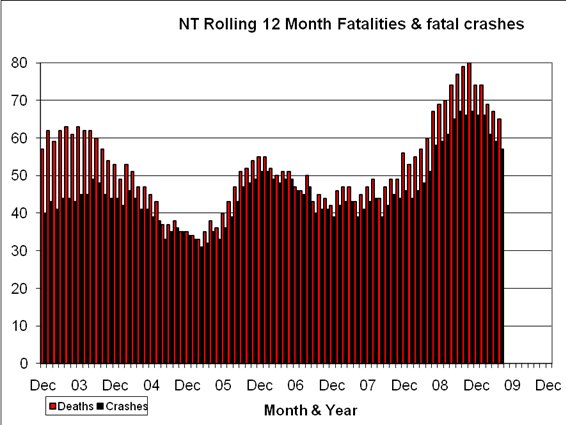
Up until 2007, rural freeways in the Northern Territory, Australia had no speed limit. Claiming that speed limits were essential to saving lives, the state government imposed a 130km/h (80 MPH) limit on the Stuart, Arnhem, Victoria and Barkly highways and a 110km/h (68 MPH) speed limit on all other roads, unless otherwise marked lower. Despite the best of intentions, however, the number of road deaths actually increased 70 percent after the change — despite worldwide drop in traffic levels (view chart).

Read More >

By on July 14, 2009

Up until yesterday, there were only two Ferrari Californias on Australia’s streets. The number is now down to one. Police have impounded the rare Ferrari California being driven by Financial Review motoring writer Rod Easdown. Baruthian car and driver were clocked by Australia’s finest at 231kmh, more than twice the legal limit.

Read More >

By on June 10, 2009

Bob Lutz needs to clear something up. Fun lovers, report to GM Fastlane, stat! It seems that the Man of Maximum is steamed about a WaPo piece which he complains casts him as “ambivalent” towards his beloved Volt. In fact, the piece is a sweeping look at the Volt’s place in GM, and it contains more than a few anecdotes that reflect poorly on GM management (shocking, I know). And the facts of the matter clearly illustrate that the Volt’s importance arises from political considerations far more than the inherent passion  of GM’s product planners to create reliable, fuel-efficient transportation. Hence the accusation of ambivalence. But political motivation has to be disguised with pure intention (no matter how implausible) in order to work. And so Lutz is off to man the crumbling Maximum rampart.

Lutz writes,

The reporter said that we are “ambivalent” about the Volt, largely because it flies in the face of what he perceives me to be all about, namely speed, horsepower and burning rubber – and fossil fuels. In fact, he neatly expanded this ambivalence angle to describe GM, and Detroit as a whole, as the auto industry faces a new future.

Look, I know how it works. A reporter has a great idea for a story, with a terrific angle, and, even if the facts indicate otherwise, he can’t help but try to shoehorn the story into the angle. It’s just too good an idea!

Yes, Bob Lutz knows how the media thing works. And the WaPo juxtaposes the Volt and the Camaro,

. . . type of vehicle they and their colleagues in the press insist GM is all about, the gas guzzler. Trucks, SUVs and muscle cars. They would have you believe that GM and the other American auto companies are the only manufacturers on the planet that have ever built any SUVs. They would have you believe that we are secretly bemoaning the coming of the Volt because it means the end of cars like the Camaro and the Corvette, cars they don’t think any Americans want to drive anyway.

Huh? Bob, the Post quotes you as saying,

When you get out into the marketplace, it’s probably just 5 percent of the public that desperately wants something environmentally sound and is willing to pay a premium for it. I would say the East and West Coast intellectual establishment kind of lives in its own world. When you get to the broad American marketplace, excitement is still kind of defined in the way it used to be.

If that doesn’t betray some ambivalence towards hybrid vehicles, then what does? If America doesn’t want Volt, Bob, why are you building it? Actually, the Post piece addresses this directly, explaining,

In the summer of 2008, at a forum attended by other auto executives and then-presidential candidate Barack Obama, Wagoner recalibrated his position. Under increasing pressure from government officials to demonstrate GM’s broad commitment to more fuel-efficient vehicles, the beleaguered chief executive confidently restated GM’s goal to bring out the Volt in 2010.

But that doesn’t jive with Bob’s self-image. Political lackey he is not!

How many times since the concept car’s debut in 2007 have I said (and been widely quoted as saying) that this is the most exciting program I have worked on in my entire career? I meant it every time I said it – anyone in the press who’s spent any time at all covering the auto industry knows I don’t do “lip service.”

But if this were true, Lutz wouldn’t be blustering about his deep, abiding passion for the Volt. He’d say something along the lines of “you’re damn right I’m ambivalent about it. It’s a $40k halo car that doesn’t go fast or look like sex. That doesn’t make sense to someone like me.” Instead, he demonstrates his pathos-laden (and politically corect) ambivalence towards the very car the WaPo accuses him of favoring: the Camaro:

Given the tough economic times and the high priority of fuel economy, we were almost wishing we hadn’t done the Camaro. We looked at it as something radically mistimed.

Which it is. But Lutz’s conspicuous ambivalence only shows how willing he is to reshuffle his priorities based on political considerations. If Lutz was brought into GM to provide clear-sighted leadership on product quality, he has clearly lost the independent, instinctive edge he once promised. Absent the need for a working compass of the American consumer psyche (thanks to bailout billions), Lutz has become little more than a breathless apologist for a program he clearly doesn’t think will be successful on its own merits. The curse of governmental control can already be felt at GM. What a crock of shit.


By on April 8, 2009

Following a ruling by the Supreme Court of Victoria, Australia, a 27-year-old will have a chance to shut down the A$4.8 billion Airport Link toll road next Tuesday. The BrisConnections toll project, built upon highly leveraged shareholder debt, fell apart as the credit crisis hit and the share price plunged to just A$.001. This allowed a young Internet entrepreneur, Nicholas Bolton, to snap up 73,100,993 shares representing eighteen percent of the company with an initial investment of just A$47,923. That cheap initial purchase price, however, came with a catch. The BrisConnections stock is a “partly paid security” that requires a A$1 per-share payment on April 29, 2009, and a second A$1 payment on January 29, 2010, for the shares to become fully paid.

Read More >

By on January 16, 2009

GoAuto hears from GM Car Czar Maximum Bob Lutz himself that the Camaro and G8 will be the last US market GM products based on Holden’s RWD Zeta platform. “The strategy we had a few years ago of basically deriving a whole sweeping global portfolio off the Australian Zeta architecture … frankly, we have had to abandon that dream,” said Lutz. “This is because, whether you are in the United States or in China, fuel economy mandates are getting more and more severe, and we just could not base our strategy on doing relatively large and relatively heavy rear-wheel-drive cars. I suspect the same thing is going to start to bite the traditional rear-wheel drive producers.” Not that they’re ditching the platform entirely. “It is our intent to continue the Australian rear-wheel-drive cars; we will continue building them and doing a next generation and so forth and so on,” says Mr Maximum. “And, to be honest, they continue to be my favourite cars. I think they are absolutely wonderful – but the regulatory environment is such that it would be imprudent to base a whole global platform strategy on them … much to my personal chagrin, by the way.” And what of the rumored Alpha compact RWD platform?

Read More >

By on January 6, 2009

Pickuptrucks.com has learned that the Pontiac G8 ST has been canceled. Incidentally, Automobile Magazine is reporting that the Suzuki Kizashi has not been canceled, but will debut in production form at this year’s New York Auto Show.

By on December 23, 2008

By taking a quid-pro-quo (cash for a new model) approach to its automaker bailout, the Australian government and Holden have opened themselves for significant criticism. And it’s starting to pile on. From The Australian we have reports of backlash from, among others, Australia’s Green party. And their scathing remarks are centered on the GM Cruze variant that received specific subsidization. Greens senator Christine Milne questioned why the “green car innovation fund” was being spent on something that was “neither particularly green, nor in any way innovative.” Says Milne of the SubsiCruze, “even if it is an efficient four-cylinder car, that is hardly green innovation. This is keeping the Australian car industry on life support instead of giving it a new lease of life.” Sound familiar? Getting tired of that question? Apparently Australia’s Greens expected something more revolutionary than a boring ICE compact. According to Senator Nick Xenophon, there is “nothing green about a petrol car. You can make it more efficient but that is just fiddling at the margins.” Incidentally, Xenephon goes on to destroy his credibility by suggesting Australia’s government subsidize a local version of GM’s Volt. Now we’re getting realistic! In other news from the exciting world of The New Mercantilism, Canadians are beginning to worry that their own bailout “is a very difficult situation, because we’ve got a financial plan without a business plan, and that’s the wrong way to do things,” according to Joe D’Cruz, a professor at the University of Toronto’s Rotman School of Management. How did nobody see this coming? Oh wait. (Thanks to JT for the tip)

By on December 22, 2008

The Australian federal government has hopped on the auto bailout bandwagon, “investing” $149m in production of a Holden-badged GM compact car. The South Australia state government will kick in $30m as well, as the Delta-platformed Cruze-alike will be produced near Adelaide. Styling and engineering will be carried out in Melbourne. And what do the Australian people get for their representatives’ fiscal abandon? According to Adelaide Now, the project will “support” 600 GM jobs and 600 supplier jobs, but it seems that these will likely not be new hires. Money for the project comes from Australia’s “Green Car Innovation Fund,” and its use is being justified by the possibility of ethanol, LPG and CNG powertrains at some indeterminate point in the future. “We recognise the needs and desires of motorists are evolving with growing concern around environmental factors and shifting consumer sentiment,” says Holden Chairman Mark Reuss. “Such evolution calls for an innovative approach… (and) the new vehicle will cater for growing demand for smaller cars focussed on economy.” when all is said and done though, the environmental issues are simply a greenwash for Australia to prop up weakening production and subsidize a “domestic” Corolla competitor. Sound familiar? The irony is that the GM doesn’t especially need a bespoke version of its global Cruze for Australia, although it will be required to match the government’s $149m outlay.

Read More >

By on August 27, 2008

Nothing to see here. Now go drive your Prius.Think Australian cars and you're likely come up with three words: large, RWD, sedan. Well, Ford CEO Allan Mullaly has turned the land down under upside down by suggesting that the next Falcon might be a front-drive model. The Motor Report gasps at the announcement, but with the new Falcon FG selling slowly, it seems large rear-drive sedans are going the way of the SUV in this country. Mullaly's pronouncement that the decision would "be driven by what the customer wants and values" has Aussie hoons hoping they still have a chance to stop the cruel march of progress. In the real world, rumors that the new Falcon could be a global platform suggest that it will almost certainly be FWD. Mullaly also gently broke the news that in the long term, V8s would be less prominent in the lineup thanks to Eco-boost. Of course the quantifiable benefits of an FWD platform are numerous. Besides the greater global flexibility, an FWD model would offer more interior space and efficiency for less money. GM's Holden brand has probably saturated what few niche markets exist abroad for the Aussie formula of cheap-and-cheerful, drift-happy muscle sedans. In decisions which reflect their general strategies, GM has gone for the marginally-profitable gusto by bringing its Aussie RWD V8 sedan stateside as the G8, while Ford plays it safe by (probably) globalizing its Aussie throwbacks. From a business perspective, it's hard not to prefer Ford's approach. As an RWD nut, well… change can suck.

By on August 14, 2008

GM Hates YouMemo to car manufacturers: naming contests don't work, except to grind my gears. It didn't work for Alfa Romeo, who had to ignore contest results for the car we now know as the MiTo (fan chosen name was Furiosa). And now General Motors has revealed that the production name of the Pontiac G8 ST concept – a "sport pickup" version of the Australian Pontiac G8 – will be the Pontiac G8 ST. Jalopnik's Jalops went so far as to hand out buttons calling for an El Camino revival. While that moniker might not have been GM's best call– it's a Chevy name– neither is G8 ST. Then again, with the G8 ST being a niche within a niche, big diff (no LSD implied). The name choice really does show, however, GM's incredible ability to minimize the impact of a car when it comes to market– especially one they've been talking up for the last twenty-some years. This really smacks of the Astra: an overseas product that car lovers craved that GM eventually pushed it into the corner. Same with the Commodore-cum-G8 (at least that one got a few TV commercials). And when it goes on sale in late 2009 (another year wait? are they kidding?), the G8 ST sport truck is likely to be yet another victim of GM's monumental ADD.

By on July 28, 2008

If it\'s good enough for Mulally, why isn\'t it good enough for us?By some accounts, the new Australian Ford FG Falcon is a good car. It's said to have earned Ford Australia the right to develop Ford's new global rear wheel-drive (RWD) architecture. Former Lexus driver FoMoCo CEO Alan Mulally claims he covets the G6E Turbo model. So it's selling well, right? In a word: no. The Australian reports that the FG Falcon has "flown into a perfect storm, with high petrol prices and tumbling trade-in values conspiring to slam the brakes on sales of the new large sedan." Though sales are technically up eight percent over last June, Ford has moved only 4k of the new RWD sedan since its launch two months ago. There's been no appreciable bump typically associated with all-new products. Even Ford Australia boss Bill Osborne is worried: "The underlying market for large cars is even weaker than what was on display in June, and that's cause for concern for us." Ford is confident that they can "build momentum" because turbo models weren't available at the launch, but they also won't rule out layoffs or production cutbacks because they "don't know where fuel prices are headed." Anyone want to help them out on that?

By on June 20, 2008

hsv-w42722.jpgThe car we know as the Pontiac G8, you probably already know is a twin of one of GM's Australian bread and butter cars, the Holden Commodore. They've got all sort of variations of it over there – El-Camino style sport trucks (yes Jalopnik, we know), station wagons, AWD models, long wheelbase luxury versions, and yes, in-house specially-tuned high-performance professional ass kickers. We'll be getting one of the latter category of INSTHPPAK models as the Pontiac G8 GXP with a 400 horsepower 6.2 liter V8 out of the Corvette. But that's not enough if you're properly power hungry. Holden's HSV tuning folks presented the 7.0 liter (they call it a 427, because they are that badass) LS7 powered murderer version of the Commodore. Not only that, but in the ultimate act of hilariosity, the HSV W427 model as it's called will be available in the stretched luxury car called the Statesman. Like the Corvette Z06, the Holden W427 will have a hair over 500 horses and 472 lb ft of torque. Holden is building only 427 examples of the car, and they cost $150,000 AUD. That makes it 3.5 times the cost of a V6 Commodore (which is the $27,000 G8 V6 in America), but about the same price as BMW M3 in Australia. Still a hell of a bundle of cash.  [Source: Holden ]

Click here , here and here for aural sex. 

By on June 12, 2008

svhybrid_narrowweb__300×3890.jpgToyota recently declared that it would begin building Camry Hybrids in Melbourne, potentially reversing the industry's decades-long decline. The announcement vindicated the Australian government's half-billion dollar initiative to encourage local production of full-sized eco-friendly cars. PM Kevin Rudd and the Victoria provincial government each cut a $35m check to Toyota in return for its promise to build 10k Camry Hybrids per year. Win-win for all concerned, right? And then Toyota Australia spokesman Mike Breen opened his big mouth. Breen told The Australian an inconvenient truth: Toyota would have built Camry hybrids in Melbourne with or without the taxpayer-funded incentives. This prompted howls of outrage from the opposition, claiming the handout "amounts to nothing more than a $35m photo opportunity for the prime minister." Of course, Toyota has since backpedaled, disingenuously demurring that "Toyota's decision to build a hybrid Camry in Australia was based on various business considerations… however, the Governments' support was a critical factor in securing local production." Ford and GM reps are sure to learn the lesson when they meet with Australian Industry Minister Kim Carr this week; there's still $465m in taxpayer dross to be hustled Down Under.

By on April 7, 2008

toyota_camry_hybrid.jpgIn our latest editorial on Australia's tanking car industry, I noted that a government report emphasizes future production of large vehicles with green powertrains. The Australian reports that the Aussie government's half-billion dollar green car manufacturing fund could be used to lure production of the next-generation Toyota Camry hybrid down under. Toyota Australia VP Dave Buttner says ToMoCo had been pushing to build a hybrid car here for five years but "policies conducive to investment" (a.k.a. public money) were vital to the plan. The plan seems to convenient to avoid: Aussie politicians get to check of the box next to "build large, green cars" on their bureaucratic checklists, and Toyota gets enough money to offset Australia's high labor costs and strong currency. Oh, and Toyotas actually sell well in the land of Oz as well, especially the Prius, who's sales rose 63 percent last year. So who loses out in all of this? Just Toyota's competitors and Australia's taxpayers.

Recent Comments

  • Lou_BC: @Carlson Fan – My ’68 has 2.75:1 rear end. It buries the speedo needle. It came stock with the...
  • theflyersfan: Inside the Chicago Loop and up Lakeshore Drive rivals any great city in the world. The beauty of the...
  • A Scientist: When I was a teenager in the mid 90’s you could have one of these rolling s-boxes for a case of...
  • Mike Beranek: You should expand your knowledge base, clearly it’s insufficient. The race isn’t in...
  • Mike Beranek: ^^THIS^^ Chicago is FOX’s whipping boy because it makes Illinois a progressive bastion in the...

New Car Research

Get a Free Dealer Quote

Who We Are

  • Adam Tonge
  • Bozi Tatarevic
  • Corey Lewis
  • Jo Borras
  • Mark Baruth
  • Ronnie Schreiber