



 While "going green" is often little more than PR posturing, fuel-intensive businesses see alternative energy as simply a way to save money. But while electric, hybrid and other efficient drivetrain technologies proliferate in cars, commercial trucks have largely been left out of the green wave. Greentech Media reports that Electrorides, a green truck startup, is hoping to cash in on this absence by offering the first electric commercial-duty truck. The ZeroTruck is based on an Isuzu N-series platform, retrofitted with a UQM Technologies electric motor, offering 100-mile range when unladen. But commercial trucks aren't of much use when empty, and when loaded down the range falls sharply. That's why Electrorides offers a biodiesel engine which converts the vehicle to a parallel hybrid, adding another hundred miles to the truck's range. Like most new green vehicles reported in the media, the ZeroTruck is in beta testing, and is not yet available. Start watching out for the silent colossus this August (literally… this thing will sneak up on you!).
Category: Bio-fuels
 German officials have de-boondoggled on the E85 front, withdrawing plans mandating a 10 percent bio-fuel content for the lowest grade unleaded fuel. For some reason, the government didn't check the stats (or did?) before establishing a threshold for making the switch. If one million cars couldn't run on the plant juice blend, they'd hold off on E10. Deutsche Welle reports the numbers: "The [auto industry] sources said that some 330,000 cars made by German manufacturers, as well as more than 2 million imported cars, could not run on the new fuel and that the cars' owners would be forced to fill up with higher octane, more expensive types of gas." The German association for technical inspection (GTÜ) reports [via The Local] that the country's cars may have enough problems without worrying about running on bio-fuels. "A 2007 GTÜ study found that 8 million vehicles were found to have significant problems during general inspections. 'The finding is even more alarming when you consider that many of the vehicles had been repaired just before they were inspected,' said GTÜ chief Rainer de Biasi. His said the findings indicated that every sixth car in Germany poses an accident risk." Sobering stuff. Of course, one wonders about Germany's standards relative to, I dunno, New Jersey.
 Today's proof that the ethanol revolution is being kept alive by the GM kool-aid sippers comes from Texas, where the first dealership-owned E85 station just opened. Installed at a cost of a mere half a million dollars, the Classic Clean Fuels (not spelled with the always-klassy "K"?) nine-pump station serves up E10, E85 and biodiesel in suburban Dallas, right next door to the HUMMER dealership that owns it. "We'll offer a biofuel powertrain in every model we build by the end of 2010," HUMMER General Manager Martin Walsh said. "A Hummer's off-road capability and care for the environment are in no way mutually exclusive. This is simply one more step in our effort to promote responsible adventure." A two-hour 85-cents-per-gallon sale on E85 and a free tank of corn juice with the purchase of any new HUMMER are only the beginning of the marketing possibilities, as GM Media Online strains to use one dealership's actions as a measure of the success of the company. "This signals that GM and our dealers are trying hard to give our customers choices," says GM VP for R&D Larry Burns. "Down the road, we may even want to consider hydrogen dispensers at dealerships." Because building fuel-efficient vehicles is just too obvious.

Higher corn prices could soon be passed on to those filling their cars up with ethanol, says CNNMoney. The increasing cost of growing corn, along with favorable prices for other crops such as soybeans could fuel a decrease in corn production. Even though ethanol is heavily subsidized, it has contributed to the rise in corn prices, which has hurt poultry, beef and pork companies who use corn to feed their animals. But a decrease in corn production would also be bad news for the corn-juice industry. According to the Renewable Fuels Association, the number of ethanol plants has increased from 50 in 1999, to 134 today, with more plants on the drawing board. Given that, on average, a 100m gallon-per-year ethanol plant consumes about 33 million bushels of corn, more ethanol plants and less corn could spell trouble ahead. The decreased supply could drive corn prices even higher, which would offset any possible "advantages" corn-based ethanol was supposed to offer.
 With all of the downsides of corn-based biofuel now widely known, eco-friendly motorists are anxious to hear a little good news from the developers of so-called second-generation biofuels. One of the most promising of these new, non-food-based fuels comes from algae, which scientists have been breeding and researching since the Carter Administration. The March cover story at Green Fuels Forecast tells of the National Renewable Energy Labs Aquatic Species Program (ASP), which has been looking for biodiesel-producing algae since 1978, and is now providing the backbone of technology for some frenzied venture capital activity. When the program started, it was estimated that all of America's transportation and home-heating needs could be met by 15k square miles of algae farms. Of course in the 90's as petroleum costs dipped, the Clinton Administration axed the ASP in favor of further ethanol research. Now, the government's abandoned investment is attracting the big boys: Chevron, Shell and others are forming partnerships with start-ups who are building on the ASP's knowledge base. The upsides? Algae needs only sun and C02 to produce the oil which can be burned as fuel or used in a number of other applications which currently require petroleum products. In other words, the perfect fuel source for your favorite Waterworld-esque, post-apocalyptic fantasy.
 Math is not my forte, in the sense that I grew up thinking times tables supported New York newspapers. But there are many of you who know your way around a calculator. For your number crunching pleasure, I submit this article from Seeking Alpha, a stock tip site. The unnamed author crunches the numbers: the total amount of potential ethanol production vs. total U.S. gas consumption. The conclusion: "Corn ethanol will never replace any meaningful quantities of gasoline nor diesel." More specifically, "ethanol (spark ignition) will not substitute for diesel (compression ignition) anyway without substantial vehicle and fuel changes. Ethanol will not easily substitute for heating oil nor jet fuel neither. And if you add in ALL the energy-related inputs, some have said we may be able to replace, at best, 3-4% of U.S. gasoline using all U.S. corn." And so ethanol supporters will move on to cellulosic sources or trash or lithium ion crystals, with your tax money.
 Nestle CEO Peter Brabeck has come out against biofuels, warning that trying to fill up to 20 percent of energy demand with plant-sourced fuel could result in a food shortage. As a food company executive, Mr Brabeck's opinion is neither surprising nor entirely altruistic. However, his warnings echo remarks from UN Special Rapporteur On The Right To Food, Jean Ziegler, last year. In October, Ziegler cautioned that every 13 gallons of corn-based biofuel could feed a child for a year, and called for a five-year ban in the EU on converting croplands to biofuel production. Just something to keep in mind the next time you put 30 gallons of E85 in your Suburban.
 Timothy Gardner and Rebekah Kebede of Reuters [via the Calgary Herald ] claim that an increase in America's output of cheap, subsidized ethanol, along with additional gasoline refining capacity coming online, may lower U.S. gas prices. According to the U.S. Department of Energy, American production will rise by 130k barrels of ethanol per day in 2008 (up to 550,000). Gardner and Kebede note that the government subsidizes blenders to the tune of $0.51/barrel of blended ethanol, and that "the subsidies have made ethanol cheaper than gasoline and a much sought after component for blending into motor fuel." Another factor that could contribute to falling prices: the slowing of American demand for gasoline. While demand grew by 1.3 percent annually from 1971 to 2007, growth has slowed down 0.7 percent in 2007 and the government forecasts a paltry 0.4 percent for 2008. And what of transportation costs and logistics? (Ethanol can't be transported via existing pipes; it must be transported by diesel burning tanker trucks.) Or consumer reluctance to use corn juice once they figure out the (often hidden) fact that 85 delivers significantly less bang-for-the-buck? Nothing.
 The MinnPost reports that the local E85 lobby is joining the Minnesota Auto Dealers Association's opposition to California-style emissions standards. Although ethanol had been [tortuously] justified as an eco-friendly fuel, Minnesota corn growers say the standards would "make it difficult to certify E-85 vehicles." (This despite the fact that California has already certified 300k flex-fuel vehicles.) James Erkel of the Minnesota Center for Environmental Advocacy argues that the corn growers have stopped making sense. "These bills would not curtail ethanol markets and in some respects actually help it." Erkel added that the new regs wouldn't affect Minnesota's attempt to "upgrade" its E10 fuel to 20 percent ethanol. But the Minnesota Auto Dealers Association have convinced their agricultural pals that stricter-than-the-feds tailpipe standards would kill the market for new pickups and SUVs, including flex-fuel versions of same.
 In The Wall Street Journal [sub], Daimler CEO Dieter Zetsche and GM Car Czar Bob Lutz discuss their respective companies' approach to environmentally-friendly vehicles. Dr Z wants to sell more diesels. (And there you have it.) Maximum Bob eschews oil burners to hang his proverbial hat on E85. Of course, Lutz' preference for corn juice will cost consumers plenty through government spending on ethanol infrastructure and corn price supports. But the winner of TTAC's first annual Bob Lutz Award reckons developments in corn breeding will blunt E85's inflationary impact on food prices. "So I think that people who say, well, the ethanol industry is taking food from the mouths of babies and it's driving tortilla prices up– I think these are highly suspect conclusions." Meanwhile, both executives say Daimler's success selling the smart in the U.S. heralds the end of the efficiency vs safety debate. "There are no statistics that would support [the idea] that you are less safe in the smart than you are in any kind of vehicle," says Dr Z. Lutz appears equally oblivious the laws of physics, stating "If a vehicle is registered for sale in any developed market of the world, it is going to be an extremely safe vehicle."
 Good news! The April issue of Ethanol Producer Monthly (EPM) is already online! Actually, if Sarah Smith's article "Ethanol's Excedrin Headache: Where Have All the Good Sites Gone?" is anything to go by, the news isn't that great for the mag's target market. EPM has identified organized ethanol plant protests in 14 states. "Rural communities that once heralded the arrival of an ethanol plant are now thumbing their noses at them." Before listing litigation from California to Wisconsin, Smith gives ethanol boosters a quick course in how not to win friends and influence people. "Plaintiffs swap strategies over the Internet, trade petition forms, success stories, failures, even going so far as to design T-shirts and coin the perfect acronym for their groups. Their reasons for filing causes of action are as myriad as the ethanol technology itself: not in my back yard, zoning board decisions, economic benefit, industry distrust, environmental concerns and water use issues. The view from the third tee box, listed in one cause of action, illustrates the lengths plaintiffs will go to halt a project in its tracks. After all, golf is life, isn't it?"

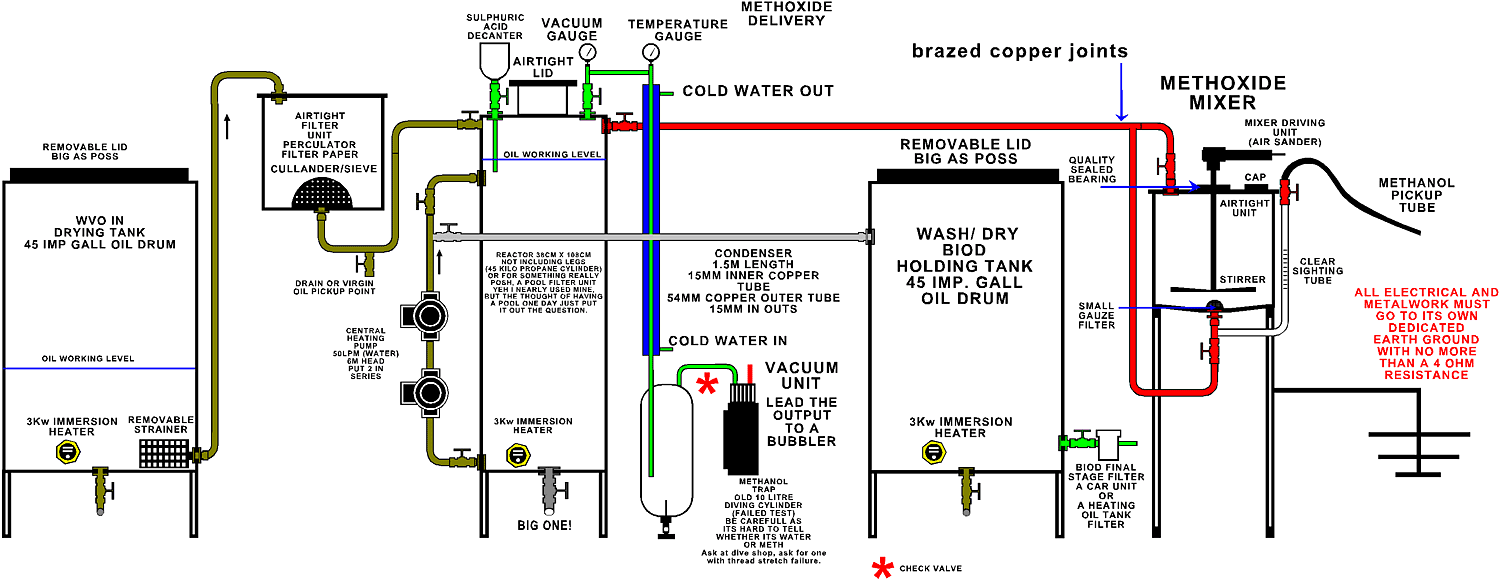
Okay, we're a couple of days late with this story, but we think chuckgoolsbee would approve anyway. Finally, a high-school class with real-world implications from KPRC: the students in a chemistry class at Dobie High School in Houston, TX are spending their spare time turning donated vegetable oil into biodiesel. Sure, the students could have purchased a biodiesel reactor (processor). But as reporter Courtney Zavala points out "that wouldn't be very much fun." So, they built their own, "piece by piece." Senior Russell Zuber says it's, like, pretty cool stuff: "It's fun. It's interesting. We're working with our hands, learning a lot of advanced science and a lot of like, getting ahead." And according to junior Jennifer Linares, "you get to learn a lot and it also helps you for future careers if you're interested in engineering or the oil industry." The students' goal is to operate a diesel car for one year with the biodiesel they're making in class. Of course not everyone "gets it" when it comes to home-brewing biodiesel. Near the end of TV's station's story, one of the female news anchors turns to her colleague and says: "It strikes me a lot like the airplane, Dominique: over my head." Why are we not surprised?
 Kind of an ugly sucker, no? And before you start groaning, Motor Authority reports the proposed Raptor can also run on regular gasoline. Obviously, Saleen already has the manic, monstrous S7 hypercar (which creates so much downforce it can be driven upside down) in its stable. Only problem there is, the massively scalloped S7 retails for $600,000. The S56 Raptor however, should it see the light of day, will sticker for "just" $190,000. And what does the monetary equivalent of a five-bedroom house in Albuquerque get you? A mid-engined, supercharged 5.0-liter V8 than can summon 650 horses and 630 lb-ft of twist. That will equate to a 0-60 time of 3.2 seconds and a top speed in the 200 mph 'hood. Our favorite part? It's getting a six-speed manual instead of some high-falutin' flappy paddle misnomer. Will they build it? Don't know. But you can never have too many supercars, now can you?
 Recordnet.com reports on a new trend: "green" auto shop. To wit: Mark Armstrong's students at Santa Rosa Junior College have upgraded dozens of cars to run on biodiesel. They've converted five cars to run on vegetable oil, modified one to use ethanol and transformed three into electric vehicles. Mike Yonan and his automotive seniors at the Weber Institute of Applied Sciences and Technology modded a fire-engine red 2002 Neon to run on eight lead-acid batteries. Armstrong, who owns a heavy equipment repair business, believes the work teaches his charges self-reliance, resourcefulness and [left coast] Yankee ingenuity. "If we really want alternative fuel vehicles, let's get off the couch and start making them." Yonan says amen to that, and counsels his fellow students to learn the value of simple persistence. "Thinking hurts. Sometimes it gets so frustrating you don't really want to do it. But you think about what it's going to be like and keep going."
 There are two main reasons why E85 is going nowhere fast: over-production and under-consumption. The U.S. Department of Energy has tackled the latter part of the non-equation with a federally-funded report exhorting gas station owners to get on the corn juice bandwagon. E85 Retail Business Case: When and Why to Sell E85 advises that "E85 offers relief from this [local] competition by differentiating a station as green, cutting edge, patriotic, and pro-farmer." So, greenwashing it is! What about, you know, making money? "E85 projects can be profitable investments. However, their profitability depends on numerous factors… This checklist includes robust local competition in the gasoline market, access to low E85 costs, mid-grade tanks available for conversion, large potential throughput of E85, and state or local incentives for E85 infrastructure." Large throughput as in sales? Good luck with that. Meanwhile, there's lots of agri-prop. My favorite argument: who cares about gas anyway? The money's in snack foods and car washes! And that's good news because "even if E85 drew no new customers but merely converted gasoline customers from the same store, the number of customer visits would increase. This is because a vehicle’s range is reduced by 23% to 28% when operating on E85 because of ethanol’s lower energy content compared to gasoline." The mind boondoggles.



Recent Comments