



 According to the AP, Korea’s Yonhap news agency reported last week that work could be delayed at Kia’s new West Point, Georgia factory. A wait and see approach would make a lot of sense too, considering that Kia is cutting production worldwide and that the bottom appears to be falling out of the American car market (Hyundai sales being no exception). Except that the report was not true. “No change has been made to our schedule to complete the plant by the end of November and to start production in December (2009)”, says Kia’s Michael Choo. The $1.2b plant was announced in 2006, and will employ 2,500 workers building 300k vehicles annually at full capacity. The West Point factory is Kia’s first in the US, joining parent company Hyundai’s single factory in Alabama. This makes the Georgia Kia’s third overseas production center, joining China and Slovakia, the latter of which is the subject of a fascinating piece by the International Herald Tribune. In it the secretary general of the Automotive Industry Association of Slovakia brushes aside those who would call her country (which builds more cars per capita than any other) “the Detroit of Europe.” “We’re in a good position to grow,” Maria Novakova tells the IHT. “Frankly, we don’t want to be compared to Detroit because we don’t want to end up like Detroit.” An understandable sentiment, to be sure, and one that is poignantly underlined by Kia’s decision to build cars in the US.
Category: Industry
 As the battle over bailout bucks rages, it’s easy to get the impression that Fortress Detroit is unanimous in its support for the home team. As usual though, there’s more to the story than just the loudest voices. The New York Times conducted interviews across the state over the last two weeks, and found that opposition to the bailout, if only in private. “There are plenty of people who are rolling their eyes,” said Bill Ballenger, editor of Inside Michigan Politics newsletter. “You keep your head down if you’re one of them, but they’re out there.” And much of the opposition seems to come from Michigan residents who lost their jobs before the automakers even came begging for a bailout. “How many other, small companies would like a bailout?” asks Heather Davison, an unemployed graphic designer who lost her job at a real estate publication a year ago. “It seems to me that the car companies saw the banks getting a bailout and said, ‘Oh, let’s go!’”
 The other day, I told my mechanic I needed winter tires, and asked for a recommendation. “I’ll get you some Dunlops, they’re not bad, and cheaper than the Uniroyals you had last time.” When I asked him about rolling resistance and about tire wear, he looked at me like I was stupid, and repeated: “They’re pretty good tires”. So I looked at some car sites in the Internet, gave up after about five minutes, and ordered the Dunlops. Does buying tires have to be a “trust the guy in the greasy overall” event? The EU Commission (the executive branch of the European Union) says no, and intends to introduce new rules for labelling tires. The tire industry agrees that yes, change is probably necessary, with some qualifications, under certain conditions… Read More >
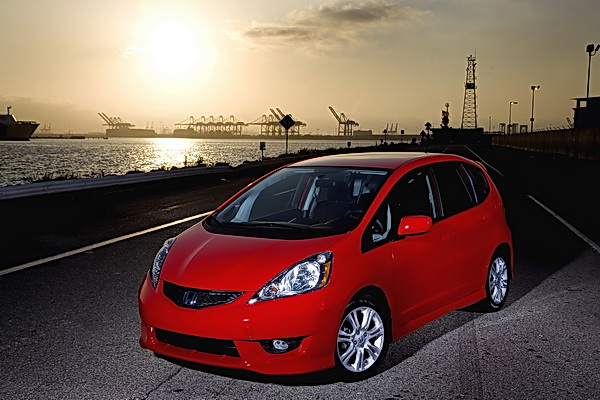
At this week’s LA Auto Show Honda’s vice president of corporate planning and logistics told Marketwatch that Honda is considering expanding production of its popular Fit to the United States. “We have about 19 days worth of supply, which is much too low,” said Honda VP Dan Bonawitz. “We can’t fill all our dealer orders.” Honda is “exploring all options” to ramp-up Fit supply, Bonawitz said.
 Like everyone, Honda is cutting production. The Financial Times reports that Honda’s Swindon, England plant is shutting down for the months of February and March. The Japanese company’s reputation for employee friendliness is taking a bit hit with the news that Honda’s “5,000 workers in Swindon will be laid off without pay during the shutdown.” The much lauded Japanese no layoff policy has gone by the wayside at Honda just as it has at Mazda and Isuzu. Toyota is likewise shoving people out the door of it’s Japanese factories without pay, but continues to hide behind the “contract workers” ruse which has long allowed them to in reality hire and fire to meet demand changes while claiming not to do so. Toyota “plans to reduce the number of contract workers on its Japanese payroll to about 3,000 by the first quarter of next year from more than 9,000 in the same period this year.” In simple terms, Toyota is laying off 6,000 people … without calling them layoffs. Meanwhile, “Fitch Ratings downgraded Nissan’s long-term debt rating on Friday from “A-minus” to “BBB-plus” and signaled that further cuts could follow.” Layoffs, plant shut-downs, debt rating downgrades and plunging profits. Sound familiar?

In their best-case scenario, Ford and GM would already be waiting anxiously by the mailbox for their federal bailout checks. Instead, it’s back to the drawing board to try to come up with enough cash to survive until December 8. Plus they still have to convince Congress that they have some kind of plan to survive beyond waiting anxiously by said mailbox. Accordingly, GM and Ford are announcing another round of cut-and-shuffle. Ford will close its Chicago Taurus/TaurusX/Sable/MKS plant for the weeks of Dec. 15 and 22, and its Flat Rock, MI Mustang/Mazda6 plant for the week of Dec. 22. According to Automotive News [sub], “the only Ford assembly operations scheduled to run the week of Dec. 22 are a van plant in Avon Lake, Ohio, an F-150 pickup production line in Kansas City, Mo. and an F-150 plant in Dearborn, Mich.” Meanwhile, GM will close the Impala plant in Oshawa, Ont. and the Lordstown, OH Cobalt/G5 plant from Jan. 12 to Jan. 20. Automotive News [sub] reports that GM will also shut down its Orion Township, MI Malibu/G6 plant from Jan. 5 to Jan. 12. GM’s Kansas City, KS Aura/LaCrosse plant will be closed Dec. 23-Jan. 20, and a planned week of downtime there has been moved up to Jan. 12 from Jan. 26. The permanent closure of GM’s Oshawa, Ont. truck plant has also been moved up, from July to May 14.
 This week’s round of congressional testimony has forced our elected officials take sides on the auto industry, a topic that typically doesn’t often factor too heavily into national level grandstanding politicking. Detroit News Scribe Bryce G. Hoffman figures that the divisive issue of aid to automakers is creating a house divided… along the old Mason-Dixon line. The split is based on another legislative battle that hasn’t visited the corridors of power as often in recent years: anti-union “at will” employment laws. These laws are popular in many southern states which have used the lack of labor organization to attract transplant auto factories which have bring hundreds of jobs– and an ambivalence to Detroit’s self-made hell– to their sunny shores. And like much of Detroit’s newspapers’ coverage, Hoffman is taking his lead from UAW boss Ron Gettelfinger who blasted Alabama’s congressional delegation at a recent press conference. “Alabama paid $175,000 per employee to create those jobs there,” he said. “It just seems odd to us that we can help the financial institutions in this country — that we can offer incentives to our competitors to come here and compete against us — but at the same time we’re willing to walk away from an industry that is the backbone of our economy.” Read More >
 The cynical amongst you will see this as a direct rebuke to Detroit: a shot across the bow of the Big 2.8 execs who sat in front of America’s duly elected representatives and refused [almost] point-blank to take a pay cut, whilst asking for a $25b federal “bridging loan.” And so it is. But anyone who thinks Toyota is trying to make Motown look bad– a pursuit in which they need no special assistance– doesn’t have a grasp on the “Toyota Way.” Even before this auto sales meltdown, the Japanese automaker’s top ten execs earned less money COMBINED than Ford’s Alan Mulally, Chrysler’s Bob Nardelli and GM’s Rick Wagoner (individually). In fact ALL of Toyota’s execs together earned 3.92b yen. That’s $40.5m. And now Yomuiri reports “Toyota Motor Corp. will consider cutting the pay of its directors in fiscal 2009, it was learned Wednesday. The aim of the nation’s top automaker is to clarify the executives’ management responsibility after the company announced last week that it expected a 73.6 percent dive in group operating profit for fiscal 2008, due to sluggish new car sales resulting from the global economic downturn. Toyota also expects reducing the remuneration of its directors to set an example as the company prepares to embark on thorough cost-cutting.”
 Carlos Ghosn wants your help, and he isn’t shy about asking for it. In an interview yesterday with The Wall Street Journal, the Renault-Nissan chief announced his intentions to obtain a €40b ($50b) loan package from the French government, in addition to some undisclosed additional quantity of yen from their Japanese counterparts. Today, before a packed house during his keynote address at the LA Auto Show, Ghosn continued along this path, turning his attention to obtaining tax credits and other government assistance here Stateside. Citing October 2008 as the worst month for US car sales in the last 25 years, Ghosn claimed that the severity of current economic conditions were “putting the usual rules of business up in the air” and that “nobody knows” how long these conditions would continue. As he tore a page from Detroit’s eco-efficiency bailout pitch book, Ghosn stressed retooling for the development of Earth-friendly technology as a key driver for receiving state support.
 We’ve been ringing this bell for a while now, so it’s nice to see some of the big guns in the media world back us up. The New York Times has a scathing piece on the oft-cited Center for Automotive Research study on auto industry employment today, stripping the statistics of much of their bailout-justifying clout. The Times points to two significant shortcomings in the study, the first of which is that the statistics presented by CAR account for the entire industry, including those firms which build cars here but aren’t going under. As we have argued before, these statistics prove only how vital the entire auto industry is. For Detroit to claim that these numbers are somehow indicative of the amount of jobs which will be lost if the American automakers go under is beyond misleading. In fact, if the Detroit Three fessed up to the fact that the “foreign” transplants employ more Americans than they do, you would have a good sense of how “viable and relevant” they really are.
 Holman W. Jenkins Jr. is not a happy camper. The Wall Street Journal columnist begins his broadside by taking on the Hail Mary-shaped plug-in hybrid gas – electric Chevrolet Volt. Jenkins reckons it’s what the Brits call a “non-starter.” “Even as GM teeters toward bankruptcy and wheedles for billions in public aid, its forthcoming plug-in hybrid continues to absorb a big chunk of the company’s product development budget. This is a car that, by GM’s own admission, won’t make money. It’s a car that can’t possibly provide a buyer with value commensurate with the resources and labor needed to build it. It’s a car that will be unsalable without multiple handouts from government.” While Jenkins’ anti-Volt tirade isn’t especially accurate (you could even call it inaccurate), at least his rhetoric is a moving target, as he changes targets.
Scientists all over the world are in a mad scramble to find a vaccine against the vehicular flu, commonly called “motor malaise.” Now, Europe also finds itself in the grips of the pandemic. Today (Farago beat me to it), the European association of auto makers ACEA released their January through October numbers. Analysts from the automotive anorexia formerly known as America may envy the fact that from January to October, Europe (as defined by ACEA) fell only 5.4 percent to 12.852m units. Taking a closer look, we now know why the EU was so eager to enlarge eastwards. In the new easterly member states, there was at least an ittsy bit of growth, 2.5 percent for the first 10 months. Without the eastern comrades– make that members– the EU would be looking at an even heftier percentage-letting. Have a Maalox, or a stiff drink, and read on, if you dare ….
 Germany’s industry rag Automobilwoche [sub] is running an interesting ballot. “Who do you think would profit the most if GM goes bust?” (or German words to that effect). The options are kind of odd. Only Ford, Renault/Nissan, Toyota, and Volkswagen are eligible. But keep in mind, Automobilwoche is a German rag. They could have asked “What if Opel would die?” But they didn’t. Do they know more than we do? 846 souls have voted so far.
One of the theories explaining GM’s downfall is that they did not invest enough in R&D. Wrong! Booz & Co.’s latest report on Global R&D spending says: bar Toyota, GM was tops. Here’s the 2007 ranking:
Company R&D expenditures in $m
Toyota 8,386
GM 8,100
Ford 7,500
Honda 5,142
VW 4,757
Daimler 4,321
Nissan 4,001
BMW 3,995
Peugeot 2,835
Renault 2,531
Booz says in comparison to 2006, R&D expenditures in the auto industry grew by about 10 percent. European “champs” pale, with the European primo (VW) being only around half as research-intensive as the biggest spender. Here are some other findings…
 Production maven Laurie Harbour-Flex has a guest column in Automotive News [sub] that could easily run as a Deathwatch editorial on any of The Big 2.8. Describing the tough conditions that automakers find themselves in, Harbour-Flex argues that flexible production lines will be key in determining who survives and who doesn’t. As the market for new cars swings from segment to segment, chasing volatile fuel prices, manufacturers who can shift production on the fly to meet changing demand will do well. The upshot? Japanese firms use flexible production, Detroit doesn’t. Sure, Chrysler (for example) can claim that its Belvedere, Ill plant is “fully flexible,” but the Patriot and Compass are built on identical platforms. True flexibility, argues Harbour-Flex, means the ability for a manufacturer to “produce any vehicle in their lineups within their body, paint and assembly shops.” And this actually happens. Honda’s Alliston, Ontario plant builds the Honda Civic and Ridgeline and the Acura CSX and MDX, while its East Liberty, Ohio plant produces the Honda CR-V, Civic and Element. Harbour-Flex identifies four key points that are necessary for truly flexible production.



Recent Comments