Find News by Subject:
By
Bertel Schmitt on February 24, 2011

Yesterday, Porsche went through more mood swings in a single day than a manic depressive in three months. In the morning, Munich’s Süddeutsche Zeitung, usually well clued into high level auto gossip in Germany, had the good news that the public prosecutor in Stuttgart had dropped most of the investigation into former Porsche CEO Wendelin Wiedeking and former CFO Holger Härter. Supposedly, no evidence of share price manipulation was found. With that out of the way, the formal amalgamation of Porsche into Volkswagen could now progress at full speed, said the paper. However, they were misinformed. Read More >
By
Edward Niedermeyer on February 23, 2011

In what may be one of the most important Supreme Court rulings for the car industry in some time [full opinion in PDF here], the highest court in the land has found that compliance with minimum federal safety standards is not a defense against personal injury or wrongful death suits brought in state courts. The case in question involved a 2002 accident in which Than Williamson was killed when a Jeep Wrangler hit her family’s 1993 Mazda MPV. The Williamson MPV had only lap belts because shoulder belts weren’t required by federal law until 2007. A California court has already barred the lawsuit from coming forward, arguing that federal regulations supersede any local rulings, and that then-legal seatbelts should protect manufacturers from personal injury liability. But in the wake of another ruling involving pharmaceutical companies, it seemed that the court might overturn that ruling, which it now has.
Read More >
By
The Newspaper on February 23, 2011

A consensus is growing among the appellate divisions of the California Superior Court that red light camera evidence currently offered by private companies does not meet the appropriate legal standard of proof. In December, a three-judge appeals panel in San Bernardino handed down a unanimous decision reversing the photo ticket issued to motorist John Macias.
Macias received a ticket in the mail after his car was photographed in Victorville on January 10, 2009 making a slow right-hand turn at a light that had been red for 0.36 seconds. His attorney, Robert D. Conaway, argued that when San Bernardino County Sheriff’s Deputy Baker testified as a witness against Macias, Baker had no personal knowledge of the facts of the case. As such, his evidence was hearsay.
Read More >
By
The Newspaper on February 22, 2011

A group of motorists earlier this month filed a federal class action lawsuit against Florida’s toll road system for detaining motorists who attempt to pay the tolls with cash. About 600 miles worth of toll roads and bridges are under the jurisdiction of The Florida Department of Transportation (FDOT), which hands operational duties over to the private firm Faneuil, Inc., which is responsible for the toll collectors. The complaint charges both firms with false imprisonment and other civil rights violations.
“For approximately four years, FDOT and Faneuil have engaged in a practice of detaining motorists and their passengers on the Turnpike System until such motorists provided certain personal information in exchange for their release,” attorney James C. Valenti wrote on behalf of the plaintiffs. “The motorists and passengers have been detained without their consent and without legal justification.”
Read More >
By
Edward Niedermeyer on February 18, 2011

Arizona is home to the oldest continuously operating speed camera programs and the US headquarters for the two largest private companies that operate the equipment. It could also be the latest state to join the fifteen jurisdictions that ban automated ticketing machines. The Arizona Senate Government Reform Committee voted 5 to 1 on Wednesday to approve legislation repealing the statutes that have allowed the use of red light cameras and speed cameras in the state. The move represents a significant reversal for a legislature that in the previous session introduced no significant legislation to curtail photo enforcement thanks to a leadership that fully backed the program.
Read More >
By
Edward Niedermeyer on February 17, 2011
Automotive News [sub] reports:
Sixty-four dealerships that were terminated during Chrysler’s 2009 bankruptcy reorganization sued the U.S. Treasury Department today, seeking at least $130 million.
The suit, filed in the U.S. Court of Federal Claims here, alleges the government violated the Constitution by taking the stores’ franchises and their state legal rights without adequate compensation.
Lawyers for the plaintiffs say that more dealers could come on board, as the 64 suing dealers represent only eight percent of Chrysler’s cull. Neither Treasury nor Chrysler (which is not named in the suit) have commented. The suit, which can be read in its entirety in PDF format here, claims violation of Fifth Amendment rights, arguing that:
[the dealer cull] served the public purpose of promoting stability to the financial system of the United States… This is a loss that should not, however, be borne by a few individual dealers but, by reason of its broad and salutary public purpose, must in fairness and justice be borne by the public as a whole.
By
Edward Niedermeyer on February 17, 2011

Automotive News [sub] reports that Global Vehicles, a firm with a contract to distribute Mahindra pickup trucks in the US, has dropped its lawsuit in US court in an apparent attempt to rescue its distribution deal. The contract between Mahindra and GV called for British arbitration of disputes, and apparently the British arbitration panel required that all claims be handled through it rather than in US courts. The dropped suit would have required Mahindra to press forward with its US launch regardless of pending arbitration. Mahindra, meanwhile, has said it is looking outside of its deal with GV for a US distributor, so it’s not clear if GV’s olive branch will even make a difference.
Read More >
By
The Newspaper on February 16, 2011

Traffic camera vendor American Traffic Solutions showed no municipal love as it filed a breach of contract suit against Baytown, Texas on Monday. The St. Valentine’s Day complaint accused the city of failing to approve the mailing of an expected number of red light camera citations generated by the company.
Read More >
By
Edward Niedermeyer on February 15, 2011

Baltimore’s WBAL TV reports that some 2,000 red light camera citations were “verified” by a police officer who died months ago. Baltimore police say only external copies of citations bear the signature of the deceased officer, and that internal versions of the citations bear the signature of officers who were alive when they signed them. Still, it’s not clear how the deceased officer’s signature appeared on the copies of the citations that were sent out… and given some of the shenanigans that have surrounded the red light camera industry, I’m sure some will speculate that a conspiracy is afoot. Especially with camera proliferation on the march in Baltimore County. [WBAL won’t allow embedding of its videos, but you can find the report on Youtube]
By
The Newspaper on February 15, 2011

The Virginia House of Delegates and a state Senate committee approved legislation that would make a rolling right-hand turn on a red light a reckless driving offense. On Thursday the Senate Transportation Committee unanimously approved a bill introduced by Delegate Bill Janis (R-Glen Allen) which the lower chamber had approved by a 67 to 31 margin on February 4.
“Any person who drives a motor vehicle in violation of Section 46.2-833 is guilty of reckless driving,” House Bill 1993 states.
Read More >
By
The Newspaper on February 14, 2011

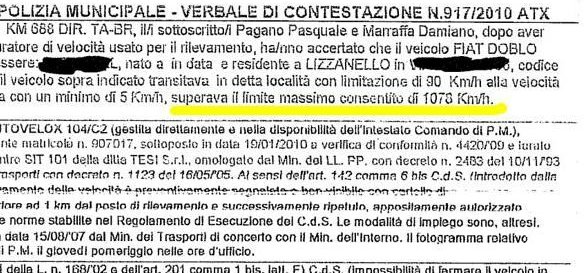
The owner of a family van was surprised to receive a ticket in the mail from police in the southern Italian town of Oria accusing him of driving 1230 km/h (764 MPH). The Lizzanello resident had been driving his Fiat Doblo on the SS7 in the province of Brindisi on November 6 and weeks later received a letter demanding that he pay 165 euros (US $223).
Italian tickets allow a five percent tolerance to account for the possibility of error. At 1230 km/h, the motorist exceeded the 90 km/h (56 MPH) speed limit with an adjusted velocity of 1078 km/h (669 MPH), according to the notice signed by two officers (view ticket). Oria police insist that the camera managed by the private firm Sodi Scientifica SpA is perfectly accurate. Officials blamed the incident “clerical error” in a statement issued Thursday.
Read More >
By
Edward Niedermeyer on February 13, 2011

Via the excellent lawbloggers at The Volokh Conspiracy comes news of a decision by a California appellate court in re: State vs Xinos which finds that the data recorded by a vehicle’s Event Data Recorder or “black box” is protected by the fourth amendment. The ruling covered a case in which police used EDR data to charge the driver in a fatal crash of vehicular manslaughter, and under appeal, the ruling was handed down that
We do not accept the Attorney General’s argument that defendant had no reasonable expectation of privacy in the data contained in his vehicle’s SDM. The precision data recorded by the SDM was generated by his own vehicle for its systems operations. While a person’s driving on public roads is observable, that highly precise, digital data is not being exposed to public view or being conveyed to anyone else. . . . We conclude that a motorist’s subjective and reasonable expectation of privacy with regard to her or his own vehicle encompasses the digital data held in the vehicle’s SDM.
And, according to Volokh
the computer data is in the car, not outside the car, so the legal standard that governs access to the data probable cause but not a warrant
Given trends towards ever more storage of vehicle telemetry data, this is a heartening development for motorists and privacy activists… but don’t be surprised if the issue ends up in the Supreme Court. [Hat Tip: TTAC commenter fincar]
By
Bertel Schmitt on February 12, 2011

In the brouhaha over Ferrari’s alleged trademark violation, Ferrari did the smart thing and surrendered. Ferrari withdrew the “F150” name for its new Formula One race car. Ford had brought suit in federal court, alleging that “Ferrari has misappropriated the F-150 trademark in naming its new racing vehicle the ‘F150′ in order to capitalize on and profit from the substantial goodwill that Ford has developed in the F-150 trademark.” Read More >
By
The Newspaper on February 11, 2011

The South Dakota House of Representatives voted 43 to 24 on Tuesday to prohibit the use of red light cameras and speed cameras in the state. A bipartisan group of lawmakers led by state Representative Peggy Gibson (D-Huron) took aim at the controversial automated ticketing machine set up in Sioux Falls, describing the due process denied innocent motorists ticketed by the system.
“My constituent not only did not own the car that was photographed, but she was not even in Sioux Falls at the time,” Gibson said Tuesday. “In other words, she was presumed guilty of a traffic violation she did not commit in a car she did not own, but she had to go to great lengths to prove her innocence.”
Read More >
By
The Newspaper on February 10, 2011

The Eleventh Circuit US Court of Appeals on Tuesday saw no problem with jailing a man for eight hours after he blew .03 on a breathalyzer — far below the legal limit. Santa Rosa County, Florida sheriff’s deputies had arrested Roger A. Festa on the charge of driving under the influence of alcohol (DUI) on April 9, 2005. Since he had been entirely sober, Festa sued Deputy Adam Teichner and Deputy Douglas Burgett for unlawful arrest.
Read More >
Receive updates on the best of TheTruthAboutCars.com
Who We Are
- Adam Tonge
- Bozi Tatarevic
- Corey Lewis
- Jo Borras
- Mark Baruth
- Ronnie Schreiber





Recent Comments