OK, OK, this is the Lancia-branded version of the Chrysler Ypsilon… and even when it gets a Chrysler badge, it won’t be coming to the United States (at least not in this iteration). Still, this is a huge moment for Chrysler: after all, the brand has not offered a legitimate subcompact car since the Omni/Horizon shuffled off the mortal coil some 21 years ago. And like the Simca-derived L-Platform subcompacts, the Ypsilon is thoroughly continental under its badging: the Fiat 500 platform underpins this hatch, though it has been stretched slightly to accommodate four doors. Performance will be modest as engine sizes range from 900cc to 1.3 liters, but with leather and Alcantara interior options, the first mini-Chrysler in over 20 years should offer a stately cabin for a subcompact. But will this be the Fiat-produced, B-Segment Chrysler that we’re expecting in 2013? And if so, will they change its name to Horizon?
Category: News Blog
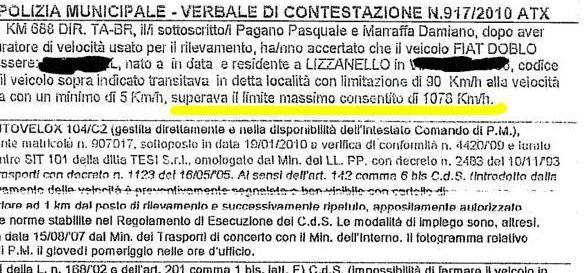
The owner of a family van was surprised to receive a ticket in the mail from police in the southern Italian town of Oria accusing him of driving 1230 km/h (764 MPH). The Lizzanello resident had been driving his Fiat Doblo on the SS7 in the province of Brindisi on November 6 and weeks later received a letter demanding that he pay 165 euros (US $223).
Italian tickets allow a five percent tolerance to account for the possibility of error. At 1230 km/h, the motorist exceeded the 90 km/h (56 MPH) speed limit with an adjusted velocity of 1078 km/h (669 MPH), according to the notice signed by two officers (view ticket). Oria police insist that the camera managed by the private firm Sodi Scientifica SpA is perfectly accurate. Officials blamed the incident “clerical error” in a statement issued Thursday.
It’s not out yet, and it won’t be before the end of the year, but Opel is already flogging the Euro-version of the Volt, the Ampera, as the perfect cop car. Main selling point: It’s a veritable multi mission vehicle. “Whether emission free on patrol, or silent during undercover surveillance, or fast and persistent when in hot pursuit – the Opel Ampera is the ideal police cruiser,” brags Opel, which appears to humor AutoBild. Read More >
The China Passenger Car Association reports that sales of passenger cars rose 12.6 percent to 965,238 units in January, says the Associated Press. However, as explained in my small lecture on the use and abuse of auto industry statistics, this is not the number we are waiting for. We are waiting for the sales of all motorvehicles in China with 4 wheels and over, also known as “automobile sales.” Read More >
For quite some time, we have been tracking a growing trend in China: Chinese cars. Well, Chinese cars, made by joint ventures with foreign carmakers. Here could be a new one, with a twist: Toyota so far has been hesitant following Nissan and others on the plugin bandwagon. Its Chinese joint venture, FAW-Toyota, will change that. They will come out with a Chinese-branded car that is a Toyota on the outside, and a Chinese-developed EV on the inside. If the information of BJNews (via Gasgoo) is correct, that is. Read More >
The wild Chinese autoblogosphere had been abuzz about a Chinese version of TopGear for a week now. Truth be told, it escaped my divided attention. No excuse, it will happen again. First on the story was my good friend Tycho, the intrepid red-haired Dutchman who runs the TheTycho car blog. He had an inside source at China’s state TV CCTV. Now, the matter is (semi-) official. Read More >
For years now, the compact pickup market has withered away due to the chicken-and-egg dynamic of poor sales and little investment in new models. Ford’s Ranger and Chevy’s Colorado are scheduled to die off this year, and with the new global Ranger not coming to America, Mahindra’s endless delays and weak mileage ratings, and no signs of other small truck investment, the segment looks ready to die. But, as it turns out, 2011 might not be the year that kills the compact pickup: tflcar.com reports from the Chicago Auto Show that
a well placed source within the company is that Chrysler will announce a new entry-level light pickup this year.
Since Fiat took over at Chrysler, there have been rumors of a Ram-branded unibody pickup… but rumors of a Jeep Wrangler-based pickup have been rampant as well. Whatever format a new Chrysler compact pickup comes in, here’s hoping it inspires other companies to bring out a rugged, fuel-efficient, compact pickup for the US market. You paying attention GM?
Bloomberg seems to think GM is heading back towards bad habits, reporting
General Motors Co. is offering to waive the last three payments on existing leases if holders buy a new car, adding an incentive onto deals that last month exceeded offers made by rivals.
The promotion began this month and is valid on most models with leases that expire between now and Aug. 31, according to the company. GM raised incentive spending in January by 16 percent to an average of $3,663 per vehicle, the highest among major carmakers, according to researcher Autodata Corp. GM sales outpaced the industry that month.
GM said in a video presentation for its initial public offering in November that it intended to offer fewer incentives that crimped margins and created an impression that price was the main selling point for GM vehicles. Early-return leasing deals may conflict with the that pledge, said Jessica Caldwell, an analyst at Edmunds.com.
“I hope they’re not walking down that road,” said Caldwell….
Given GM’s decision to release less incentives data, the signs do seem to be piling up. But, says Chevy marketing VP Rick Scheidt
I am not seeing any internal behavior that suggests we have gone back to old ways. It’s still way too close to the bankruptcy for us to be sliding back into bad habits. We know everybody’s watching.
Ever since Mercedes released its CLK back in 1996, Mercedes has offered one premium coupe slotted between its E and C-Class sedans. Sure, it offered the unloved C-Class Sportcoupe (aka CLC) for a few years in the US as an attempt at an entry-level Mercedes, but nobody really seemed to notice. Otherwise, between there and the none-too-cheap CL, Mercedes offered one coupe, known as the CLK (not counting the CLS “four door coupe”). Now, however, Mercedes has moved in a new direction, offering an “E-Class Coupe” and a “C-Class Coupe,” the latter of which will debut shortly at the Geneva Auto Show. The strange part: they’re both built on the C-Class platform. Mercedes, it seems, has learned an important lesson: when it comes to selling cars, it’s what’s on the outside that counts.
Via the excellent lawbloggers at The Volokh Conspiracy comes news of a decision by a California appellate court in re: State vs Xinos which finds that the data recorded by a vehicle’s Event Data Recorder or “black box” is protected by the fourth amendment. The ruling covered a case in which police used EDR data to charge the driver in a fatal crash of vehicular manslaughter, and under appeal, the ruling was handed down that
We do not accept the Attorney General’s argument that defendant had no reasonable expectation of privacy in the data contained in his vehicle’s SDM. The precision data recorded by the SDM was generated by his own vehicle for its systems operations. While a person’s driving on public roads is observable, that highly precise, digital data is not being exposed to public view or being conveyed to anyone else. . . . We conclude that a motorist’s subjective and reasonable expectation of privacy with regard to her or his own vehicle encompasses the digital data held in the vehicle’s SDM.
And, according to Volokh
the computer data is in the car, not outside the car, so the legal standard that governs access to the data probable cause but not a warrant
Given trends towards ever more storage of vehicle telemetry data, this is a heartening development for motorists and privacy activists… but don’t be surprised if the issue ends up in the Supreme Court. [Hat Tip: TTAC commenter fincar]

Having heard that the littlest Land Rover will go by the name “Range Rover Evoque,” Autoblog caught up with the Jaguar-Land Rover’s communications team at the Chicago Auto Show, and asked whether Tata’s luxury group would be trying to differentiate the Range Rover brand. Their answer?
Dealers will add Range Rover branding to their towers. the issue is in flux right now.
They will? This decision forces the question: what differentiates a Land Rover from a Range Rover?
Land Rover is more utilitarian, Range Rover is the top end of luxury. You don’t lose any capability with the Range Rover, but the Evoque especially is about unabashed on-road and urban driving.
There you have it. Certainly, “Land Rover Range Rover Sport” is an awkward formulation, but is “Range Rover Range Rover Sport” really any better? Is JLR making a worthwhile distinction between brands, or is it simply adding to America’s auto brand clutter?
Range Rover is apparently fairly serious about moving upmarket as Autocar reports it is about to announce a $200k+ “Ultimate” special edition. Plus, a new aluminum-platformed Range Rover is under development which will reportedly lose nearly one thousand pounds compared to the current model. More legroom and an interior featuring “the kind of lavish materials and design typified by Bentley” are said to be on tap for the new model. In short, it wounds like Range Rover is definitely headed upmarket… but where does that leave the Land Rover models?
While EVs are slowly, very slowly – catching on would be exaggerated, people are starting to think about the finer points. For instance: Electric vehicles and plug-in hybrids are powered by high-voltage batteries of up to 400 volts, possibly more. What happens if one crashes and first responders have to attack the vehicle with power cutters? Will the responder die from electrical shock? This is a hot topic amongst first responders, right up there with dealing with explosive airbags, belt tensioners and other surprises. Read More >

Normally, I don’t consider parking-lot photos for variations of the “interesting car parked in public” schtick, but this Caprice is special: it parks in a train-station parking lot in the roughest neighborhood in East Oakland. Every day. Read More >
Yes, and yes, says a study of the Resources for the Future (RFF) institute. The Washington think tank’s study examined “the unexplored link between the prevalence of overweight and obesity and vehicle demand” for bigger and more gas guzzling cars.
RFF brands itself as a “nonpartisan organization that conducts independent research.” Their study found “that the prevalence of overweight and obesity has a sizable effect on the fuel economy of new vehicles demanded. A 10 percentage point increase in the rate of overweight and obesity among the population reduces the average miles per gallon (MPG) of new vehicles demanded by 2.5 percent, an effect that requires a 30 cent increase in gasoline prices to counteract.” Basically what they are saying: Fat people choose fat cars. More fat people, more fat cars.
Shame on you if your belly keeps you from reading the numbers on the bathroom scale, you are driving up the cost of our gas, fatso. If you would eat less, we would pay less. If the study is correct. Read More >
Though the the impact of nationality on the auto industry may be fading, the issue couldn’t be more central for Sergio Marchionne and his Fiat-Chrysler Empire. Having accepted aid from both the Italian and American governments, the future merging of Fiat and Chrysler raises a delicate question: will a merged Fiat/Chrysler be an Italian or American firm? When Marchionne suggested that the Fiat-Chrysler alliance could be headquartered in Detroit, Italy erupted in recriminations. The Italian government called Marchionne onto the carpet to explain himself, even as critics lashed out saying
The government is moving too late, but better late than never. Marchionne is more oriented strategically toward the U.S. than Europe
And sure enough: Fiat restated its commitment to investing some $27b into Italian production, but as AFP reports
the question of whether Fiat would remain based in its birthplace of Turin remained unclear, with local officials saying it had been put off for three years and would depend on the company’s performance.
But, while American and Italian stakeholders bicker over the “national character” of a merged Fiat-Chrysler, the proposal establishing four headquarters in Turin, Detroit, Brazil and “somewhere in Asia” points to the real issue: Fiat-Chrysler must orient itself around its markets, not any national corporate character. The longer the divide between Italy and the US is played up, the more Fiat-Chrysler runs the risk of developing a dysfunctional corporate culture like the DaimlerChrysler “marriage of equals.” It’s just too bad that, by tying itself up with the governments of the USA and Italy, Fiat allows the “national character” question to take such prominence.


Recent Comments