


Europe has tried long and hard to stop Chinese cars at its gates. Mainly by smashing them to bits and putting the results on YouTube. The cars that make EU certification remain unmentioned. This is going to change.
Read More >


Europe has tried long and hard to stop Chinese cars at its gates. Mainly by smashing them to bits and putting the results on YouTube. The cars that make EU certification remain unmentioned. This is going to change.
Read More >
If we’re learning anything from the twists and turns leading into GM’s Cadillac V-Series Challenge, it’s that a good stunt is hard to stage these days [unless you have access to China’s rich reserves of stunt drivers, as shown above]. Jaguar’s US PR boss Stuart Schorr has informed us that his firm’s legal and safety advisers have put the kibosh on the XF-R’s planned entry into the event. Because Jaguar was previously the only manufacturer to enter the race, the pullout leaves TTAC, Jalopnik and the New York Times’ Lawrence Ullrich without an OEM-backed ride. As a result, the media challengers (as we’re being called) will go mano-a-mano with Bob Lutz in… a CTS-V. Which makes the event a bit more of “may the best man win” than “may the best car win,” but then that’s not exactly our problem, is it? [Don’t miss the literal Chinese fire drill at 1:56]

Imagine, for a moment, how different this Curbside Classic would be if Honda actually built this little electric neo-600.

Fans of oil-burners, brace yourselves. Dodge is confirming [via Detroit News] that a hybrid Hemi version of its light-duty Ram pickup is in the works. A diesel option, however, is still being reviewed. And its prospects aren’t looking good. When Chrysler senior vice president of engineering Scott Kunselman confirmed that the hybrid would be a reality, the only thing he would say about the diesel option is that he “isn’t convinced there is enough of a market among recreational buyers,” who buy light-duty trucks. His argument is that recreational light-duty buyers don’t see the long-term reliability of diesels as being worth the extra price of admission, a perspective which reflects both the classic “Detroit knows best” attitude and a resignation on Chrysler’s part to doing business from Consumer Reports’ cellar. Especially considering Chrysler’s partners in developing its two-mode hybrid appear to be walking away from the technology. And since 85 percent of heavy-duty rams are bought with the diesel engine, you’d think it would make a certain amount of sense to offer a Cummins option in the mass-market model. But it’s looking like that train will not be coming back to the station. Meanwhile, has anyone seen Mahindra lately? We’re starting to worry…

Though we don’t have a [sub] for Consumer Reports‘ members-only data, their latest reliability survey summary has enough interesting tidbits to warrant a mention. Based on their subscriber base’s 1.4m autos, and using only data available for at least 100 examples of a given model, the survey is one of the better indicators of reliability out there (although when it comes to this topic there is no gospel). If nothing else, it’s hard to argue that CR’s reliability results aren’t influential, so sales are definitely at stake. The results? All Toyota/Lexus/Scion received ratings of “average” or better, an improvement over last year when CR found Camry V6, Tundra V8 4WD, and the Lexus GS AWD to be lacking. Honda/Acura and Subaru also showed extremely well where complete data was available, and Hyundai/Kia models were average or better except for Sedona and Entourage. Hybrids also scored surprisingly well, with nine gas-electrics scoring above average. But CR is making the biggest fuss over Ford, which they say is “on par” with the Japanese firms on all but a few truck-based models. The rest of the Detroit firms? Not quite so much.

Walter McManus, former GM economist and current head of the Automotive Analysis division of the University of Michigan Transportation Research Institute, wants you to know GM’s SUV strategy of ignoring efficiency as a marketing input was his fault. In an interview with Energy and Environment News [via Edmunds Green Car Advisor], McManus explains how surveys in the 1990s showing consumers did care about efficiency were ignored:
The survey would estimate that people would estimate fuel economy fairly highly. Being a good economist, I said, ‘No, they don’t,’ and I changed the results. There was a systematic bias against such results. Our job was not to seek the truth, but to justify decisions that had already been made… It’s my fault they had the wrong vehicles until now
Can you say culture issues? McManus’s explanation for the insular attitude is a familiar refrain, namely that decisions “are being made by upper-middle-class white males, by and large. They don’t understand that the customers are not the same as they are.” Now that gas prices have made efficiency impossible to ignore though, McManus sees change coming.

The Ford Mustang is not only Autoblog’s meat and potatoes, it’s also America’s most modded machine. Turning the relatively demure ox-cart suspended pony car into a overwrought, overpowered death car is big business. As our Best and Brightest know, the Las Vegas SEMA show is the temple of VTEC—I mean, modded motors. This year, Ford is sponsoring the show and bringing the noise (or whatever the current colloquialism may be). They’ve sent the usual herd of free ‘Stangs to the tuners with the inevitable results. White wall tires are in again? Who knew? “SEMA is important to Ford,” said Brian Wolfe, director of Ford Racing. “It’s not only about making great cars, but for those enthusiasts who want to take their cars beyond what manufacturers build.” So does that mean that people who take their cars beyond what manufacturers build are not making great cars? Perish the thought.


Chrysler’s five-year product and business plan won’t be officially announced until next Wednesday, but the leaks have begun already. The Wall Street Journal was so curious about Chrysler’s product plan, they were able to squeeze a few broad strokes out of “people briefed on the plans.”

It gives me great pride to give UAW Local 435 workers the opportunity to partner with Fisker Automotive to create a greener America by building a plug-in hybrid car that will compete globally
So goes the line from Gary Casteel, the new Union boss for Fisker’s new Wilmington, Delaware plant at Automotive News [sub]. Why would the luxury EV startup hitch its wagon to the union that helped bring down Detroit? Was it a condition of GM’s sale of the plant where Pontiac Solstice/Saturn Sky were once built? Or does Fisker think that running a union shop might help bring in federal dross? Or are projected profit margins so strong that Fisker just doesn’t care? One thing’s for certain: though the UAW has agreed to a number of concessions over the past year, there’s a reason that most new US auto plants avoid union representation like the plague. From VW and Kia to Hybrid Kinetic Motors and Tesla, new US factories are being located in Southern states and California largely to escape the profit and productivity-sapping union. Either Fisker knows something that they don’t, or inviting the union into the new shop was a potential error of enormous magnitude.
Stanford University bring us a little closer to the day when cars will come with a pre-programmed Nurburgring (or, in this case, Pikes Peak) lap time. [Hat Tip: Robstar]

Sometimes, I come across a quote that is, in or itself, perfect. Like this one from 11alive.com, re: the theft of seven Shriners parade cars.
What these burglars have done is really set the organization back in terms of our parades. Our next parade would have been the College Park Parade, in College Park. And without our cars, it’s just real difficult. So me and the other members of the Temple, we’re going to have to come up with a plan and see what we can do to try to put ourselves back in the parades…. The Temple has clowns. But if you didn’t have the mini-cars, I mean, to me, it’s not a parade.
Anyone with coulrophobia, a kind heart or both can send your donations to Nabbar Temple Motor Unit, 330 Auburn Ave., Atlanta, GA 30312. Meanwhile and in any case, click here for my favorite Shriners’ Mini car site.

After a dismal PR year for Detroit (if only because lobbying efforts were successful enough to secure an unpopular bailout), the American Automotive Policy Council has been launched to represent the very special interests of Ford, GM and Chrysler. As Politico unironically puts it, “(Debbie) Dingell, the wife of Rep. John Dingell (D-Mich.) and longtime auto industry lobbyist Stephen Collins are leading the new American Automotive Policy Council.” Because former GM lobbyist Dingell, who was moved to an administrative position when she married Rep John Dingell (D-MI) is somehow not a longtime industry lobbyist? Marrying the then-Chairman of the Energy and Commerce Committee is like winning the gold medal for Detroit lobbyists… Dingell just had her number retired. Anyway, the new lobbying council is an offshoot of Automotive Trade Policy Council, a group known for such truth-telling efforts as Driving The Future: The New American Auto Industry [PDF], published in the heady optimism of June 2008. Which is a good indication of what we can expect from the AAPC. First up, a “manufacturing initiative” intended to “develop credible and reliable information for policymakers.” This is gonna be good.

It’s your classic case of schlechte/gute Nachrichten. Post-Chrysler Daimler is predicting positive earnings in the fourth financial quarter—before interest and tax. After that, after the federal money’s gone, things will go from worse to worserer. “Global demand for cars should fall this year by only around 10 percent thanks to state incentives . . . Negative effects on demand can be expected when the state support programs are phased out in the following years, particularly in the volume segments of more mature markets.” Reuters’ numbers tell the tale. Sales at Daimler’s high margin division, Mercedes-Benz Cars, fell by 15.7 percent in the first three quarters of the year to 825,600 vehicles. Remember: that’s compared with last year, which was no sales bonanza, Hoss. Without a buoyant Chinese market uh, buoying Mercedes, the numbers would be even bleakerer. Meanwhile, Automotive News reports that Honda has revised and tripled its profit forecast—and sounded the same alarm. “Honda, the world’s seventh-biggest carmaker, attributed the bulk of the revision to state-backed measures to stimulate sales and warned a real recovery in demand was still some time off.”

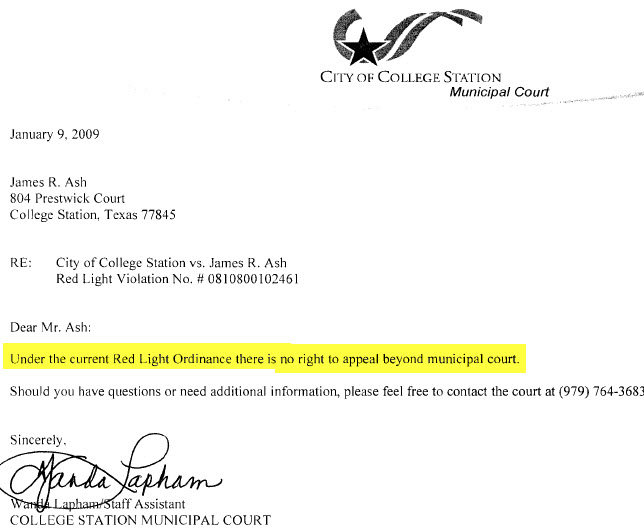
In the state of Texas, the right to a meaningful appeal in a red light camera case does not exist. While several states have allowed photo enforcement tickets to be appealed to the highest level — Minnesota’s highest court ruled on a photo ticket in 2007 and a red light camera case is currently pending before the California Supreme Court — several Texas municipalities are using an ambiguity in state law to deny challenges beyond the lowest level of the court system. “Under the current red light ordinance there is no right to appeal beyond municipal court,” College Station Municipal Court assistant Wanda Lapham wrote in a letter to Jim Ash (view letter).



Recent Comments