I recently received an email from the now bi-weekly AutoWeek offering me a FREE YEAR! “Now, for a very limited time, you can take advantage of our lowest rate ever. For just $19.95, you can enjoy TWO YEARS (52 issues) of your favorite magazine! That’s 90% off the retail rate–just 38¢ per issue!” Despite “bi-weekly race results, news straight from the auto show floor and unbiased editorial reviews,” I’m holding out for the last 10 percent discount, and the removal of the two-year requirement. That’s not as strange as it sounds; we’re getting reports that Car and Driver subscribers are getting the buff book long after they’ve let their subs expire. Subscription income sacrificed on the Alterman of advertising? Perish the thought! Meanwhile this from Automobile: “An exclusive limited-time offer has been reserved for you from Automobile Magazine. Through October 9, you can get a full year of Automobile for only $10! That’s $49.88 off the cover price – an 83% savings!” Clearly, these guys are toast. The question is, what, if anything will replace them? Personally, I think it’s the ideal time to start a new car magazine; one that redefines the genre with coffee-table compatible paper stock, world-class photography and scintillating, insightful reviews and features (a la The Rodders Journal). Or is it time to stick a fork in the whole car mag thing?
Category: News Blog
The Beacon News in Illinois has another story of ticket camera bureaucracy causing problems for motorists. Here’s an excerpt:
Unsure why the Kane County Circuit Clerk would send him anything in the mail, Ernie Bolen assumed he’d been summoned for jury duty.
Needless to say, a letter stating he owed $375 for speeding in an Interstate 88 construction zone came as a surprise to 43-year-old Bolen, who says he never saw a ticket or anything notifying him of a court appearance.
“I haven’t seen it,” the Montgomery man said of a citation. “I was like, what the heck is this.”
Court records show the ticket was generated by a tollway construction zone speed camera on May 5. A June 19 court date was scheduled. Bolen, who says he never received any notice of a court date, received a judgement against him and the fines were assessed.
A TTAC source asks us to perform the following mental exercise:
“Just imagine that you’re a car salesman and you come into work this morning. Your boss says we have a bunch of new incentive programs you need to learn. And here they are . . .”
Maryland officials wasted no time in kicking off the required warning period for the statewide interstate highway speed camera program authorized by a law that took effect yesterday. Transportation Secretary Beverley K. Swaim-Staley announced that the first three locations for the cameras would target motorists in so-called work zones on some of the most heavily traveled interstates in the country. Starting November 1, privately owned speed camera vans will issue actual tickets to commuters and travelers headed between New York and Florida. For example, on an average day 184,152 drivers will pass the new speed camera location on I-95 between MD 198 and MD 216 in Prince George’s County. The Baltimore County I-95 location, between I-895 and White Marsh Boulevard, will target 162,812 drivers daily. On Interstate 695 at Charles Street in Baltimore, the cameras will record the passing of 159,021 cars.
Kelsey writes:
My boyfriend recently sold his F-150, and we’ve been looking at ’95-2000 4Runners as a replacement. He needs a V6 to tow his work trailer occasionally, and our biggest concern is reliability, then efficiency. We’re working with a $7,000 cash budget. Should we broaden our search to other makes/models?
Volkswagen was up 1.5 percent, despite huge drops in total Rabbit (-74.5 percent) and Passat (-55.8 percent) sales. Passat CC more than made up the difference for its pedestrian sibling, selling nearly three and a half times the Passat at 2,290. Tiguan (-17.7 percent) and Touareg (-49.4 percent) tanked, but surprising Routan sales (+140 percent, 901 units) helped make up for it. Jetta wagon was down 9.1 percent but Sedan sales rose 10.4 percent on much higher volume, making for an 8.5 percent increase. New Beetle dropped 12.1 percent while Eos fell 21.8 percent. Audi was down 4.9 percent with only A3 (+26.1 percent), A5 (+37.3 percent) and R8 (+5.5 to 77 units) up on the month. Q7 (-46.7) and A8 (-28.4 percent) were the biggest losers.
Mercedes was down 9.6 percent with only the refreshed E-Class (+28.4 percent) making significant volume gains. The new GLK sold 1,558 units, but that wasn’t enough to beat ML volume which slid 14.4 percent to 2,552. Mercedes’ best seller was the C-Class, which fell 26.1 percent to 5,002. That model outsold E-Class and S-Class put together.
BMW sales increased 3.6 percent in September, including a 9.7 percent bump in MINI sales. BMW-brand cars were up 17 percent while SUVs fell 37 percent. The 3-Series was the best-selling Bimmer with 6,523 units sold.
Porsche was up eight percent, with Cayman and Boxster models gaining faster than most 911 and Cayenne models. Carrera 4S and 4S Cabriolet were exceptions to unexceptional 911 sales, recording 89 and 105 sales respectively.
Earlier this year, when sales were down almost across the board, Subaru was usually Hyundai’s only company in the sales-increase club. Subaru didn’t come close to Hyundai’s percentage increase in September, recording only one percent growth, but it’s still up ten percent year-to-date. Impreza tanked by 42 percent after the Clunker crowd binged on Suby’s smallest model last month. Tribeca also stunk it up, falling to 358 units. Otherwise things were all cheddar and gravy (so to speak). Forester, which carried Subaru’s strong showings through most of the year, edged up by one percent. But that was more than offset by a 63 percent boom in sales of the new Outback, which hit 4,268 units. Legacy added 2,762 sales, a 24 percent increase.

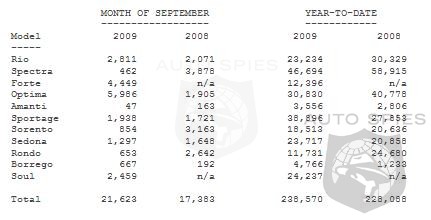
If Ford, Honda, Toyota and Nissan are nursing headaches after the Cash For Clunkers party and GM and Chrysler are still asleep in puddles of their own vomit, Hyundai Group never went to sleep and is still partying hard. With sales up 26 percent over September ’08, Hyundai is holding a clinic on the difference between a soft landing with an excuse and real success. And Kia [via Autospies] isn’t far behind, with sales up 24.4 percent. As if to prove that nobody has it easy in today’s global car game, Bloomberg reports that the strength of the Korean Won is gouging Hyundai’s overseas profit. Still, in the American market, Hyundai wouldn’t trade places with any other manufacturer.
The three Japanese majors saw September sales slides that were generally closer to Ford’s mild Clunker hangover than GM and Chrysler’s cliff dive belly-flop. Honda‘s 20 percent overall decline was the worst of the bunch, and was led by a 30 percent drop in Acura sales. In contrast, Toyota-brand vehicles fell 19.1 percent while Lexus actually recorded a 7.3 percent increase. Nissan-brand sales declined a mere 5.8 percent, while Infiniti fell 15 percent.
If you’re looking for proof that shoppers are avoiding the auto industry’s bailout babies, here’s the final piece of evidence you need: Not only did Ford outperform GM and Chrysler during Cash For Clunkers, but it’s also weathering the post-clunker decline with a mere five percent September decline compared to GM and ChryCo’s 45 and 42 percent drops. Across every segment, Ford is proving resilience that cannot be explained by mere product comparisons. Perception feeds reality, and the perception that Ford has not received a federal bailout is clearly helping the Blue Oval move metal.
The bailout babies of the US auto industry took a pummeling in the post-Cash For Clunkers sales environment, as Chrysler very nearly matched GM’s precipitous decline. Unlike GM though, Chrysler isn’t predicting a turnaround by year’s end. “We believe the remainder of 2009 will continue to be a challenge for the U.S. automotive market,” says Chrysler brand boss Peter Fong [via PRNewswire]. “Credit markets have thawed slightly, but still remain tight, and consumer confidence, as we saw in September, is tenuous.” And yet nothing seems to be quite as tenuous as Chrysler’s grip on its razor-thin market share.


Recent Comments