Find News by Subject:
By
The Newspaper on March 1, 2011

Texas Attorney General Greg Abbott does not want anything even resembling a speed camera to operate in the Lone Star State. In an opinion handed down yesterday, Abbott denied the request of the city of Plano’s request to use handheld laser speed guns equipped with cameras and GPS devices on the grounds that doing so would violate a Texas law that bans automated photo radar devices.
Read More >
By
The Newspaper on February 25, 2011

A peer-reviewed article published Wednesday in the Florida Public Health Review elaborated on a previous analysis of methods used in certain red light camera studies. University of South Florida (USF) researchers Barbara Langland-Orban, Etienne E. Pracht and John T. Large returned to clarify certain points raised in response to their 2008 report that concluded red light cameras tended to increase injury accidents (view study).
“In our original critique, we faulted the research methods used in the Federal Highway Administration’s (FHWA) analysis titled Safety Evaluation of Red-Light Cameras,” the USF report stated. “One FHWA official subsequently contacted us to point out that we overlooked an important finding: fatal crashes at red light camera sites had increased, yet were ignored in the related economic analysis.”
Read More >
By
Edward Niedermeyer on February 24, 2011

Think using your cell phone or other in-car distractions don’t affect your driving? Don’t try to prove it on the road (jackass), put your reaction-time skills to the test at the NYT’s multitasking reaction-time game. While using your keyboard to navigate gates, a cell phone will distract you with New Yorkian requests which you will have to answer while continuing to navigate through randomly-opening gates. The Times team that came up with the game explains
We weren’t trying to be an exact simulation of driving down the highway or the road — it’s not realistic to have all those gates and people often text in shortened words. It is a game to give you a sense of how a distraction can decrease your ability to react quickly
When you finish, the game will tell you how much multitasking impaired your ability to navigate. Let us know how you did, and if the game changed your opinion about distracted driving.
By
The Newspaper on February 24, 2011

A police officer in Houston, Texas thought he had a slam dunk case against a motorist he stopped for driving on the wrong side of the road on September 15, 2008. The US Court of Appeals for the Fifth Circuit in a February 10 decision overturned the stop on the grounds that driving on the wrong side of the road is not always against the law.
Read More >
By
The Newspaper on February 23, 2011

A consensus is growing among the appellate divisions of the California Superior Court that red light camera evidence currently offered by private companies does not meet the appropriate legal standard of proof. In December, a three-judge appeals panel in San Bernardino handed down a unanimous decision reversing the photo ticket issued to motorist John Macias.
Macias received a ticket in the mail after his car was photographed in Victorville on January 10, 2009 making a slow right-hand turn at a light that had been red for 0.36 seconds. His attorney, Robert D. Conaway, argued that when San Bernardino County Sheriff’s Deputy Baker testified as a witness against Macias, Baker had no personal knowledge of the facts of the case. As such, his evidence was hearsay.
Read More >
By
The Newspaper on February 21, 2011

Redflex Traffic Systems of Australia today announced that the Australia-based toll road giant Macquarie and the asset management firm Carlyle Group would spend $300 million to dominate the red light camera and speed camera business.
“The proposed acquisition of Redflex by the consortium will be by way of a scheme,” Redflex stated in its announcement to the Australian Securities Exchange. “The scheme is subject to certain conditions including Redflex shareholder and court approval, regulatory approvals and other conditions that are usual for a transaction of this nature.”
Read More >
By
Edward Niedermeyer on February 18, 2011

Arizona is home to the oldest continuously operating speed camera programs and the US headquarters for the two largest private companies that operate the equipment. It could also be the latest state to join the fifteen jurisdictions that ban automated ticketing machines. The Arizona Senate Government Reform Committee voted 5 to 1 on Wednesday to approve legislation repealing the statutes that have allowed the use of red light cameras and speed cameras in the state. The move represents a significant reversal for a legislature that in the previous session introduced no significant legislation to curtail photo enforcement thanks to a leadership that fully backed the program.
Read More >
By
The Newspaper on February 17, 2011

Activists in Winnipeg, Canada yesterday charged city leaders with using photo radar to exploit a hard-to-see sign used to provide notice of a change in the speed limit. To make its case, WiseUpWinnipeg broke out a copy of the official regulations governing signs, the Manual of Uniform Traffic Control Device (MUTCD) for Canada, to determine whether the speed limit signs were placed in accordance with national standards. The group concluded that several of the signs are substantially out of compliance.
Read More >
By
The Newspaper on February 15, 2011

The Virginia House of Delegates and a state Senate committee approved legislation that would make a rolling right-hand turn on a red light a reckless driving offense. On Thursday the Senate Transportation Committee unanimously approved a bill introduced by Delegate Bill Janis (R-Glen Allen) which the lower chamber had approved by a 67 to 31 margin on February 4.
“Any person who drives a motor vehicle in violation of Section 46.2-833 is guilty of reckless driving,” House Bill 1993 states.
Read More >
By
The Newspaper on February 14, 2011

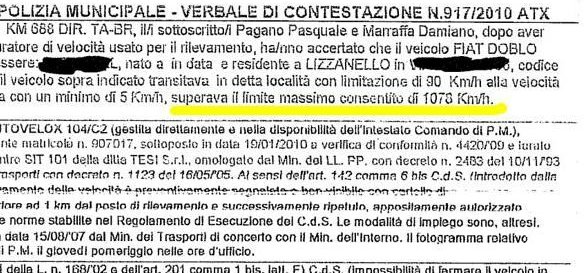
The owner of a family van was surprised to receive a ticket in the mail from police in the southern Italian town of Oria accusing him of driving 1230 km/h (764 MPH). The Lizzanello resident had been driving his Fiat Doblo on the SS7 in the province of Brindisi on November 6 and weeks later received a letter demanding that he pay 165 euros (US $223).
Italian tickets allow a five percent tolerance to account for the possibility of error. At 1230 km/h, the motorist exceeded the 90 km/h (56 MPH) speed limit with an adjusted velocity of 1078 km/h (669 MPH), according to the notice signed by two officers (view ticket). Oria police insist that the camera managed by the private firm Sodi Scientifica SpA is perfectly accurate. Officials blamed the incident “clerical error” in a statement issued Thursday.
Read More >
By
The Newspaper on February 10, 2011

The Eleventh Circuit US Court of Appeals on Tuesday saw no problem with jailing a man for eight hours after he blew .03 on a breathalyzer — far below the legal limit. Santa Rosa County, Florida sheriff’s deputies had arrested Roger A. Festa on the charge of driving under the influence of alcohol (DUI) on April 9, 2005. Since he had been entirely sober, Festa sued Deputy Adam Teichner and Deputy Douglas Burgett for unlawful arrest.
Read More >
By
The Newspaper on February 9, 2011

A century ago, the forerunners of the American Automobile Association (AAA) provided a service that warned motorists about upcoming speed traps. AAA Carolinas turned away from this history and used its considerable influence on Monday to support a speed trap declared illegal by South Carolina’s attorney general and several of its lawmakers. Since August, the tiny town of Ridgeland has allowed a private company to operate a speed camera on Interstate 95 in direct defiance of a state law enacted in June specifically to stop the program (view law).
“All branches of government are facing constricting budgets,” a AAA Carolinas statement explained. “Law enforcement agencies will not be able to simply add staff to handle the growing traffic volume and therefore must look to creative solutions to do more with less. This photo-radar enforcement program in the Town of Ridgeland is one such example and should be replicated as opposed to rejected.”
Read More >
By
Edward Niedermeyer on February 8, 2011

A recent report from High Road Auto Research [full report in PDF here] finds that
It has been consistently found that the higher a vehicleʼs travel speed (even when driving at or under the legal limit), the greater the focus of the driver on their surroundings. The increased perception of danger triggers an increased endocrine reaction within the brain. This, in turn, forces the individual to play closer attention to objects in motion around the vehicle. Even relatively small changes in vehicle speed can result in substantial increases in spatial acuity and response time.
On the surface the report seems to be trading in truisms: after all, who would argue that higher speeds don’t trigger faster stimulus responses in drivers? But how does that apply to the real world of highway safety legislation and speed limits?
Read More >
By
The Newspaper on February 8, 2011

Anonymous informants may direct police to pull over any motorist regardless of whether the other driver has committed any traffic offenses under a ruling handed down by the Michigan Court of Appeals last week. The state’s second highest court reversed the finding of a circuit court that had insisted on police officers having probable cause before initiating a traffic stop.
The court considered a March 17, 2008 incident in which Michigan State Trooper Christopher Bommarito was on patrol in the city of Southgate. As Bommarito was heading out of a parking lot, a woman behind the wheel of a red pickup truck pointed at a nearby car and mouthed the phrase “almost hit me.” Bommarito immediately activated his siren and entered into hot pursuit. He had no other information aside from the point when he pulled over Shaun David Barbarich who was later arrested for drunk driving.
Read More >
By
The Newspaper on February 7, 2011

The Maryland Court of Appeals ruled on January 24 that officers who received speed camera tickets while driving police cars on duty must pay the $40 fine. Montgomery County Officers Dean Cates, Randy Kucsan, Bill Tran, and Dana Way protested after their department reissued citations in their names in 2008. They were found guilty in district court, but a circuit court judge dismissed the charges on the grounds that the officers were denied their due process rights. The state appealed, hoping the court would rule that police officers are not entitled to due process before liability for a speed camera ticket is transferred.
Under county policy, speed camera tickets are re-issued to the policemen, paramedics and firemen who were behind the wheel of police cars, ambulances and fire trucks if the emergency lights on the vehicles were not visibly activated in the photograph. The officers complained that their sergeant would ask them weeks or months after an alleged offense to explain why they were speeding. Read More >
Receive updates on the best of TheTruthAboutCars.com
Who We Are
- Adam Tonge
- Bozi Tatarevic
- Corey Lewis
- Jo Borras
- Mark Baruth
- Ronnie Schreiber





Recent Comments