Nissan’s got a new platform (codename “V”) that will underpin a number of low-cost body styles for third-world markets… like the US. According to Automotive News [sub], a four-door sedan, a five-door hatchback and a multipurpose vehicle will be based on the sub-Versa platform, collectively replacing the non-US-market Micra. Nissan hopes to sell a million of the three-cylinder subcompacts annually worldwide, necessitating a US campaign that will launch sometime after 2010. The vehicles will offer 50 percent fuel economy improvements over the Micra, use 18 percent fewer parts, and will not be built in Japan as Nissan has sought to keep costs for the range as low as possible. Auto Motor und Sport adds the crucial consideration that the new model will not fall into the gender-specific categorization that caused 80 percent of German Micra sales to come from women. Thank goodness for that then.
Category: Nissan
![]() |
Nissan ReviewsThe Nissan name was first used in 1933, but the company's history goes back much further. Originally known as Kwaishinsha Motorcar Works, the company produced its first automobile, the DAT, in 1914. DAT later became Datsun (son of DAT) in 1931 and Datsuns went on to become the first mass-produced vehicles in Japan. Americans got their first look at the Datsun in 1958 - the 1200 Sedan. The Datsun 240Z was released as a 1970 model and it became the best selling sports car in the world, selling 500,000 units in less than 10 years. |
Another day, another meticulously-crafted yet completely bastardized retro-mod, conceived but not realized by a designer working for a major car company, finished via the patronage of California collector Ron Kellogg. This time ’round, Big Ron’s looking to de-acquisition an Aerodyne Streamliner Coupe penned by Nissan Design’s California model shop manager John Toom. The quote marks denote deconstruction. Toom’s fantasy whip sits on a 1956 Jaguar XK140 frame, powered by a rebuilt 3.8-liter XKE engine. Et voila! A Bugatti Type 57 SC Atlantique knock-off! Whatever it isn’t, the Jag-based whip’s got bespoke door handles, gauges, dashboard, the works. Unlike Kellogg’s cod-Bug, the sales bumph for the made-up Jag doesn’t include a list of concours events which have welcomed the car. Take that as you will. Referring to Kellogg’s car photo website, we can speculate that the collector’s willingness to do the wild thang with a Jag connects to his first car: a XK120 coupe. More than this, I do not know, and the Internets will not reveal. Suffice it to say, if I were a mainstream manufacturer’s car designer with a hankering to reinvent a classic car, I’d think twice before risking the Curse of The RestoMod Motors.
| 1. Chrysler Group | $4,584 | +18% |
| 2. GM | $3,796 | +6% |
| 3. Ford Motor Co. | $3,451 | +2% |
| 4. Hyundai-Kia | $2,998 | +40% |
| Industry Average |
$2,835 | +10% |
| 5. Nissan North America | $2,511 | +19% |
| 6. Toyota Motor Sales | $1,620 | +22% |
| 7. American Honda | $1,310 | +9% |
Through September, as calculated by Edmunds [via Automotive News [sub]]
There’s the newly-updated Mitsuoka Viewt. It’s a Nissan Micra with a huge crush on the Jag Mk2. And a penetrating insight into the deep reserves of quirk available on the Japanese market. Hit the jump for cognitive dissonance-inducing interior shot.
The Tennesseean (and I raise you a Kentucky) reports that Nissan’s all-EV Leaf looks set to steal a march on GM’s electric – gas hybrid Hail Mary Chevy Volt. “With the rollout of Nissan’s first electric vehicles just over a year away in Tennessee, the race is on to figure out how to set up a network of charging stations swiftly enough to get ready. It won’t be easy. Thousands of chargers will be needed to satisfy Nissan’s ambitious plans to sell thousands of the clean-running cars in the first year as it strives to be the first automaker in the world to successfully mass market an all-electric vehicle.” In other words, the Leaf is going all-in with a close-to-base roll-out strategy. “Phoenix-based ECOtality Inc. has partnered with Nissan to set up the charging systems in consumers’ homes, as well as to create public networks in Nashville, Chattanooga and Knoxville and on the interstate highways between those cities.” And who, pray tell, is paying for all this? Well duh.

I recently came across a brand new Lincoln MKS. I’m a pretty hard core Japanese car fan but I had to admit that this car looks pretty slick. I had heard that it was pretty fast too. I like fast. Upon inspecting the exterior of the car it came to my attention that the MKS is equipped with ‘EcoBoost.’ Not being up on the very latest in automotive tech, the unfamiliar name intrigued me. Was this some hybrid or electric technology? Curious, I started off on a quest to find out what this EcoBoost is and what makes it so… EcoBoost-y.
As the latest sales show (and have been showing for some time now) Scion is one hot mess. And though the best advice we can give is for Toyota to start selling its JDM confections as Toyotas, somehow we don’t think the big T wants to hear it. Instead, why not pick a new lineup from the latest batch of Daihatsu concepts shown at the Tokyo show [courtesy:AutoBild]? Or better yet, post a link to other Toyota/Daihatsu products that could pep up the least youthful “youth brand’s” sales. After all, anything would be better than leaving Scion as-is.
The “Z-car” has been with us now for forty years, but let’s be honest: most of those years were fairly disappointing. The original 240Z was a fabulous car that richly deserves its place in history, and the 1990 300ZX Turbo was a singular statement of high-speed style, but the story of the Z is too often a story of bloat, questionable visuals, and dismal V-6 engines. So it was with the 2003 350Z. As with Volkswagen’s New Beetle, adapting show-car style to an oversized platform-variant production model took a horrible aesthetic toll. The interior was dismal and the driving experience was too clearly that of a short-wheelbase G35. A ten-minute test drive six years ago was all I needed to cross the porky Zed off my personal list permanently, and not even the rather stunning-looking Nismo run-out model was sufficient incentive to change my position on the matter.
Penske Automotive’s official explanation for pulling the cord on Saturn was that they couldn’t get a supply deal. Renault-Samsung figured the risks of supplying a reborn Saturn were high, while the reward was (at best) competition with established Nissan offerings. But Roger Penske was putting his company out on a limb as well. Penske Automotive stock had been bid up in the days before the Saturn deal fell apart, as speculators sought to get in on the ground floor of the new company. As usual though, the speculative bid-up was based more in hype and long-term potential than underlying financial realities. Despite a losing over $3 in share price after the collapse of the Saturn deal, Penske’s forbearance is being rewarded. Standard and Poors had put Penske on a credit-rating downgrade watch on fears of the firm over-leveraging to take on Extreme Makeover Saturn Edition. With the deal called off, Penske stock might not have the speculative upside it once did, but it has already doubled this year. And backing away from a potentially messy revival of a troubled brand has PAG headed out of the credit-rating doghouse. And as the man himself has said, “my dad told me a long time ago, it’s not what’s good for you Roger, it’s what’s good for the company.” Meanwhile, Pete “Autoextremist” DeLorenzo figures the Saturn network would make a good upscale network for Hyundai’s Genesis and forthcoming Eqquus lines. A whole network for two vehicle lines? I wouldn’t be holding my breath. Luckily Saturn dealers have had a few years to get used to being unwanted.
Hyundai is awesome. They are undoubtedly a threat because their products are cheap, and the quality is improving
Honda CEO Takanobu Ito in the Canadian Press. “Hyundai is the biggest threat for the Japanese automakers,” adds Nissan senior VP Shiro Nakamura. “We have to offer the equivalents of sushi, tempura and kaiseki to compete against Korean barbecue.” Now imagine the reaction these quotes would have received ten years ago.
| 1. | Ford F-Series | 33,877 |
| 2. | Toyota Camry | 25,745 |
| 3. | Honda Accord | 20,826 |
| 4. | Toyota Corolla/Matrix | 20,741 |
| 5. | Chevrolet Silverado | 19,401 |
| 6. | Honda Civic | 16,093 |
| 7. | Honda CR-V | 14,554 |
| 8. | Dodge Ram | 13,452 |
| 9. | Chevrolet Impala | 13,047 |
| 10. | Nissan Altima | 12,149 |
| 11. | Toyota Prius | 10,984 |
| 12. | Ford Fusion | 10,834 |
| 13. | Chevrolet Malibu | 10,479 |
| 14. | Toyota RAV4 | 10,398 |
| 15. | Volkswagen Jetta | 9,568 |
| 16. | Ford Focus | 9,182 |
| 17. | Ford Escape | 8,692 |
| 18. | Lexus RX | 8,228 |
| 19. | Pontiac G6 | 8,097 |
| 20. | Chevrolet Camaro | 7,961 |
[via The Freep]

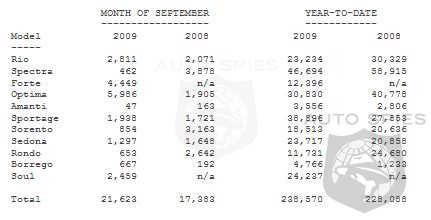
If Ford, Honda, Toyota and Nissan are nursing headaches after the Cash For Clunkers party and GM and Chrysler are still asleep in puddles of their own vomit, Hyundai Group never went to sleep and is still partying hard. With sales up 26 percent over September ’08, Hyundai is holding a clinic on the difference between a soft landing with an excuse and real success. And Kia [via Autospies] isn’t far behind, with sales up 24.4 percent. As if to prove that nobody has it easy in today’s global car game, Bloomberg reports that the strength of the Korean Won is gouging Hyundai’s overseas profit. Still, in the American market, Hyundai wouldn’t trade places with any other manufacturer.
The three Japanese majors saw September sales slides that were generally closer to Ford’s mild Clunker hangover than GM and Chrysler’s cliff dive belly-flop. Honda‘s 20 percent overall decline was the worst of the bunch, and was led by a 30 percent drop in Acura sales. In contrast, Toyota-brand vehicles fell 19.1 percent while Lexus actually recorded a 7.3 percent increase. Nissan-brand sales declined a mere 5.8 percent, while Infiniti fell 15 percent.

Scanning the autoblogosphere, I did a figurative double-take on Autoblog’s headline: 2010 Detroit Auto Show main floor is full, recession officially OVER. Since when does Autoblog do irony? Since never, apparently. Here’s the genesis . . . After a disastrous 2009, where major manufacturers pulled out of the North American International Auto Show (NAIAS) like a recently divorced billionaire riding bareback, the event’s organizers are fighting for their employer’s survival. Like any marketeer steeped in the ways of Motown, they’re going on all-out with their primary weapon: lies. I mean, baseless hype. Kool-Aid anyone? First to drink: the Detroit Free Press. “‘Every space on the main floor is full,’ a marked departure from the gaps that dotted Cobo’s display space this year because of the disappearance of brands including Nissan, Infiniti, Mitsubishi and Suzuki, show chairman Doug Fox said in an interview at the Frankfurt auto show. Fox declined to name any brands that could return because negotiations are ongoing. One leading possibility might be Porsche. The German sports car specialist abandoned the NAIAS for the Los Angeles auto show a few years ago but has been disappointed that its events in L.A. generate less global news media coverage than it received from Detroit.” That doesn’t sound smell like victory in the morning to me. A full main floor—at what price? How many carmakers? In fact, I smell something else. Not Autoblog though.


Recent Comments