



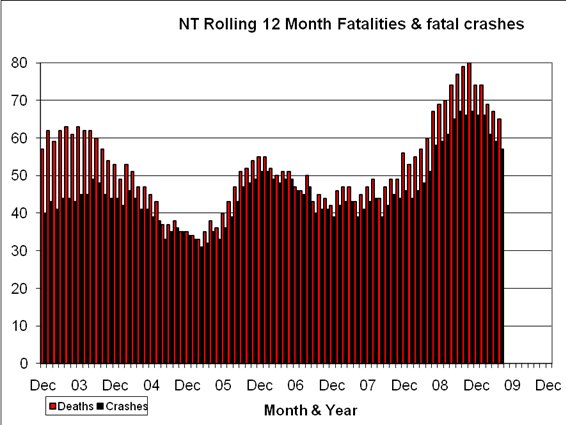
Up until 2007, rural freeways in the Northern Territory, Australia had no speed limit. Claiming that speed limits were essential to saving lives, the state government imposed a 130km/h (80 MPH) limit on the Stuart, Arnhem, Victoria and Barkly highways and a 110km/h (68 MPH) speed limit on all other roads, unless otherwise marked lower. Despite the best of intentions, however, the number of road deaths actually increased 70 percent after the change — despite worldwide drop in traffic levels (view chart).
“Our roads are safer, vehicles are safer, paramedics more skilled, drought affected roads are dry, the public have never been more aware of speed limit enforcement, penalties have never been tougher,” RoadSense founder Harry Brelsford explained. “These factors should have driven the road toll lower than before. They have not, it is rising. Clearly more of the same is not only not working, it is killing people.”
The Australian motorist rights group compiled the latest road fatality data provided by the Northern Territory Police. In 2006, the last year without rural highway speed limits, the road toll was 44. Last year, with speed limits on all roads, the death toll grew to 75 (view data, 400k PDF). The proliferation of speed cameras throughout the country has also increased the level of hazard faced by motorists.
In all of Australia, the death toll decreased by nearly a third between 1989 and 1996 — without automated enforcement. In the next eight years following the introduction of speed cameras, 1997-2004, fatalities only dropped ten percent. Between 2005 and 2007, the death rate began to skyrocket.
“A major reason for the failure of the policy is the extreme focus on the dangers of above the limit travel to the exclusion of nearly all other risk factors,” Brelsford said. “This implies that traveling below the speed limit is safe, leading to complacency, inattention and increased fatalities. Additionally, the current policy of hidden speed cameras has actually impaired driver awareness through adding to an increasing list of dangerous distractions.”
RoadSense advocates setting speed limits at the 85th percentile speed, or the speed at which the vast majority are comfortable traveling. The group suggests that government efforts would be better directed at the 98 percent of accidents that happen while traveling at or below the posted speed limit.



I would not be surprised if most people in the Northern Territory ended up driving faster when the limits were set, having previously only driven at the speed they were comfortable with, whatever that might have been.
It always seems like the speed “limit” is either a median or minimum speed (varying by locality), rather than, you know a limit.
These are interesting statistics but the blog leaves out far more important statistics. What is the net revenue generated for the state since the implementation of the cameras and new restrictions?
Quantifiable revenue growth will tend to win out over a few human lives in most profit driven ‘democratic’ western societies.
If the above is true, the simplest thing to do to halve traffic fatalities would be to turn off the traffic cameras and lift limits on rural roads. I’ll put $20 out that this doesn’t happen in the next 3 years. Any takers?
What’s the point of enforcing speed in the middle of nowhere?
It seems that the dudes in power try to control people in as many ways as they can come up with. That it brings them extra revenue is an added bonus. A speed limit makes sense in busy areas, but not “in the middle of nowhere”.
As an Aussie, i can confidently say the speed camera policy is one reason i won’t be moving back there in a hurry.
Nothing but road side cash registers.
As an Aussie, i can confidently say the speed camera policy is one reason i won’t be moving back there in a hurry.
Nothing but road side cash registers.
U.S. citizens are going to have to fight to keep them from popping up all over the place here too.
Here in the us, fatalities dropped after dumping the 55 mph limit. Smooth traffic flow is better than one guy blocking a lane and forcing others to pass him.
What is up with Australia ? They make orwell look optimistic.
i see australia as part of the continuum of white western society that has the United Kingdom at one end and the US at the other
every nation will face the same issues with internal security, over taxation, socialism and gun control
australia is just more over the to UK side of things than the US
right now most australian states are running huge deficits where hospitals are running in emergency mode
so every state is compiling strategies to increase state revenue
maybe that’s with higher alcohol or tobacco taxes, stamp duty, car registration or moving violations
at the end, saving lives is the last thing on their minds… saving lives is a cost
Apparently speed doesn’t kill. Go figure.
paul_y :
I would not be surprised if most people in the Northern Territory ended up driving faster when the limits were set, having previously only driven at the speed they were comfortable with, whatever that might have been.
I’ve often thought this about U.S. rural roads as well…especially rural stretches of interstate highways.
The bit about the speed cameras being nothing more than another distraction seems spot-on to me, too. If I’m knowingly breaking the speed limit by a small margin (as low as 5 mph), I find myself spending a disproportionate amount of time scanning for cops instead of truly focusing on ALL the traffic around me. The majority of my focus is on whether that approaching white car in the opposing lanes is a Crown Vic or not. I would be a far safer driver in those situations if I wasn’t having to worry about it and could actually focus on the driving task without worry of my speed.
I’d like to see a lot of rural speed limits lifted or at least raised while enforcement of no cell phone/no texting laws and reckless driving citations went up exponentially. It’s not necessarily the fast drivers who are the problem. It’s the drivers not paying attention, the ones not signaling their lane changes, those who are constantly cutting other motorists off just to hit an exit at the last second, and the morons riding in the left lane of a divided highway while others have to pass (dangerously) on the right. Those are the folks that scare me. The ones who fly by me at 80 mph while I’m happy doing 60? Not so bad. As long as they get back in the right lane when they’re able…and they signal their intent to do so.
This sort of data is usually abused by those who advocate speed limits. This time, the other side is being just as disingenuous.
This is a rural area that does not have that much traffic or that many road deaths in absolute terms. (To create a comparison, the number of deaths that they have in a year is about what California has in one week.) With such low numbers, it doesn’t take very much to create a huge data blip, upward or downward, at any given time.
There is also no other data presented here that could provide appropriate context. The factoids are presented in such a way that it is left to the reader to conclude that the speed limit either had no effect or else actually caused the increase, but without any details about the results of the accident investigations, we have no way of knowing of whether that is or isn’t true.
If this area is like other rural areas, I would guess that this is doomed to have a relatively high fatality rate because of high DUI rates, combined with accidents that occur in locations that are too far from first responders to provide timely treatment to the badly injured. But without more facts, nobody can conclude anything from what is provided here.
The national motorists association website is very enlightening on this subject:
http://www.motorists.org/speedlimits/
Pch101 :This sort of data is usually abused by those who advocate speed limits. This time, the other side is being just as disingenuous.
Actually, if you read, it’s saying that imposing speed limits did not produce the reduction in death promised by the politicians. Or, conversely, that removing a speed limit doesn’t automatically result in more deaths.
The main “other factor” in the fatality rate is the improvement in medical services — fewer people die with better technology — and better automobile safety. Deaths should always be headed downward.
Deaths should always be headed downward.
Over the long run, that’s true. But it is incorrect to claim that the short run should necessarily resemble the long run.
That’s particularly true when the data pool is so small. The difference between 44 and 75 isn’t much when a few incidents can create that difference.
It’s also disingenuous to focus on a comparison of only two individual years. Without the context of multiple years, that really doesn’t tell you much of anything.
It comes down to correlation vs. causation. If there were fewer speeding deaths, then one could argue that the law was effective. There is no information here that indicates whether or not that is true; we have no idea how these people were killed or whether the circumstances were different from year to year.
This data is definitely being abused in this article. We can’t expect rational analysis when both sides have an ax to grind, and have no shame in cherry picking their numbers in an effort to score points. And I say that as someone who doesn’t necessarily favor speed limits.
i find that attitude quite reprehensible
simply because it’s used by the government like this…
if we have a result that suits our hypothesis… yeah that’s our doing… we did our research, spent tax payers dollars and saved lives
if we have a result that goes contrary to our hypothesis we’ll that’s just because the sample pool is “too small” or it’s just a ‘statistical blip’ so we need to continue to pour more money and sacrifice more lives [i]until we get a result that we are happy with[/i]
this is horrible horrible government
I would not be surprised if most people in the Northern Territory ended up driving faster when the limits were set, having previously only driven at the speed they were comfortable with, whatever that might have been.
This. A combination of people driving faster than before because the limit tells them to, and people driving slower than before and so paying less attention.
As an Aussie living in the U.S. I am surprised that nobody has mentioned boredom or weariness. It is a well known and oft discussed topic in Oz as a major contributor to rural accidents. I suspect that the Northern Territory which has long, straight highways such as you can barely imagine probably carries the highest risk of falling asleep at the wheel. Making people crawl for hours can only increase this risk and I suspect this lack of attention is a major reason for the increased fatalities.
The reasons for this are obvious: I’m surprised the B&B haven’t picked up on it.
Speed is not as dangerous as difference in speed. The do-gooders all slowed down to the “speed limit” while reasonable people continued driving at higher speeds. This means more sudden moves, passing, distractions, road rage, etc.
When multiple vehicles are travelling at 50+ mph differences in speed it is very unsettling to the non-racer. Unless, of course, you are Jack Baruth.
Speed doesn’t kill. Impact does.
Speed doesn’t kill. Impact does.
I need this on a tee shirt.
if we have a result that goes contrary to our hypothesis we’ll that’s just because the sample pool is “too small” or it’s just a ’statistical blip’
In other words, you want to rewrite basic rules of statistical analysis because you find them to be inconvenient.
Here’s a basic mathematical example to illustrate the problem of scale on these numbers: The town of Podunk has a murder every other year, resulting in an average of 0.5 murders per year.
But then, there is a year during which there are two murders. The sensationalists would focus on percentages — “Murder rate up 400%!” Which of course, it is, but that misses the point that there is usually 0-1 murders, and that 2 is not much greater than 1.
Now let suppose that in the year following the two murders, Podunk gives the police chief a pay raise. The number of murders in the next year is one. Now the sensationalists print a new headline: “Murder rate falls in half!!!”
Only a statistical illiterate would fall for such percentages or just assume that there is a correlation to this one specific data point (in this case, the police chief’s pay increase.) The percentage is distorted by the small denominator, and there is no evidence that the pay increase led to there being one less homicide.
Obviously, a 400% increase in the murder rate in a place as small as Podunk would not at all be comparable to a more populous area, such as what a 400% increase in the murder rate would look like for the US as a whole. There is just no comparison.
The data provided in this article is misleading because it presumes causation and exploits the scale problem. If you look at the actual numbers (http://www.roadsafety.nt.gov.au/transport/safety/road/stats/index.shtml), you will note a few points:
-For each accident that occurred, the average number of fatalities per incident was greater than has been typical in prior years. Furthermore, the most dramatic increase in deaths was not among car drivers, but among passengers, pedestrians and motorcycles. (The first point might be attributable to higher passenger loads per vehicle, perhaps as a result of higher fuel prices encouraging people to ride together, which makes these accidents more bloody than before.)
-Combined with some of the other information provided, one can surmise that this particular increase in fatalities occurred in the town of Darwin, not in the countryside. So these additional deaths have no bearing on evaluating the impact of the law, because they did not occur in locations that were affected by the speed limit.
-Fatalities between January – July 2009 have been far lower than they were in the comparable six month periods prior to the speed limit change. So someone on the other side who wants to manipulate numbers, as has this article, could try to give credit to the limit, just as this article has attempted to do the opposite.
All told, you can’t use this data accurately, and come to the same conclusions as this article. The speed limit appears to have no relationship of any kind, positive or negative, to the increase in fatalities. Those increases may well be a fluke that occurs when examining data during short periods, and not indicative of anything in particular.
I suspect that the Northern Territory which has long, straight highways such as you can barely imagine probably carries the highest risk of falling asleep at the wheel.
This is generally not the case. Alcohol is far more likely to be a factor; fatigue is rarely an issue.
The do-gooders all slowed down to the “speed limit” while reasonable people continued driving at higher speeds. This means more sudden moves, passing, distractions, road rage, etc.
Again, the data doesn’t suggest that at all in this case. You should read the backup, rather than make assumptions, as is usually the case with those who passionately advocate for and against speed limits. Both sides tend to cherry pick their information to suit their own agendas, in an effort to mislead the public.