



 Money’s too tight to mention. But Rick Brown, president of GM Asia Pacific, mentioned it to Automotive News [AN, sub]. “We won’t be participating [in the you can call it the Tokyo Auto Show]. If you really look at the business conditions that we are in right now, where we really have to make a bang out of every buck we spend, it’s simply a business decision.” AN reckons a presence at the Tokyo show cost $2m. No wonder Japan’s Yomiuri newspaper says Ford and Chrysler also “missed” last year’s deadline to register for the show. That’s the price of one year’s G4 lease! As we reported yesterday, the Japan Automobile Manufacturers Association is hemming and hawing about whether or not to cancel the event until 2011. Previous media speculation centered on whether one of Japan’s “Big Three” (Toyota, Honda, Nissan) would withdraw and kill the event. Now, with the Americans out of play, it’s only a matter of time. Who’s next to go? New York? Barcelona? Watch this space.
Category: Toyota
 |
Toyota ReviewsToyota Motor Co., the world’s largest automaker, has been producing cars for more than 70 years. It wasn’t until after World War II, however, that production started to pick up. Toyota went from making 8,500 cars a year in 1955 to 600,000 in 1965. Models like the Toyopet and Land Cruiser hit the United States in 1957. Today Toyota is among the leaders when it comes to hybrid technology. |
 Fact: high school reunions make their attendees change their long-standing beliefs about their former classmates. Consider the quiet girl nobody noticed who turned into a beautiful woman when nobody was looking. That’s my first reaction to meeting the Toyota Camry SE on a fast sweeper. And while the inner-teenager never forgot the person from yesteryear, do Pistonheads need to give the rarely mentioned, often overlooked Camry SE another chance? Or do some things never change?
Review: 2009 Toyota Camry SE Car Review Rating
-
Overall Rating:

 4/5 Stars
 20 years. When most folks ask me how long the average car should last, that’s what I tell them. It’s actually not true though. The real answer these days is a lifetime. In fact, I’ve seen cars at the auctions that were literally passed on from one generation to the next. They hit all sides of the American, Japanese, and European palette. Older Volvo 240’s and Toyota Camry’s are truly numerous. But Subaru SVX’s, Suzuki Samurai’s and even old-school Buick Roadmasters have been there in the automotive flesh as well. In fact, I’ve even seen some of the most unreliable vehicles in recent history (Excels, Chevettes, Kadetts) crawl through the 20+ year old finish line in good running order. What makes the real difference? Read on.
 Sorry, it’s a bit infrequent for a few weeks while I’m in Europe hunting the elusive Euro: An overview of what happened in other parts of the world while you were in bed. TTAC provides round-the-clock coverage of everything that has wheels. Or has its wheels coming off. WAS is being filed from Berlin – when I’m in Berlin.
Take one for the team, Japan style: Department heads at Toyota are asking colleagues in management positions to buy new Toyota cars by the end of the fiscal year to boost the company’s sluggish sales, the Nikkei (sub) says. “The rare request is the result of a voluntary effort among a group of about 2,200 departmental chiefs and other managers. Employees are under no obligation to buy a car, and no specific models appear to have been singled out.” Hitori wa minna no tame, minna wa hitori no tame. Or: one for all, all for one, as they say in Japan.
Daihatsu may have to cut back: Toyota’s Daihatsu may do “a reorganization of its production structure if sales do not recover by March,” the Nikkei (sub) reports. Daihatus’s minicars had been relatively unscathed by the weak sales. Now they begin hurting too.
 When I go to the North American International Auto Show (NAIAS), I like to get downtown early, around 7 AM. That way I don’t have to wait in any lines for credentials and I can get my favorite free parking spot about a block from Cobo Hall. While waiting for the press conferences to begin today, I stopped at the Tesla booth to say hi to Rachel Konrad, head of communications. Tesla first appearance at NAIAS consists of a small booth next to the Lotus display. Tesla’s displayed a naked Roadster chassis, which laid the car’s Lotus roots bare. But Konrad was emphatic: only a small percentage of components are shared with the Elise. She said that 150 not-Elise Roadsters have been delivered. They’re completing 15 vehicles a week, with 1100 people on a waiting list. Their facility has an ultimate capacity of 40 cars a week. With production proceeding, albeit at a relatively slow pace, Tesla has grown their company beyond Tucker stage (50 units built). It remains to be seen if they surpass Bricklin (2854 SV1s) and DeLorean (~9000 DMC-12s). In the meantime, they’re building real cars. I know because I got to drive one…
 GM can fix its own problems. Really. They don’t need a miracle cure or a piece of technology fabricated at MIT’s advanced labs. They don’t need a new financing scheme developed by the alchemists on Wall Street. Nor do they need Nancy Pelosi & Co. to fashion tnier future. What they need to survive can be summed-up in two words: truth and honesty. If GM would be honest about its products, finances, dealers, marketing, reliability, (lack of) executive talent, and on and on– it could begin to resurrect itself. Until and unless GM gets glasnost, the automaker will remain forever stuck in the quagmire of its own making, relegated to the support of the taxpayers, always looking for its next fix. To understand the possibilities, compare and contrast GM’s perfidy with “One Ford”….
Like GM, FoMoCo was a company headed for extinction. Sales, market share, profits, product competitiveness, branding– Ford was outclassed, out-maneuvered and out of gas. Unlike Rick Wagoner and his Board of Bystanders, Ford CEO and Chairman Bill Ford and the Ford family admitted the inevitable. In the summer of 2006, they looked outside the company– and the industry– for a well-seasoned executive to replace the family scion. Ford brought in ex-Boeing exec Alan Mulally to clean house.
Ford’s hopes for survival didn’t– and don’t rest upon CEO Alan Mulally’s engineering or union-wrangling expertise. It’s Mulally’s leadership, his impact on Ford’s culture that will leave the automaker the last man standing.
Under Mulally, Ford has publicly acknowledged and accepted the fact that the days of owning 25 to 30 percent of the U.S. new car market are gone. Profitability must come at just 15 percent. To achieve this new, more limited goal, Mulally has attacked Ford’s culture of complacency and infighting. By all accounts, Mulally demands a “truthful and honest” assessment about the company’s health. And he demands that his managers demand it.
We’re seeing the realization of this new paradigm. Ford cars more-or-less equal Toyota and Honda products’ reliability. Ford is also matching factory production to actual demand–rather than bogus sales forecasts from marketing and finance. And although Ford is talking-up an electric car that they don’t have, they understand that their survival doesn’t depend on a “leap of faith” technology. They’re looking for single, double and triples, not home runs.
GM remains stuck in its past. Whether it’s the Volt or a Volt-based Cadillac or HUMMER’s non-prospects, everything they do is shrouded in a fug of hype. Lies, half-truths and deceptions are perpetuated upon journalists and the public until they become the truth– within GM. Every statement they make– whether by marketing, dealers or top executives-– is inherently suspect. Even when the hype is demonstrably false, GM clings to the spin like grim death. Literally.
To wit: today’s NYT runs a piece by Bill Vlasic entitled “Wagoner Says G.M. Is Working on an Overhaul Tied to the Bailout.” In the story, CEO Rick Wagoner states that GM is focused on meeting the requirements of the bailout loans. He asserts that GM can become financially viable via labor cost reductions, debt swaps and reductions in brands/dealers. Wagoner provided no specifics, no proof, no concrete plan. This despite the fact that he has less than 40 days to submit the plan to Obama’s as yet unannounced car czar.
Wagoner leaves a decade of devastation in his wake. He has destroyed GM shareholder value, shed tens of thousands of high-paying jobs, sold-off once-valuable assets, lost billions on misguided foreign entanglements, failed to assure proper accounting practices and placed his company in the hands of politicians. And yet even now, he can’t tell the truth.
Rick Wagoner knows that GM can’t possibly meet the federal requirement for the $13.4b– and the rest– worth of taxpayer loans. With Uncle Sam’s wallet wide open, the mandated sacrifices will not occur. Period. Why not tell the truth to the company, its dealers and suppliers, and, above all, the American taxpayer?
If GM is to survive, Rick Wagoner should come clean. He should tell everyone that Saab, HUMMER and Saturn are toast. (How much “strategic review” do you need to figure that out?) That it’s impossible to negotiate a complicated debt-for-equity swap for $63b in two months– outside of a courtroom. That there are significant problems in amending an existing labor contract– outside of a Section 1113 motion in bankruptcy– that would overturn decades of hard-won labor gains. Wagoner should admit that GM will need additional government assistance in 2009.
The simple truth is that aGM bankruptcy was, is and will be the only path to resurrection. As a smaller company, shorn of most of its debt and burdensome labor agreements, GM can be a smart and strong competitor in North America and around the world. But everyone at GM needs to be honest and speak the truth. The truth will set you free. Just ask Alan.
 As Detroit’s struggles prove, life is a fight for resources. If you can’t get enough resources, you die. Well, in Motown’s case, you receive massive taxpayer subsidies and then you die. Taking it down to the personal level, the resources needed for survival form what Abraham Maslow called “a hierarchy of needs.” The most basic of these are lumped together: air, water, food and sex. Yup, sex is at the bottom of the pyramid. So it’s no wonder that exhibitors at The North American International Show (NAIAS) pay young, attractive females to pose next to their vehicles. It appeals to the mostly male jobbing journos’ most basic needs (after securing shrimp), drawing their attention to the automakers’ vehicles. It’s effective, morally reprehensible and now, self-defeating.
The worldwide auto industry is undergoing a major makeover. For the last few years, government regulation, economics, media fashion and (arguably) public opinion have led to the de-Luztification of the business. In other words, the horsepower uber alles halo cars worshiped by GM’s septuagenarian head of product development as a young man are no longer the sine qua non of vehicular excellence. These days, environmental responsibility is the name of the game.
High gas prices or low, good times or bad, green is the new black. Imagine this year’s don’t call it The Detroit Auto Show without the new Toyota Prius and Honda Insight hybrids vying for primacy. Today’s auto shows are all about the mpgs and alt power. To wit: would NAIAS have welcomed former coach-builder (i.e. Mercedes SL and BMW 8-Series reskinner) Henrik Fisker on center stage if his sports sedan holstered a V12 engine rather than a hybrid “Q-Drive”? Clearly not.
Sure, sheetmetal queens like the Fisker Karma still get attention, regardless of their fuel efficiency. But again, these days, even the sleekest of the sleek are swathed in the mantle of federally-mandated planet protection. If the Cadillac Converj concept car has an engine underneath its stunning creases– which I highly doubt– it’s supposed to be GM’s forthcoming if not theoretical Voltec electric – gas hybrid powerplant.
“Time was the big auto show in Detroit was all about glamorous gas guzzlers on turntables,” NPR’s intro to an interview with Car Czar Bob Lutz interview pronounces. “and models pointing suggestively at fins and fenders. Not this year…”
Yes, this year. While the gas guzzlers are conspicuous by their absence, the booth babes are still there, undermining the automakers’ credibility. The media talk about NAIAS’ new found “austerity” and “de-glamorization.” The shrimp may be smaller, but the booth babes’ dresses are just as tight and revealing. And their presence reveals the truth about these taxpayer-funded cutbacks: the carmakers still don’t “get it.”
While I’m no fan of political correctness (hence the name of the website), the debate over the morality of using women to sell goods and services was fought over forty years ago. The “sexual objectification” of women was roundly, stridently and publicly denounced. The practice was defeated. Depicting women as mindless eye candy more-or-less whoring for a product joined racial stereotyping as one of those things you just don’t do.
In practice, society reached a compromise: women can be objects of sexual desire in sexual situations. A flexible concept to be sure, but easy enough to identify. Victoria’s Secret models, OK. Booth babes, no. (Beauty pageants, as always, lost in the middle.) In other words, draping nubile women over automobiles is a throwback to– and a carry-over from– an earlier, less sensitive time.
Whether they’re hawking EVs or SUVs (God forbid), booth babery illustrates and symbolizes the auto industry’s arrogant refusal to adapt to society’s needs. Well, norms.
As I’ve pointed out in previous years, booth babes are also self-defeating. They intimidate the average showgoer and discourage female attendance (for obvious reasons). By adorning cars with attractive girls who know little to nothing about the vehicle nearby, women who don’t work for the company producing the product, the manufacturer inhibits serious discussions about the car itself. In fact, the carmaker is showing an active disregard for anything other than the vehicles’ surface.
I would be remiss if I didn’t point out that TTAC fell into this same trap with a spate of cheerleader pictures, whose ironic intent– illustrating the automotive media’s attempt to “sex up” bad news– offended our audience. Commentators rightly pointed-out that the tits and ass snaps had nothing to do with TTAC’s core mission. It lowered the site’s tone and robbed us of the one thing we depend on for survival: our reputation. We admitted our mistake, ceased the practice and moved on.
It’s time for the “serious” car shows to lose the titillation. Not because it isn’t a welcome distraction from the hype, hot air and hypocrisy that surrounds the event. But because it is.
 Can you say price war? How else is Toyota going to shift 180k Priora when the market for hybrids has tanked (Prius sales down 44.7 percent in December) and Honda’s Insight has arrived to do battle? In their best year, Toyota shifted 181,221 gas – electric hybrids. The obvious answer: they’re not– barring a sudden recovery of the American automotive market and an increase in fuel prices. (Federal gas tax hike?) Could be. As far as the Insight’s concerned, ToMoCo isn’t. US Prez Jim Lentz told Ward’s Auto there’s room in the market for three hybrids. “You’re going to have Honda at the entry end. You’re going to have Prius kind of in the center, and you’re going to have (the) Lexus (HS 250h) on the luxury side,” he says. “It gives consumers clear choices, a large array of hybrid products.” So much for the Ford Fusion or any GM hybrid, then. Sad; but true?
 The first presentation I attended on the second day of NAIAS was for Lincoln (no mention of Mercury). The MKT crossover has a roomy interior that manages to look and feel more upscale than that of the MKS sedan. Stitched upholstery on the center stack and center console are an improvement over silver-painted plastic. As in the MKS and the related Ford Flex, seats in the first two rows are very comfortable. So what’s not to love? That would be the clunky, chunky exterior.
It’s not that the MKT is a bad design. It’s worse than that. Lincoln’s cetacean snout looks slightly ridiculous on its cars. On a crossover, it’s tacky enough to demand a Russ Meyer remake: faster pussycat; krill, krill, krill! From Lincoln I went to GM’s stand, where CEO Rick Wagoner announced that the batteries for the Volt would be manufactured in Michigan. And that GM was going to make battery technology a core competence, with a new 31k-square foot engineering center. And that LG Chemical (of Korea) has been selected as the supplier of the battery cells. One of these statements doesn’t fit with the others.
 Then things started to really not add up. BYD, a Chinese battery and vehicle manufacturer, announced it was going to be offering a five-passenger pure electric vehicle with a 250-mile range. The vehicle in question strongly resembles Honda’s Asian-market Odyssey. (All of BYD’s cars strongly resemble someone else’s car.) The technology that makes this possible? BYD’s breakthrough “ferrous” battery technology. Now, ferrous means iron. Who knew that iron was such a good basis for a battery? Also, batteries usually combine two elements. What’s the unnamed second element? Hype?
 On the subject of knockoffs, the Chinese aren’t the only ones doing it. The photo above isn’t a BYD knockoff of a second-gen Toyota Prius. It’s a Honda knockoff of a second-generation Toyota Prius. Only even more ungainly. Meanwhile, Toyota introduced the third-generation Prius, which is much better looking than both the current car and Honda’s facsimile. Check out the attractive five-spoke 17-inch alloys. The high point of the roofline has been shifted rearward by four inches. While the official reason for this is more rear seat headroom, it also greatly improves the car’s proportions. Inside, the new Prius has more room and a more nicely finished interior.
 Yesterday, Lexus introduced its first efficiency-focused hybrid off the Prius platform: the HS250h. Which also happens to be the first U.S.-market Lexus with a four-cylinder engine. I took a look today. The interior is Lexian, but the exterior makes the previous generation Corolla look like a suite at the Ritz. Call me El Finesse, but I’m not seeing a Lexus in this exterior. Or in the powertrain– unless driveability is way up from the second-gen Prius.
LastIy, I attended Henrik Fisker’s presentation, where his company introduced a strikingly attractive (top up or down) hardtop convertible. The former Aston designer promises his hybrid hottie will be available for discerning customers in 2012. I’ve had a number of questions about their Karma foor-door (hint: don’t call it a sedan):
 1. How can Fisker manage to offer a stylish, luxurious, large (124.4-inch wheelbase, 196.3-inch length, 78.1-inch width) four-door car with a powerful hybrid powertrain (260 horsepower turbo four plus a pair of electric motors good for 400 horsepower) and monstrous 22-inch tires for conventional S-Class money? (Base price: $87,900)
2. Can GM’s rorty turbo four possibly behave as an engine in a $90,000+ sedan is expected to behave?
3. How can such a car go 50 miles on a charge? A huge battery pack would add weight and cost. See surprisingly low price above.
4. How can a car with such swoopy sheetmetal comfortably accommodate four adults.
 Well, after today’s presentation I was able to sit in the Karma four door. It’s C3 Corvette tight in the front seat, and even tighter in the back seat. (For reference, I’m 5’9″ and the front seat was perhaps and inch farther rearward than I’d set it.) There’s considerably more room inside a Mazda RX-8, which has far more compact exterior dimensions. Getting in and out of the Mazda’s rear seat is also easier. Getting in and out of the the Karma is a head-and-knee-bumping chore thanks to a low roof and small door openings.
I will grant that Fisker’s made the seats as comfortable as possible given the low seating position and limited interior volume. Still, a third-gen Prius is a limo in comparison. The trunk was closed to the public. When I asked about cargo volume, they responded, “Enough for two golf bags.” So perhaps 8 cubic feet. That’s what happens when a designer is running the show. The Karma sedan is very much a four-door coupe-a Mercedes CLS taken to the extreme, with all of the compromises that implies.
Seven days and I’ll be back in the United States, having bid my farewell to the Middle East (but knowing I will return). As the countdown commences, I eagerly anticipate driving something without a Toyota badge on it, and possibly buying something interesting with all the money I have saved eating government food (and some sand). These past many months I have pored over eBay, Autotrader, and mobile.de (German used car site, check it out, forbidden gems!). After looking at the multitudes of steel out there, I wondered something… what could I get that would have oodles of character, the shades of a future classic, and not cost too much. So I present, Seven Future Classics for the Depressed Economy:


 Well, the first day at the 2009 North American International Auto Show wasn’t such a bust in the end. I began the day by attending the Intro and North American Car of the Year Awards. During the intro talk the Detroit show sought to demonstrate that it was still relevant by trotting out senior executives from the auto companies that didn’t opt to skip this year’s show. Among the execs from GM, Ford, Toyota, Honda, VW, and so forth was… Henrik Fisker. “Which one of these is not like the others…” started running through my head. Pretty good for a guy who reskinned SL’s and 8’s until he figured out it was better to ride the green gravy train. But that’s the way Detroit rolls these days.
Looking over the finalists from my place amidst a press release of journalists, I wondered what the G37 was doing amongst them. The Infiniti’s engine is new for 2009, but the rest of the car is entering its third model year. Well, it wasn’t the Infiniti. The car in question was a Hyundai Genesis, which won the award. Apparently, when you can only see the top half of the car the resemblance is rather strong.
I then attended the General Motors presentation. A couple years ago, when the then-new Cadillac CTS was introduced, I commented that it was nice to see the people involved in creating the car up on stage with it. Especially since I knew some of them. This year, GM kicked itup a notch. They brought in a crowd of 100+ employees to stand behind the seated press and engage in a pep rally. Holding signs that said things like “here to stay.” The foreign journalist besides me asked who the prostesters were.
The presenting GM execs called for a cheer from said cheering section each time a car rolled up on stage– and they paraded about 15 of them. A couple of times the exec called for a louder response. A bit much.
 Some of the new GM cars were surprisingly impressive. The interior of the 2010 Equinox compact SUV is the best interior in a Chevrolet so far. It’s much nicer than that in a Toyota RAV4, and I’d also place it ahead of the Honda CR-V. Seat comfort is also excellent, front and rear. Why aren’t the seats in the larger Lambda crossovers nearly this good?
 I actually found the firmer seats in the Cadillac SRX less comfortable than those in the Chevrolet. There’s also less rear seat and cargo room in the SRX. Overall, while the Cadillac’s interior is nicer than the Chevrolet’s, it will also be much more expensive. I expect the Cadillac will have a much harder time achieving its sales targets.
 The new Buick LaCrosse is a mixed bag. The exterior doesn’t quite work for me. The “sweep spear” comes up too high on the overly tall front fender. As a result, your eye is pulled in one direction by the beltline (base of the windows) and in the other by the “sweep spear.” Beyond this, the proportions of the front fender are generally forced and awkward.
 On the other hand, the interior of the new LaCrosse is outstanding, the best yet from GM– better even than that in the Cadillac CTS. Real stitching on the instrument panel and door panels has been achieved at a Buick price by molding the stitching into the polymer panels. The panels aren’t actually upholstered as they are in newer Cadillacs, but they look upholstered. The center stack is nicely executed, with a definite upscale appearance. The curvy door panels are exceedingly well done. They combine a nicely padded armrest with a comfortable door pull, flowing organically into the instrument panel.
Is an outstanding interior enough to get people under 70 to consider a Buick sedan? Probably not.
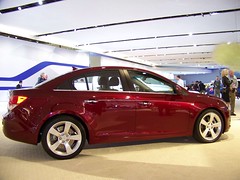 Looking back across the GM area, I wondered what a previous generation Audi A4 was doing there. Another case of mistaken identity: the Chevrolet Cruze. In the metal, the Cruze looks great– at least when it’s fitted with 19-inch five-spoke alloy rims. Inside, the instrument panel in the Cruze is trimmed in a woven fabric. This might not be to everyone’s taste, but it’s a huge step up from most compact car interiors.
 Ford has thoroughly revised the Taurus. The new car looks much more upscale, inside and out. Though the new grille is a bit too Subaru nondescript, the rear fenders have strong Bentley overtones. Viewed from the side the car has more presence than a Taurus has any right to.
 The interior of the 2010 Ford Taurus is not far off the related Lincoln MKS’, but not up to the level of the Buick LaCrosse. The panel fits aren’t as tight or as precise, and the materials seem a bit cheaper. I was surprised to hear that features such as adaptive cruise control and massaging seats– usually only available on expensive luxury cars– will be available on the Taurus. On the downside, the interior is much less roomy than that of the current Taurus. Inside, it does not feel like a full-size car.
 I skipped the Chrysler presentation, figuring the company had nothing in the pipeline. I later learned they’d shown a possible next-generation 300, billed as the 200C EV with an alt fuel powertrain. This concept’s much more curvy than the current 300; a huge advance over recent Chrysler efforts like the Sebring. But is there enough trunk space inside the sportily bobbed tail?
That’s it for today. More tomorrow.
 The news is flying thick and fast out of Detroit this week, as the annual conclave at the don’t call it The Detroit Auto show puts hundreds of journalists in close proximity to corporate newsmakers and spinmeisters. Automotive News [AN, sub] is doing the do. First up: Toyota’s admission that its “Saved by Zero” didn’t save the automaker from a humiliating December; trucks sank by 50 percent and they lost critical U.S. market share. So ToMoCo’s reaching deeper into its deep pockets.”The shift that you’ll see in January from December is more consumer cash and less APR and lease support through our dealers,” Toyota USA Prez Jim Lentz told AN. Jimbo didn’t offer any specifics, but AN rightly points out that Priora are stacked up like cordwood. “One of the largest sellers of Priuses in the country, Earl Stewart Toyota in North Palm Beach now has about 70 on the lot that it can’t get rid of. ‘Any kind of Prius anybody wants — any color, any anything — I’ve got it,’ Stewart says. ‘And if I don’t have it I can get it because there are several hundred in the port. Dealers don’t want them.'” Note: “According to Edmunds.com, Toyota had the biggest percentage boost in incentive spending in December at an average $1,995 per sale. That was up 87 percent from what the brand spent in December 2007.” The implications of all this are pretty clear…
 Time to update “the future of car?” Yup. GM’s Car Czar has admitted that Pontiac has a new motto: “Pontiac is toast.” Automotive News [sub] reports that Bob Lutz has admitted that GM is trimming Pontiac’s line-up to five vehicles– if you count the Solstice hardtop as a separate model. Which we don’t. That leaves Pontiac with four vehicles: the doomed Australian-sourced G8, the G5, the Toyota co-production Vibe and the dead-in-the-water “we don’t need no stinkin’ trunk space” Solstice. Maximum Bob’s admission that Pontiac is being strategically reviewed to death comes hard on the heels of GM NA Prez Troy Clarke’s assertion that GM will “follow through with plans to shrink to four core brands.” That would be Buick, Chevrolet, Cadillac and GMC; ditching HUMMER, Saab, Pontiac and… Saturn. “‘We’ve entered into a very, very open and candid dialogue with our Saturn retailers,” Clarke said. Saturn, launched 19 years ago, has been successful in terms of brand attributes, he said. But ‘it just hasn’t been a good business for us… We need some breakthrough options here. We can’t continue brands that have no prospect of earning their way.'” It took them how long to figure this out? And, by the way, whose fault is that?

• At the end of December, we find Big 3 dealer stocks to be about 31% above normal, which is about where they ended November. The truck mix headed higher again in December, and combined with weak industry sales to leave cars about 75% overstocked. Light trucks were about 12% overstocked.
• We estimate Chrysler to be the most overstocked of the Big 3, with dealer stocks about 45% above normal. Trucks are about 80% overstocked, while cars are about 37% overstocked.
• Ford ended the month overstocked by about 22%, with passenger cars a sharp 83% above normal, and trucks about 2% below normal.
• GM was about 29% overstocked at the end of December, with cars 70% overstocked, and light trucks about 9% overstocked.
• A look at days’ supply of foreign brand vehicles also shows a severe overstocked situation. For example, Honda dealers had 96 days of car supply in December, up from 50 days in the year-ago month; Toyota had 94 days of car supply, up from 42 days a year ago; BMW had 57 days of car supply, up from 22 days in December 2007.



Recent Comments